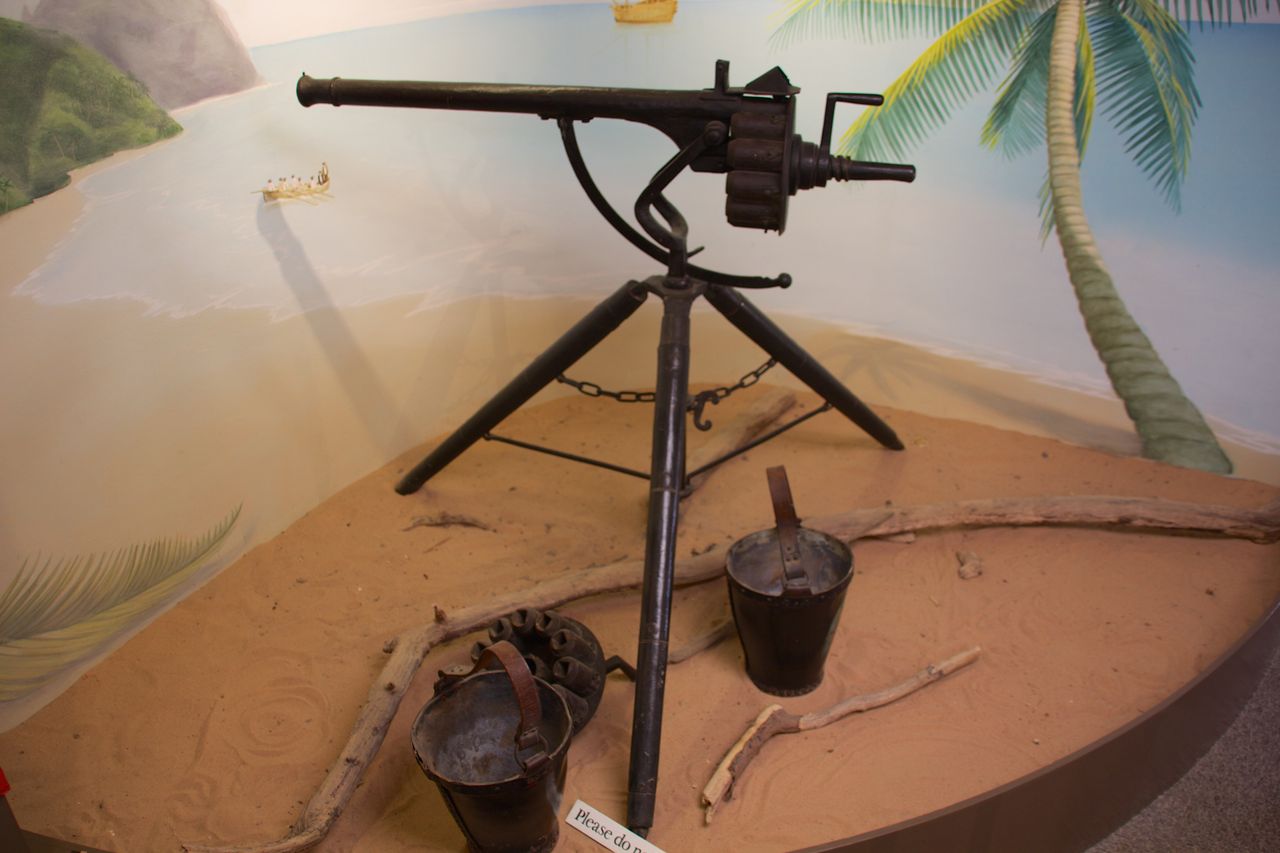
It looked like something from a lost branch of firearms history. In 1718, that is exactly what it was.
A weapon wildly ahead of its moment
In an age when most soldiers still relied on single-shot flintlock muskets, James Puckle introduced a gun that could deliver multiple shots without the full reload ritual after every discharge. Contemporary musketeers might manage roughly 2 to 3 shots per minute under decent conditions, while the Puckle design aimed for about 9 rounds per minute in testing and promotion.
That gap is what makes the gun so fascinating. Before most line infantry had rammed home a second charge, a trained Puckle crew could in theory keep firing from a preloaded revolving cylinder. For 1718, that was a dramatic leap in practical firepower.
It was not the first repeating firearm in history. Earlier systems like the Lorenzoni and later Cookson repeaters already proved that multi-shot flintlocks were possible, but those were generally costly, mechanically intricate shoulder arms or pistols rather than a crew-served defensive gun.
How the Puckle gun actually worked

The Puckle gun was a tripod- or stand-mounted flintlock firearm with a single barrel and a manually rotated cylinder. That cylinder held multiple preloaded charges, with sources describing capacities that varied by setup, commonly between 6 and 11 shots.
Mechanically, it was closer to a hand-cranked ancestor of the revolver than a machine gun. After each shot, the operator indexed the cylinder, brought the next chamber into line with the barrel, and fired again through the flintlock ignition system.
That meant it still depended on black powder, exposed priming, and all the weather sensitivity of flintlock technology. Even so, a 1722 public trial reportedly saw the weapon fire 63 shots in 7 minutes in rainy conditions, a result that helped cement its reputation as one of the boldest rate-of-fire experiments of the early 18th century.
Why 1718 mattered so much

The year matters because 1718 was when Puckle secured his patent for what he called the Defence Gun. That patent is often noted as one of the earliest to describe a firearm with a revolving cylinder in clear technical terms.
Puckle was thinking less about battlefield skirmishing and more about defense, especially aboard ships. The gun was marketed as a way to repel boarders, giving crews a faster stream of fire than ordinary muskets could provide at close range.
In other words, this was not a hunting novelty. It was an attempt to solve a real tactical problem with engineering, and it arrived more than a century before Samuel Colt’s revolvers made the rotating-cylinder concept famous around the world.
The strange details everyone remembers
No discussion of the Puckle gun stays normal for long. The design became notorious for claims that one cylinder fired conventional round bullets while another, supposedly intended for use against Ottoman enemies, fired square projectiles.
That detail appears so often in retellings because it sounds almost unbelievable today. It also captures the mixture of innovation, marketing bravado, and period prejudice wrapped up in the weapon’s story.
The practical reality is that square bullets were never the real breakthrough. The true innovation was the repeat-fire concept: a gun crew able to keep sending shots downrange while ordinary flintlock users were still measuring powder, seating ball, and priming pans one round at a time.
Why it never changed warfare

For all its ingenuity, the Puckle gun was expensive, mechanically demanding, and probably too specialized for broad military adoption. Flintlock systems were already maintenance-heavy, and adding a rotating chamber assembly only increased the burden.
That helps explain why it sold poorly. Surviving accounts suggest the gun saw almost no meaningful commercial success, with only a tiny number reportedly purchased for an expedition to the West Indies.
The broader firearms world was simply not ready. Manufacturing tolerances, logistics, and battlefield doctrine all favored simpler arms, even if they were slower. The Puckle gun promised future firepower, but it had arrived with early-18th-century metallurgy, ignition, and procurement systems still holding it back.
The legacy of the nine-shot curiosity
Today, the Puckle gun matters less as a direct ancestor of modern weapons than as proof that inventors were chasing high rates of fire long before the industrial age made them practical. It stands alongside Lorenzoni-system repeaters as evidence that the desire for sustained fire is much older than many people realize.
What makes the 1718 gun memorable is the contrast. On one side, you have the standard musket, slow and methodical; on the other, a revolving, stand-mounted repeater promising nine shots before others managed two or three.
That is why the story endures. The Puckle gun was not a revolution in service, but it was absolutely a revolution in imagination, and sometimes that is where firearms history gets most interesting.