Some guns survive on nostalgia. The Remington 870 survives because nostalgia is only part of the story.
If you want to understand why it still sells, you have to stop thinking like an engineer and start thinking like an actual buyer.
Specs don’t decide most shotgun purchases

On paper, it is easy to make the case against the 870. There are newer shotguns with smoother actions, better corrosion resistance, lighter recoil, optics-ready receivers, and more modular furniture right out of the box. If you compare feature tables alone, plenty of competitors look more modern and, in some cases, more refined.
But the average shotgun buyer is not shopping the way internet forums imagine. Most people are not building a spreadsheet with cycle speed, shell lifter geometry, and factory sight configurations. They are buying a tool they already know, a name they recognize, or the same gun their father, uncle, hunting buddy, or department armorer trusted for decades.
That matters more than enthusiasts like to admit. Remington says the 870 has been in production since 1950 and that more than 10 million have been made, while the company also calls it the best-selling shotgun in history. Field & Stream recently made the same broader point, describing it as the best-selling shotgun of all time. When a product has that much installed base, buyers do not evaluate it like a fresh entrant. They evaluate it like the default. According to Remington, that default has been reinforced for generations by sheer volume and familiarity.
There is a simple retail truth buried in that history: people buy what feels low-risk. A shotgun with technically superior specs can still feel like a gamble. An 870 feels like something the market has already vetted for you.
The 870 sells trust, not novelty

Trust is the real product here. The 870 has spent decades earning a reputation for being simple, durable, and easy to understand. That reputation was built in bird fields, deer woods, duck blinds, police cruisers, and bedside safes long before modern marketing started obsessing over lifestyle branding.
That kind of trust compounds over time. A first-time buyer hears that the 870 is a proven pump, and the claim sounds believable because millions of examples back it up. A repeat buyer already knows how it loads, how it unloads, how it points, and how it behaves under recoil. The gun does not need to impress them. It just needs to be what they expected.
Remington’s own history page calls the 870 the greatest-selling pump-action shotgun in firearms history, and its corporate site says well over 10 million have been sold. That kind of scale does not just create brand awareness. It creates a feedback loop where the gun’s popularity becomes evidence of its credibility. In other words, people trust it partly because so many other people already trusted it.
Newer shotguns often try to win attention with innovation. The 870 wins by reducing anxiety. Buyers know what it is, what it costs, how it works, and what problem it solves. In a market where a lot of purchases are practical rather than aspirational, that is a massive advantage.
Installed base beats innovation almost every time
The hidden reason old platforms stay alive is not romance. It is infrastructure. Once a firearm reaches critical mass, everything around it becomes easier: spare parts, barrels, springs, magazine extensions, sling plates, stocks, forends, shell carriers, and gunsmith familiarity. That ecosystem lowers the total cost and friction of ownership in a way spec sheets rarely capture.
The 870 benefits enormously from that effect. One reason buyers keep returning to it is that they know they can configure it for upland birds, turkey, deer, home defense, or clay shooting without starting from scratch. Even when factory part availability has fluctuated during Remington’s corporate transition, the aftermarket has remained deep because the installed base is simply too large to ignore.
That is a huge competitive edge over objectively excellent newer designs. A shotgun might have a tougher finish or a slicker action, but if accessories are scarce, replacement barrels are uncommon, or local smiths know the platform less well, ownership becomes less convenient. Most buyers do not say that out loud. They just drift toward the gun that seems easiest to live with.
This is where “better on paper” often falls apart. Better engineering does not automatically create better market gravity. The 870 has gravitational pull because the entire shooting world has been built around it for so long. Once that happens, the product stops competing as just a gun and starts competing as a standard.
It lives in more than one lane

A lot of shotguns are very good at one thing. The 870 has spent decades being good enough at almost everything. That sounds less glamorous, but it is exactly why it keeps moving units. A platform that can be a field gun, slug gun, turkey gun, youth gun, police gun, or defensive gun reaches far more buyers than a platform optimized for one niche.
That flexibility is not theoretical. Remington’s 870 history page lists a huge range of grades and variants across gauges and use cases, and the platform’s long production life has made caliber, barrel, and stock options part of its identity. A buyer does not have to love every individual model to understand the larger point: this is a shotgun family with broad utility.
That broad utility also makes the 870 easy to justify financially. Someone can buy one receiver and imagine several future roles for it, even if they never end up changing a thing. That “one gun, many jobs” logic is powerful in a category where many purchasers are budget-conscious and value practical overlap more than peak performance.
Newer shotguns that are objectively superior in one role can still lose because they are mentally filed as specialty tools. The 870, by contrast, is still seen as a general-purpose answer. And general-purpose answers tend to outsell optimized ones.
Culture keeps the 870 permanently visible
The 870 is not just a product. It is part of the visual vocabulary of American firearms culture. People have seen it in hunting camps, police racks, training classes, movies, and family gun cabinets for so long that it reads as familiar even to people who could not identify the finer details of a shotgun action.
That kind of recognition matters because buying is often emotional first and rational second. A new shooter who walks into a gun store may have heard of the 870 long before hearing of a technically excellent competitor. When a salesperson mentions it, the name lands on already prepared ground. Familiarity shortens the decision process.
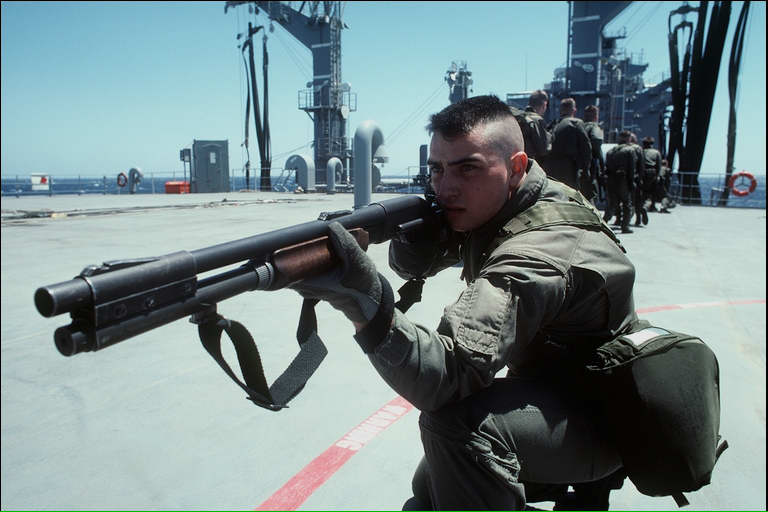
Law-enforcement history helped build that image. Field & Stream notes that the 870 was adopted by military and police departments across the country, and older industry reporting described it as a dominant law-enforcement shotgun. Even as patrol rifles have displaced shotguns in many roles, the 870’s police legacy still gives civilian buyers a sense that they are choosing something serious, tested, and legitimate.
That legacy does not have to reflect current agency-wide procurement trends to remain commercially useful. Once a gun becomes iconic, the image keeps selling long after the original institutional context changes. The 870 has reached that stage. It no longer depends on fashion because, for many buyers, it helped define the fashion.
Price, familiarity, and simplicity still win counters
Pump guns remain popular because they hit a practical sweet spot. Market research reports in the last two years have continued to place pump-action shotguns as the largest segment by share, generally citing affordability, reliability, and broad utility. NSSF’s recent participation materials also show shotgun sports and entry-level programs remain important gateways for new shooters, which keeps demand alive for straightforward, proven platforms.
Within that environment, the 870 makes sense. Buyers looking for a first shotgun often want something mechanically simple and easy to explain. They understand the idea of manually running the action. They like that many loads can be used without worrying about gas tuning or cycle sensitivity. Even when semi-autos may be faster or softer shooting, the pump still feels durable and uncomplicated.
Price positioning matters too. Outdoor Life reported that RemArms moved away from the old 870 Express and toward the upgraded FieldMaster, with a listed MSRP around $600 for that model. That is not bargain-basement territory, but it still sits in a range many buyers accept for a recognizable, proven American-made pump. Once you add the resale confidence that comes with an 870, the purchase can feel safer than trying a lesser-known alternative.
In other words, the 870 does not have to be the absolute cheapest or most advanced. It just has to remain the easiest “yes.”
The 870 wins because buyers are human
This is the part engineers hate: markets are not pure meritocracies. The “best” product often loses to the most legible one. The Remington 870 is legible. People understand what it is instantly. They know what tribe it belongs to, what jobs it can do, what parts fit it, and what its reputation means.
That does not mean every modern 870 is automatically better than its rivals. It clearly is not. Some competitors offer superior factory finishes, better out-of-box sights, more modern ergonomics, or semi-auto speed advantages. The point is that objective advantages only matter if they outweigh the buyer’s preference for familiarity, support, and perceived certainty.
And for most mainstream buyers, they usually do not. The 870 still benefits from a mountain of legacy trust, a gigantic installed base, broad use-case flexibility, deep cultural recognition, and a market that still values pump guns for practical reasons. According to Remington, it remains in production today, and the company still leans on the claim that it is the largest-selling shotgun in history because that history keeps converting into present-day sales.
So yes, newer shotguns can be better on paper. The Remington 870 keeps outselling them because paper is not where most buying decisions actually happen.