It looked unusual even by 19th-century standards. And that odd shape was exactly what made the LeMat one of the most talked-about revolvers of its time.
The revolver that carried a second gun inside it
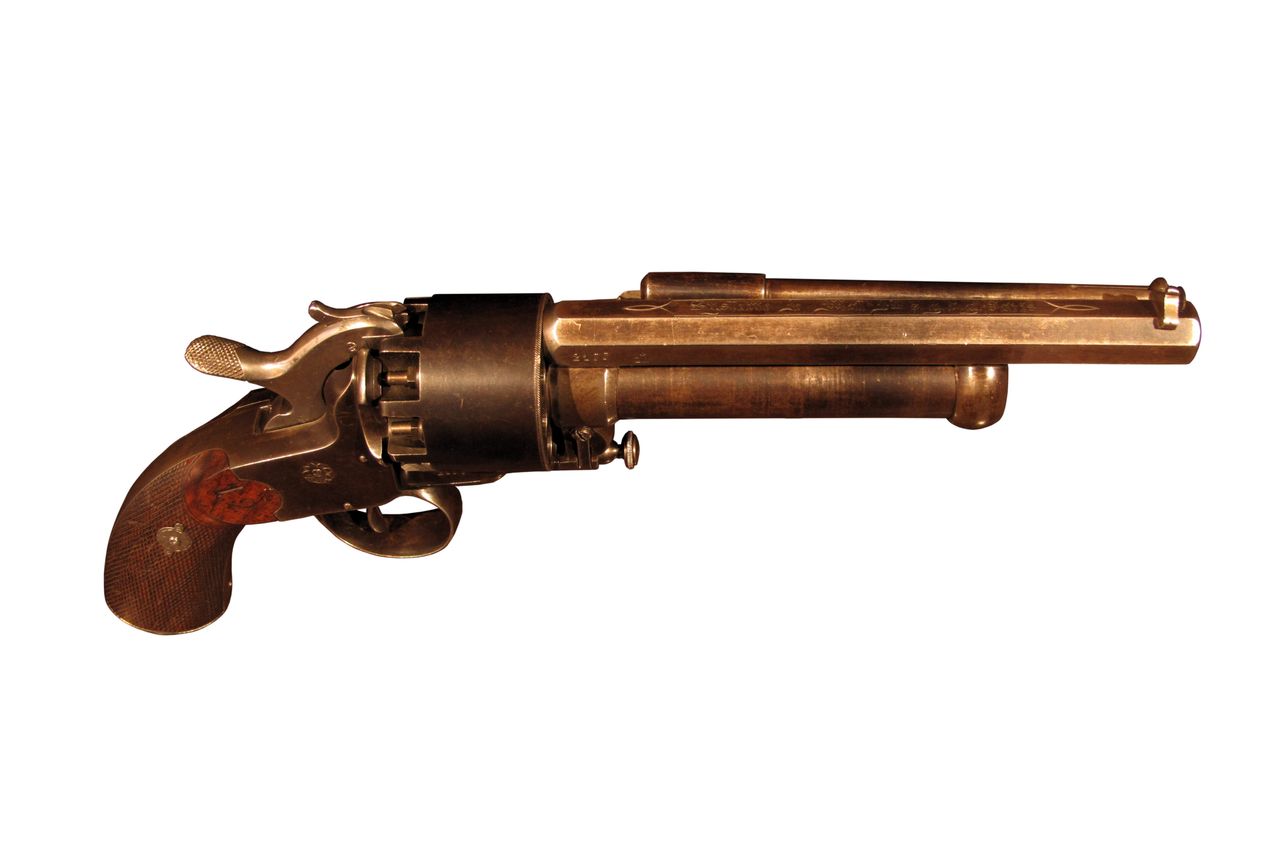
The LeMat was not just another cap-and-ball sidearm. Its claim to fame was the large central barrel running through the middle of the revolver, hidden beneath and inside the main structure of the gun. That center tube was not decorative, and it was not a support rod in the ordinary sense. It was a smoothbore barrel meant to fire a shotgun-style charge, which is why the weapon earned the nickname “Grape Shot Revolver,” as described by the NRA Museums and American Rifleman.
Around that center barrel sat a 9-shot cylinder, usually in .42 caliber on the best-known percussion model. Beneath the main rifled barrel sat the smoothbore center barrel, often described as roughly .63 caliber or about 20-gauge depending on the source and variant. American Rifleman has noted that this gave the gun an unusual dual role: revolver for repeated fire and shotgun for brutal close-range impact.
That arrangement explains the appeal immediately. In an age when many handguns held five or six rounds, the LeMat offered more capacity plus a last-ditch blast that no ordinary revolver could match. The weapon looked bulky because it was bulky, but the extra weight bought something rare for the era: flexibility in a single hand-held firearm.
Who invented the LeMat, and what problem idid t try to solve
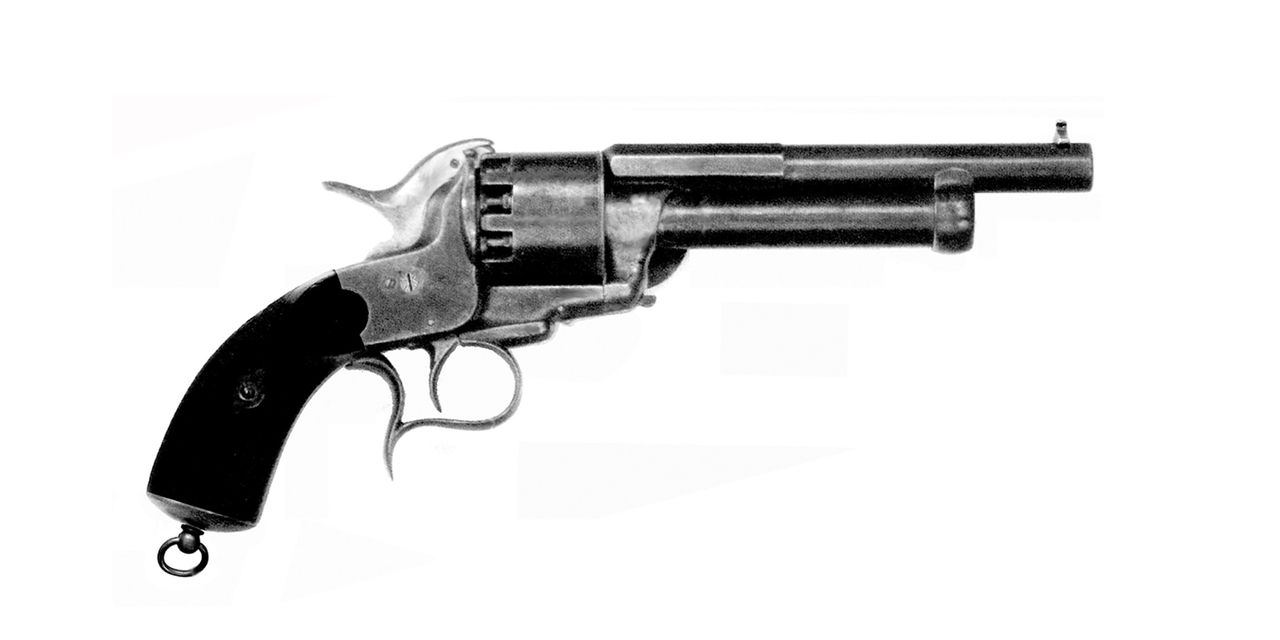
The revolver was the brainchild of Dr. Jean Alexandre François Le Mat, a French-born physician living in New Orleans. NRA Museums notes that he secured U.S. patent #15925 on October 21, 1856, for a revolver built around an upper and lower barrel system, with the lower barrel serving as the axis for the cylinder. It was an ambitious mechanical answer to a simple battlefield question: how do you make a sidearm hit harder without giving up repeat fire?
Le Mat was not working alone in business terms. Pierre Gustave Toutant Beauregard, later famous as a Confederate general, was tied to the venture as a partner and had family connections to Le Mat through marriage, according to NRA Museums. That connection mattered because a promising firearm in the 1850s needed military interest to survive.
The design was pitched as a serious martial weapon, not a novelty. A board of officers appointed by General Sterling Price reportedly recommended it in 1859, yet it was never adopted by the U.S. Army. That is a key part of the LeMat story: it was innovative enough to impress military observers, but unconventional enough to remain outside the mainstream.
Why the hidden shotgun barrel made people pay attention
The center shotgun barrel was the LeMat’s killer feature and the main reason it became famous. A selector on the hammer allowed the shooter to choose between striking the percussion caps for the revolver chambers or the cap for the central smoothbore barrel. American Rifleman described this drop-down hammer nose arrangement as the mechanism that let one gun perform two very different jobs.
For cavalrymen or anyone fighting at extremely short range, that mattered. A standard revolver gave repeated shots, but the LeMat also offered a sudden burst of buckshot or other shot load when the fight collapsed into a few feet. In practical terms, the shotgun barrel was a close-quarters insurance policy. It was the kind of feature that sounded almost too good to be true, which is exactly why the gun captured imaginations.
The design also had psychological value. A 9-shot revolver was already formidable in the 1850s and 1860s, and the idea that one more devastating charge remained in reserve made the LeMat feel larger than life. Its popularity was never about mass adoption. It was about the fact that soldiers, collectors, and later historians could not stop talking about a revolver that secretly carried a shotgun inside its frame.
The LeMat in the Civil War
The LeMat is closely associated with the Confederacy, even though it was invented in New Orleans before the full wartime story unfolded. NRA Museums says about 1,500 were imported by the Confederacy, with production arranged in Europe, including Paris and Belgium. Some accounts describe total production as a little over half of an original 5,000-gun contract for percussion arms, showing how wartime supply problems limited its spread.
Because Southern industry struggled to manufacture a complex revolver at scale, Le Mat took production overseas. HistoryNet and NRA material both point to France and Belgium as the main manufacturing centers, while some variants and later production involved Britain as well. The guns then had to run the blockade, which added cost, delay, and uncertainty.
Even with those obstacles, the LeMat developed a powerful reputation. It was reportedly carried by notable Confederate officers, including J.E.B. Stuart, and the Beauregard connection gave it extra prestige. That fame can make the gun seem more common than it really was. In truth, the LeMat was rare, expensive, and logistically difficult, but its unusual design gave it an outsized place in Civil War memory.
What it was like to carry and use one
For all its ingenuity, the LeMat was not a simple sidearm. It was larger and heavier than many conventional revolvers, and like other percussion weapons of the era, it demanded time-consuming loading with powder, ball, caps, and careful handling. The shotgun barrel added versatility, but it also added complexity. This was not the kind of handgun a casual user would master quickly.
Still, the gun had real strengths. Nine-shot revolvers offered a meaningful advantage over six-shot competitors, especially before reloading became possible. Then there was the smoothbore center barrel, which gave the shooter an option for devastating short-range fire. In a mounted clash or sudden close encounter, that extra blast could be more than a gimmick.
The tradeoff was speed and convenience. A weapon with two firing functions and a specialized hammer selector was naturally more complicated than a standard Colt or Remington. The LeMat’s reputation today sometimes emphasizes its drama over its practicality. Yet that tension is exactly what makes it interesting: it was not the most efficient revolver of its age, but it may have been the most imaginative.
Why collectors and historians still care about it
The LeMat remains highly desirable because it represents a rare branch in firearms design, a moment when inventors were still experimenting boldly with what a handgun could be. American Rifleman has noted that later LeMat revolvers appeared in pinfire, rimfire, and center-fire forms, showing that the concept did not die with the Civil War. It evolved, even if it never became dominant.
Collectors are drawn to rarity, unusual mechanics, and strong historical associations, and the LeMat checks every box. It is tied to major Civil War figures, produced in limited numbers, and instantly recognizable from across a room. Unlike many old revolvers that blend together to non-specialists, the LeMat is unforgettable. One glance at that deep frame and center barrel, and people know they are looking at something different.
Museums value it for the same reason. The LeMat tells a larger story about innovation under pressure, Confederate procurement abroad, and the 19th century’s appetite for hybrid weapon ideas. It is one of those firearms that invites questions from everyone, not just gun historians, because the concept is so visually and mechanically startling.
The real reason the LeMat became a legend
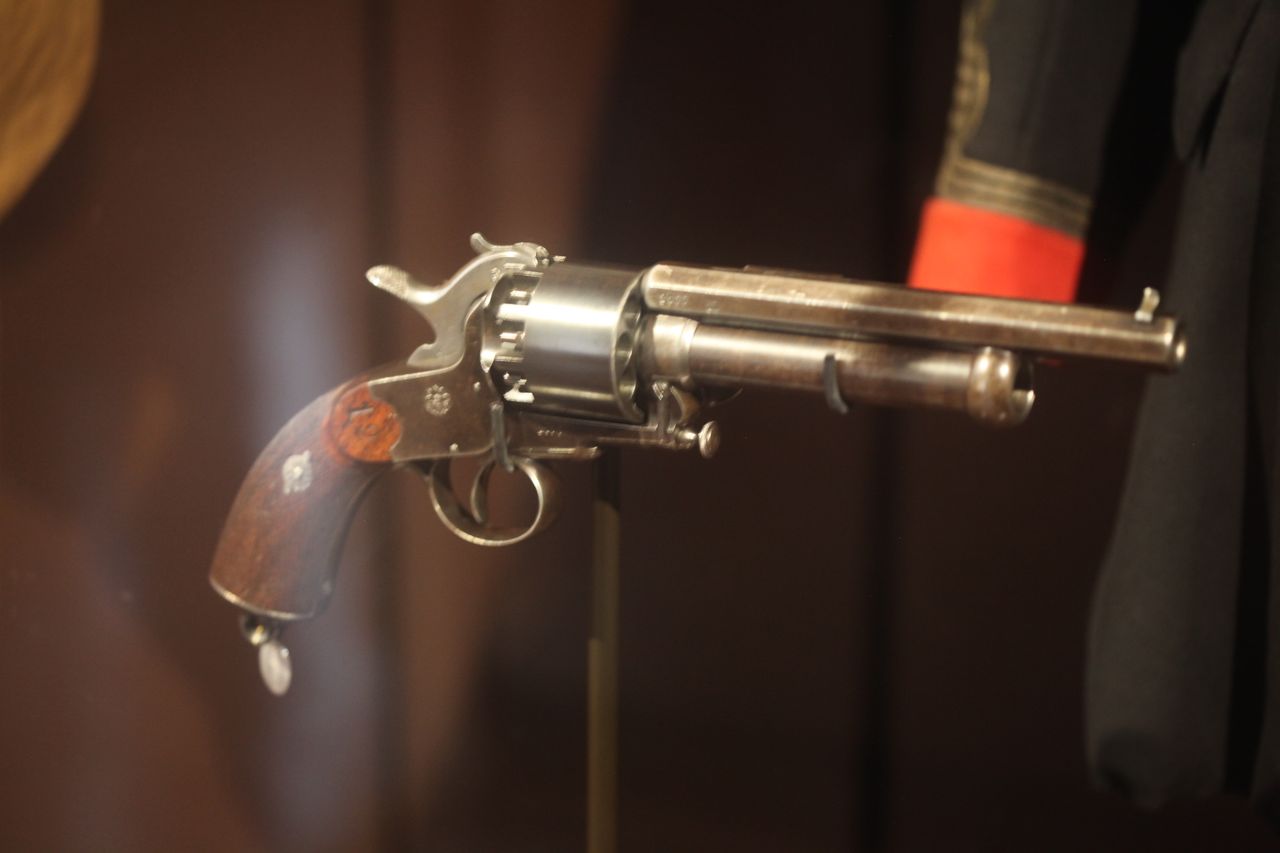
The simplest explanation is the best one: people remember the LeMat because it promised more than a normal revolver. It held nine shots, and it hid a shotgun barrel inside the same frame. That gave it an aura of surprise and excess that ordinary sidearms could not match. Long before modern marketing language existed, the LeMat had a built-in talking point.
Its battlefield importance was real but limited. It did not reshape the war, and it was never adopted in numbers large enough to change handgun doctrine. But legend is not always built on scale. Sometimes it comes from a single bold idea executed well enough to survive in memory long after more common weapons are forgotten.
That is exactly what happened here. The LeMat became popular not because it was everywhere, but because it was unlike anything else around it. A revolver with a shotgun hidden inside its frame sounded improbable, looked dramatic, and delivered a genuine tactical twist. More than 160 years later, that is still enough to make people stop and stare.