It looked cheap because it was cheap. That was the whole point.
A pistol built for desperation, not glory
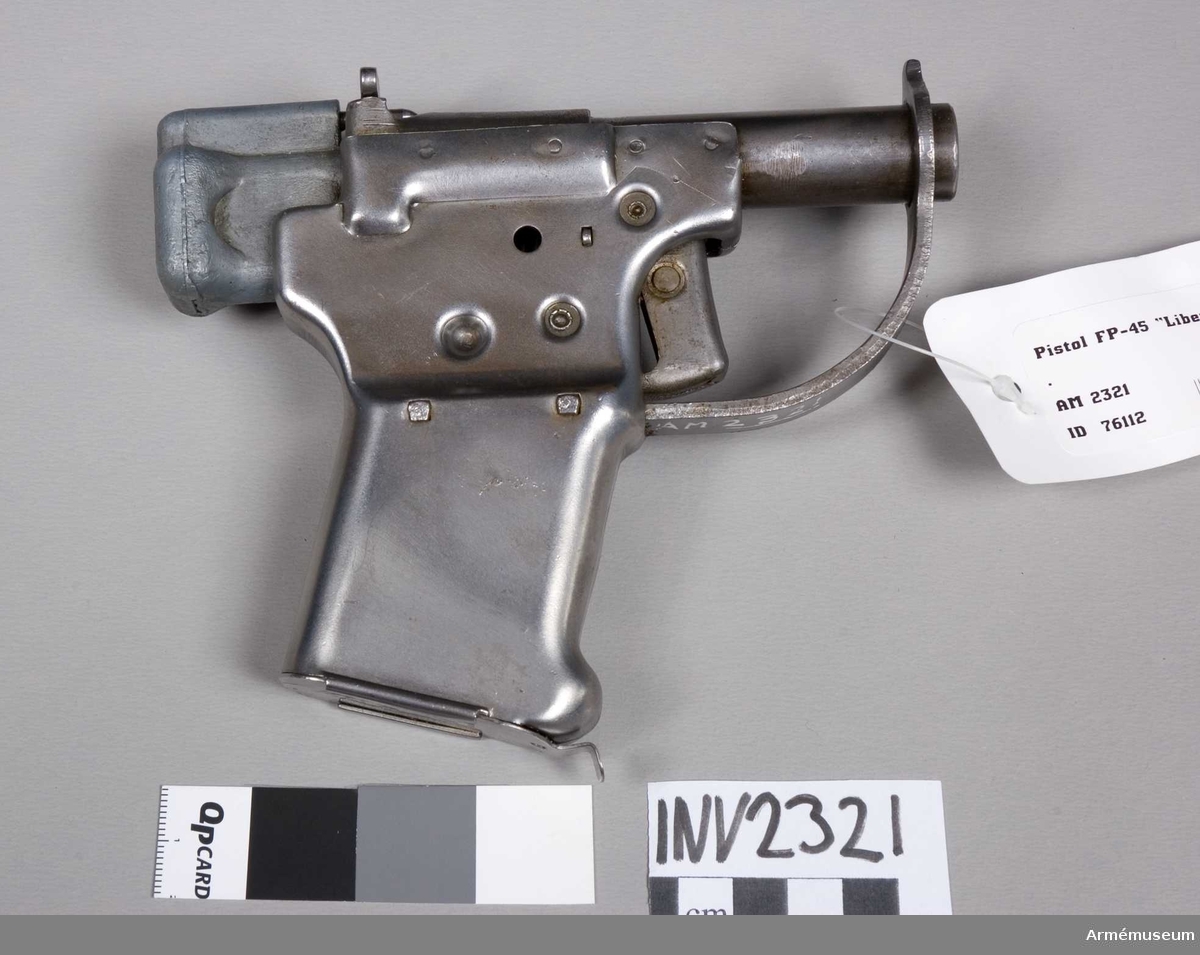
The handgun in question was the FP-45 Liberator, a blunt little single-shot pistol developed in 1942 for a very specific wartime idea: drop huge numbers of ultra-cheap guns behind enemy lines and let resistance fighters use them to kill an occupying soldier and take his real weapon. According to American Rifleman, the project moved from concept to one million completed pistols in less than six months, which remains one of the most astonishing rush jobs in small-arms history.
The name itself was camouflage. FP stood for Flare Projector, a deliberately misleading label meant to obscure the weapon’s true purpose even inside the production chain. The gun fired .45 ACP, the same cartridge used in the M1911, but there the similarity ended.
This was no service pistol. It had a smoothbore 4-inch barrel, crude stamped-metal construction, and a useful range often described as under 50 feet. American Rifleman noted that loading it took longer than making it, which sounds like a joke until you realize how brutally simplified the design really was.
And yet, that simplicity is what made the Liberator famous. It was not supposed to last, impress, or even fight fairly. It was designed as a throwaway weapon for irregular war.
How General Motors cranked out a million of them
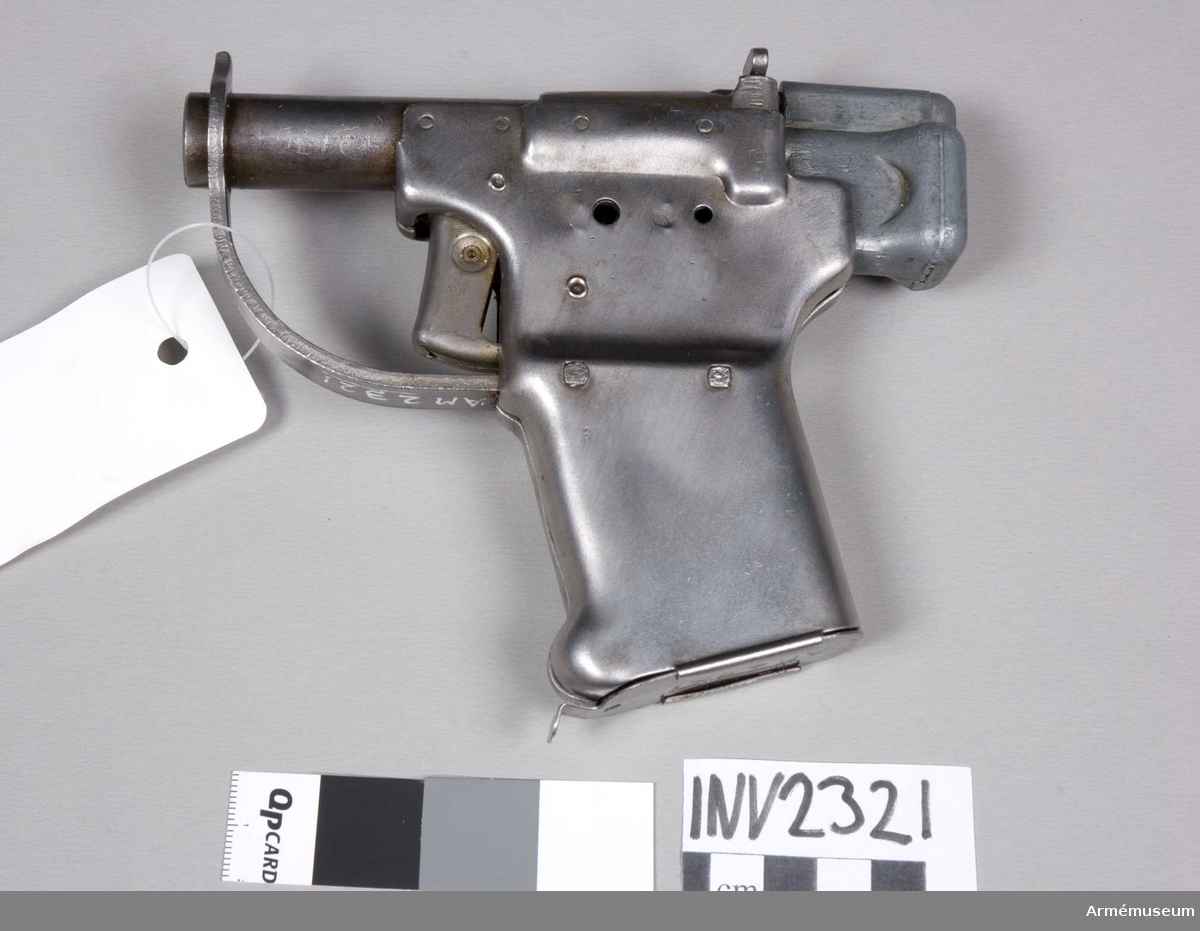
The most remarkable part of the Liberator story is not the gun itself but the industrial sprint behind it. After early development work at Inland, production was handed to Guide Lamp, a General Motors division in Anderson, Indiana, because Inland was already deeply committed to M1 Carbine work. American Rifleman reports that Guide Lamp received the contract in May 1942 and completed one million pistols by August 21, 1942.
That means the factory turned out these guns in barely more than 10 weeks. Roughly 300 workers, operating around the clock, produced an arm so simple that its average assembly time has been calculated at about 6.6 seconds per pistol. In wartime manufacturing terms, that is almost absurd.
The cost is what gave the Liberator its enduring legend. American Rifleman reported the pistol itself cost about $1.73 per unit, while the complete packaged set cost around $2.10. The National Park Service has likewise described it as the $2 Woolworth gun, a nickname that captured both its bargain-basement price and its deliberately disposable character.
Each kit came in a cardboard box with 10 rounds of .45 ACP ammunition, a wooden dowel for knocking out spent cases, and a pictorial instruction sheet that used no words. That wordless sheet mattered because the intended users might speak any language or none at all.
Why this million-gun idea barely changed the war
In theory, the Liberator was a psychological and tactical weapon. If thousands of occupied civilians suddenly had firearms, enemy troops would have to fear ambush everywhere. In practice, commanders were not nearly as enthusiastic as the planners who dreamed it up.
American Rifleman says that although 500,000 pistols were shipped to Great Britain with hopes of distribution in occupied Europe, Gen. Eisenhower’s command showed little interest beyond possible emergency use. The Pacific was not much different. Some Liberators went to China and Filipino guerrillas, and the National Park Service says the OSS distributed them especially in China and the Philippines, but the weapon never became the war-turning tool its backers imagined.
That makes sense once you understand the gun’s limits. It was slow to reload, crude to aim, and never intended for sustained combat. Some examples reportedly began showing structural wear after surprisingly low round counts, and the smoothbore barrel did accuracy no favors.
So the Liberator ended up in a strange middle ground. It was not useless, but it was far less practical than the propaganda value surrounding it. For most fighters lucky enough to use one successfully, the real goal was to discard it immediately and walk away with an enemy rifle.
Why are surviving examples so scarce today?
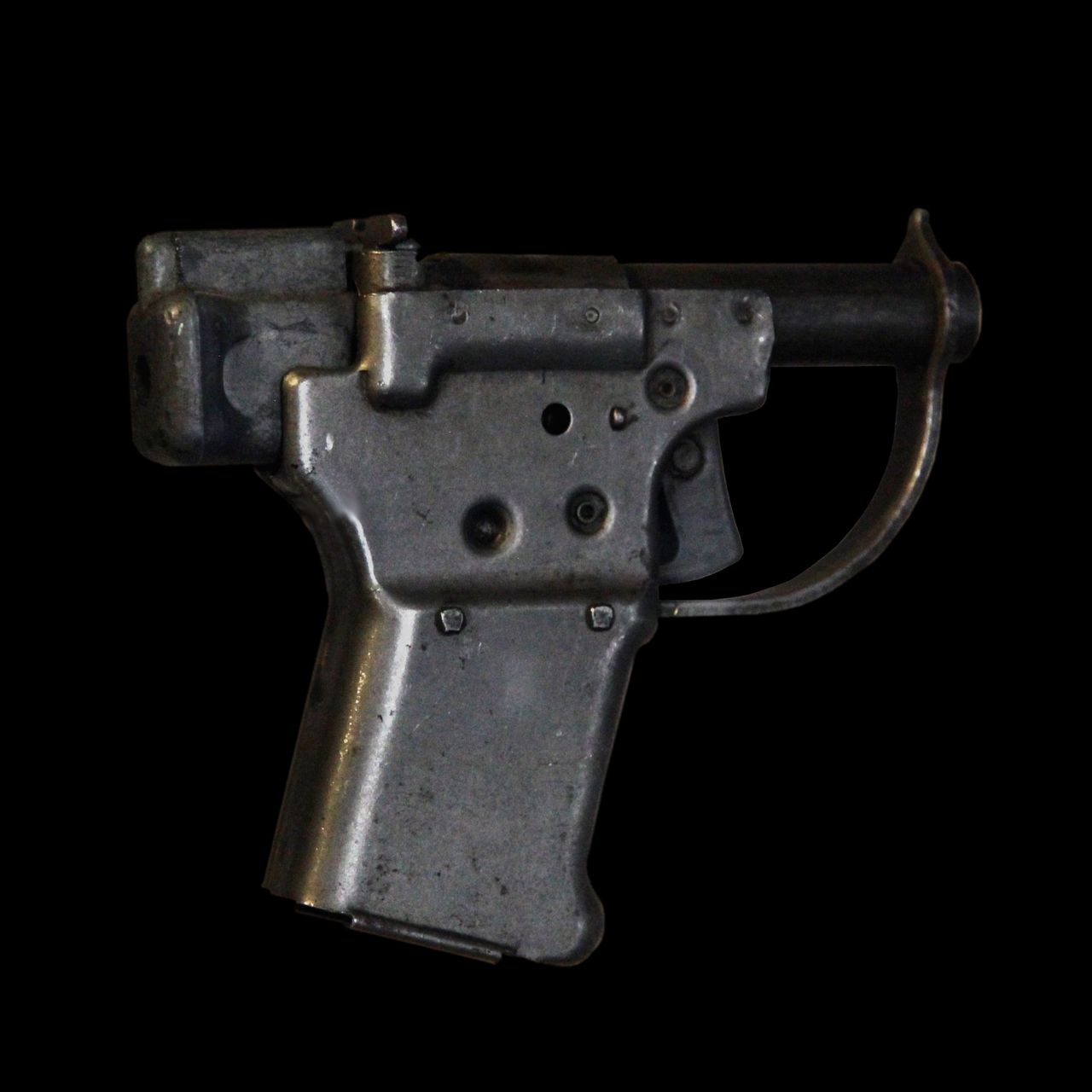
Scarcity is the engine behind the Liberator’s modern value. Even though one million were produced, only a fraction survived the war. American Rifleman reports that large numbers were destroyed after 1945, either scrapped outright or dumped into the ocean in unopened boxes. That mass disposal is the reason a gun once made by them millions of times now feels uncommon.
Collectors often forget an important rule: high production does not guarantee high survival. Disposable wartime gear is often used hard, stored badly, stripped for parts, or simply thrown away once its original purpose disappears. The Liberator checks every one of those boxes.
It also did not live an ordinary postwar life in drawers and holsters the way surplus service pistols often did. Many people have never seen one. Others mistook it for junk because, frankly, it looked like junk. The very qualities that made it cheap in 1942 made it easy to overlook for decades afterward.
Condition is only part of the story. Completeness matters enormously. A Liberator with its original box, ammunition compartment cover, wooden dowel, and pictogram instructions is far more compelling than a loose pistol missing half the kit. In collecting, context is value, and this gun is all context.
From disposable weapon to serious collector’s piece
The market has steadily rewarded that context. American Rifleman wrote that years ago Liberators might sell in the $750 to $1,000 range, then later commonly started around $1,750 and could top $4,000 for a strong original pistol kit. That article is older, but it captures the long arc perfectly: as surviving examples dried up and more collectors learned the story, prices climbed.
That rise follows a pattern seen across U.S. martial arts. Collectors do not just buy steel and springs. They buy production history, wartime mythology, rarity, and originality. The Liberator delivers all four in one of the most compact packages imaginable.
Auction houses have helped by reframing these guns as artifacts rather than curios. The same market that pays heavily for rare wartime M1911A1 variants, especially uncommon makers or documented examples, has also become more interested in oddball arms tied to covert operations, resistance warfare, and one-off emergency programs. Rock Island Auction has highlighted how wartime production oddities and scarce U.S. martial pieces can leap far beyond utilitarian value.
A Liberator will never be a refined pistol. It is valuable precisely because it is so crude, so purposeful, and so tied to one strange wartime idea that could only have existed in 1942.
What collectors look for before bidding thousands
If you are looking at a Liberator today, originality is everything. Because the pistol was simple and cheaply made, condition grading does not work exactly the way it does with a premium commercial handgun. Honest finish wear may matter less than whether the gun remains intact and correct.
Collectors usually focus on a few big points. First is the completeness of the original package. A pistol with the waxed box, dowel, and instruction sheet sits in a completely different class than a bare example. Second is authenticity, because rare martial arms always attract fakes, assembled sets, or married accessories. Third is preservation, especially around seams, the barrel area, and the flimsy stamped parts that make the Liberator what it is.
Provenance can also move the needle. Any documented link to wartime storage, OSS handling, Pacific theater use, or long-held family custody adds confidence and story value. Even when hard documentation is thin, old estate finds tend to generate stronger bidding than anonymous examples with modern packaging.
And then there is the basic reality of collecting psychology. People love contradictions. A million-made pistol that is still hard to find, a crude gun that now demands careful handling, and a throwaway design that became a prized artifact — that is exactly the kind of paradox that keeps auction rooms lively.
The real lesson of the Liberator
The FP-45 Liberator is not worth thousands because it is mechanically brilliant. It is worth thousands because it is historically vivid. In one object, you get American industrial muscle, wartime improvisation, psychological warfare theory, and the disposable logic of total war.
It also tells a bigger story about government production and the collector market. Items made in staggering numbers can become scarce when their original purpose was temporary, and their survival was never a priority. One mile sounds endless until history, corrosion, indifference, and ocean dumping do their work.
For general readers, that is what makes this pistol so fascinating. The Liberator was never a heroic sidearm in the Hollywood sense. It was ugly, simple, and opportunistic. It existed to give someone a close-range chance.
For collectors, that same harsh honesty is the appeal. The Liberator is a physical reminder that not every famous gun was built to last. Some were built for one shot, one mission, and one moment. Decades later, that is exactly why people will pay real money to own one.