Nobody held a meeting and declared these guns prestigious. They just kept surfacing in the right safes, duck blinds, ranges, and hunting camps until everyone understood what they meant.
Colt Python
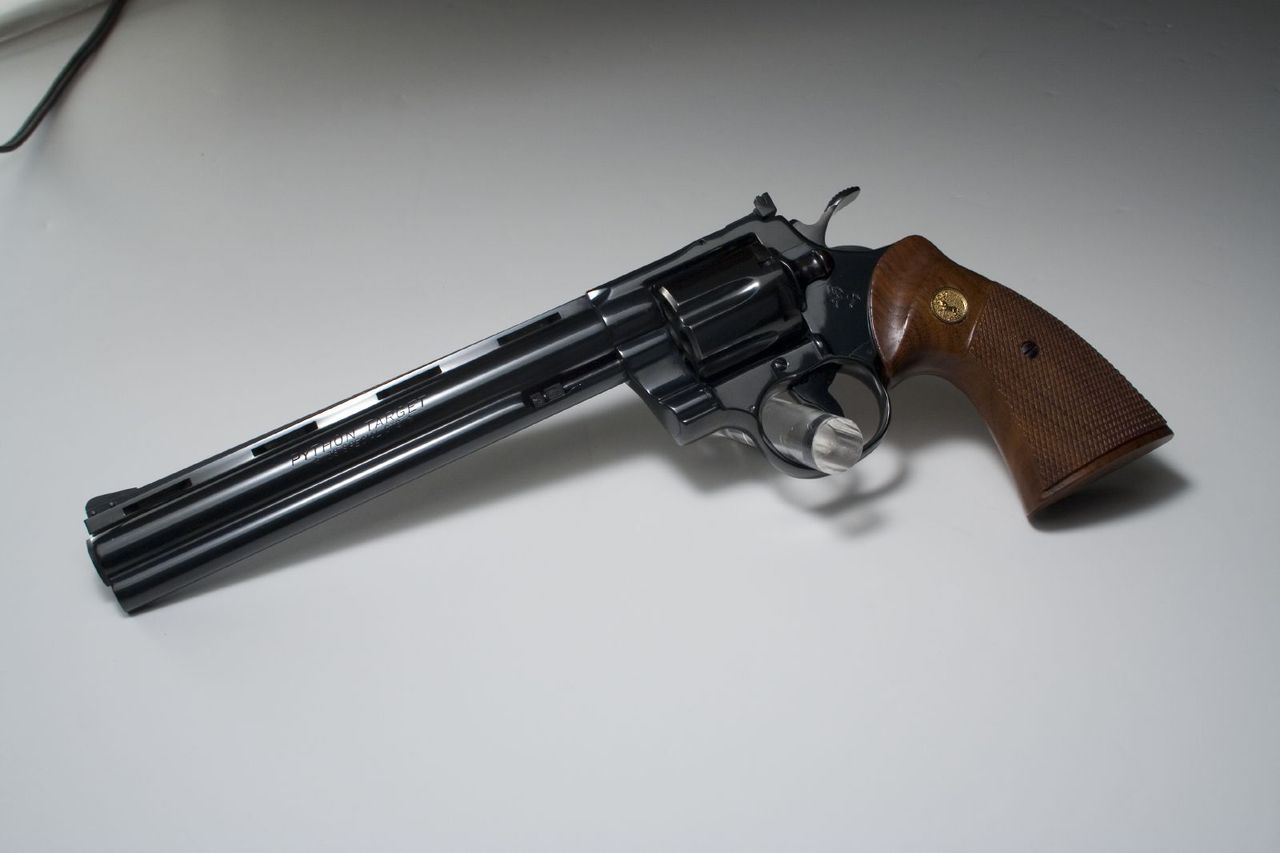
The Colt Python did not become a status symbol through scarcity alone. It earned that aura because it has always sat at the intersection of mechanical quality, visual drama, and cultural memory. Colt’s own timeline notes the Python’s 2020 return, and the current factory literature still leans on its smooth double and single action reputation, adjustable sights, and premium finish options in stainless and Royal Blue. That matters, because buyers are not just paying for a .357 revolver. They are paying for a gun that still looks expensive from across the room.
What gives the Python its social value is that nobody buys one by accident. It is not the cheapest range revolver, not the most practical carry piece, and not the first handgun many people recommend to a beginner. A Python usually shows up after someone already owns more functional choices and decides they want something with presence.
That makes it a collector’s flex without the owner needing to say much. In one glance, other shooters read the signal. This person cares about polish, heritage, trigger feel, and old-school craftsmanship. Even the modern reintroduced guns carry that charge.
The funny part is that the Python’s status was never fully manufactured. It happened because generations of enthusiasts kept treating it like the revolver equivalent of a vintage watch that still works every day.
Benelli Super Black Eagle 3

Among waterfowl hunters, the Benelli Super Black Eagle line has long been more than a shotgun. Benelli has described the platform as dominant in the 3.5-inch semi-auto waterfowl market for decades, and the current Super Black Eagle 3 lineup still leans heavily on the inertia-driven action, ComforTech 3 stock, and weather-resistant finishes. On paper, those are practical features. In the field, they function like class markers.
Part of the mystique comes from where you see one. A Super Black Eagle 3 is rarely hanging untouched on a wall. More often, it is covered in marsh grime, loaded with expensive shells, and carried by someone who hunts enough to justify a premium shotgun that can take real abuse. That creates a specific kind of respect.
It also helps that the gun is expensive in a category full of capable alternatives. Benelli’s dealer materials have listed SBE 3 models well above many mainstream semi-autos, with premium variants pushing even higher. When someone chooses one, the message is subtle but obvious: they are willing to pay for reliability, fit, and brand confidence.
No one outside hunting culture may notice. Inside it, though, a Super Black Eagle says the owner is serious, seasoned, and probably not borrowing anyone else’s decoys.
Ruger No. 1

The Ruger No. 1 is a status symbol because it makes no attempt to be efficient by modern standards. Ruger’s product history shows the No. 1 has been around since 1967, chambered over the decades in everything from small varmint rounds to large safari cartridges. That breadth matters because the rifle has never been about one niche. It is about a philosophy.
A single-shot rifle in a market full of repeaters tells you something instantly about the owner. This is a person who values elegance over volume, wood-and-steel aesthetics over tactical modularity, and the ritual of one careful shot over sheer capacity. That is not a mainstream preference. It is a cultivated one.
The No. 1 also carries prestige because it is one of those rifles people talk about with a certain tone. Owners discuss barrel configurations, older runs, tropical calibers, and stock variations the way car people talk about rare trims. You do not buy one just to have a deer rifle. You buy one because you appreciate the idea of the rifle.
That is why the No. 1 quietly signals money and taste. It is not flashy to outsiders. To gun people, though, it practically announces that the owner enjoys nice things and does not need to explain why.
Browning Citori 725

The Browning Citori 725 became a status symbol the old-fashioned way: by proving itself everywhere serious shotgun people gather. Browning describes it as a low-profile over-under built on the long-running Citori lineage, with a mechanical Fire Lite Trigger, a strong full-width hinge pin, and a design intended to improve recoil control and handling. Those are performance details, but they add up to something larger than performance.
Over-under shotguns already occupy a more refined corner of gun culture. They ask more from the buyer in price, fit, and intent. Someone carrying a Citori 725 to sporting clays or upland cover is not dabbling. They have likely decided that balance, trigger quality, and long-term durability matter more than sheer utility.
There is also the Browning effect. The Citori name has decades of credibility behind it, and Browning has noted the line’s extraordinary longevity and broad success. That means the 725 is not just another premium shotgun. It is part of a family with inherited status.
The result is a gun that broadcasts discernment rather than flamboyance. It is not the loudest shotgun on the rack. It is the one experienced shooters notice first, then nod at, because they know exactly what it costs in both money and commitment.
Beretta 686 Silver Pigeon I
The Beretta 686 Silver Pigeon I may be the clearest example of accidental status in the whole gun world. Beretta positions the Silver Pigeon family around Steelium barrels, selected walnut, elegant engraving, and the long-proven 680-series action. None of that sounds ostentatious. In fact, the gun’s whole appeal is that it looks restrained. That restraint is precisely why it carries so much social weight.
People who do not know shotguns see a handsome over-under. People who do know shotguns see a universally respected entry point into serious Beretta ownership. It is the shotgun equivalent of a luxury item that never needs a logo because the silhouette does the work.
Its status comes from how often it appears in respectable company. Sporting clays courses, bird camps, and well-stocked gun rooms are full of Silver Pigeons because they hit the sweet spot between heirloom feel and actual use. Owners are not afraid to shoot them, but nobody mistakes them for bargain tools either.
That balance is powerful. The 686 says the owner appreciates quality but does not need to overstate it. In many circles, that kind of understatement reads as more sophisticated than buying the most expensive gun in the room.
Marlin 1895 SBL

The Marlin 1895 SBL became a status symbol through a weird mix of nostalgia, practicality, and timing. When Ruger reintroduced the 1895 SBL in late 2021, the company made a point of framing it as the first Ruger-made Marlin, with Mayodan, North Carolina markings and visible attention to quality control. That instantly turned the rifle into more than a lever gun. It became a test case for whether an old icon could come back right.
Then culture did the rest. The stainless steel finish, laminated stock, big-bore .45-70 chambering, and compact guide-gun profile gave the rifle a look that feels both classic and cinematic. It appears rugged, but curated. It looks like something a person buys after they already know exactly what kind of rifle story they want to tell.
That matters because the 1895 SBL is not a rational one-rifle answer for most people. Ammunition is not cheap, recoil is real, and the platform is deliberately old-school. Yet demand stayed strong because the appeal was never merely ballistic performance.
Owning one signals that you care about heritage, but not in a fragile way. It says you want a rifle that is useful, handsome, and just self-aware enough to know it is cool without trying too hard.
Staccato 2011

Few modern pistols have climbed the social ladder faster than the Staccato 2011. Staccato’s current lineup and product materials emphasize steel-framed or duty-focused 9mm pistols, premium triggers, optics-ready configurations, and strong adoption among law enforcement and specialized professional users. That last point matters more than almost anything else. In gun culture, perceived hard-use credibility can elevate a pistol from expensive to aspirational overnight.
A Staccato is not just a handgun purchase. For many buyers, it is a declaration that they have moved past striker-fired practicality into the world of tuned performance. The 2011 pattern offers a crisp trigger, excellent shootability, and a level of fit that owners tend to discuss in almost tactile terms. They talk about it the way audiophiles talk about soundstage.
The social signal is unmistakable because the price is unmistakable. These guns live far above basic duty-pistol territory, which means buyers usually reach them after building experience and disposable income. They are rarely anyone’s first serious handgun.
That is how the Staccato became a marker of status. Not because someone voted it there, but because enough skilled, image-conscious, and moneyed shooters kept showing up with one until the message stuck.
HK Mark 23
The HK Mark 23 is one of the strangest status symbols in firearms because it is simultaneously oversized, impractical for most people, and almost absurdly prestigious. HK’s operator manual traces the Mark 23 project back to a 1991 development contract, and that military-origin story still hangs over the pistol like a myth. It is a .45 with a massive footprint, specialized history, and a reputation built on overengineering.
In practical terms, there are easier pistols to carry, cheaper pistols to shoot, and simpler pistols to maintain. None of that hurts the Mark 23. If anything, it helps. This is a gun people buy precisely because it refuses to apologize for what it is. It was built around a demanding concept, and it still feels like a machine from a different era of handgun ambition.
That gives it unusual social value. A Mark 23 in someone’s collection says the owner appreciates niche excellence, military lore, and the appeal of a firearm that became famous by being too much gun for almost everyone.
And that is the heart of accidental status. The Mark 23 does not look like a trend piece. It looks like commitment. In enthusiast circles, that often reads as the purest luxury of all.