Some Old West guns became legends because they looked dramatic. This one became memorable because it solved a very practical problem.
The revolver tied to the Wells Fargo legend
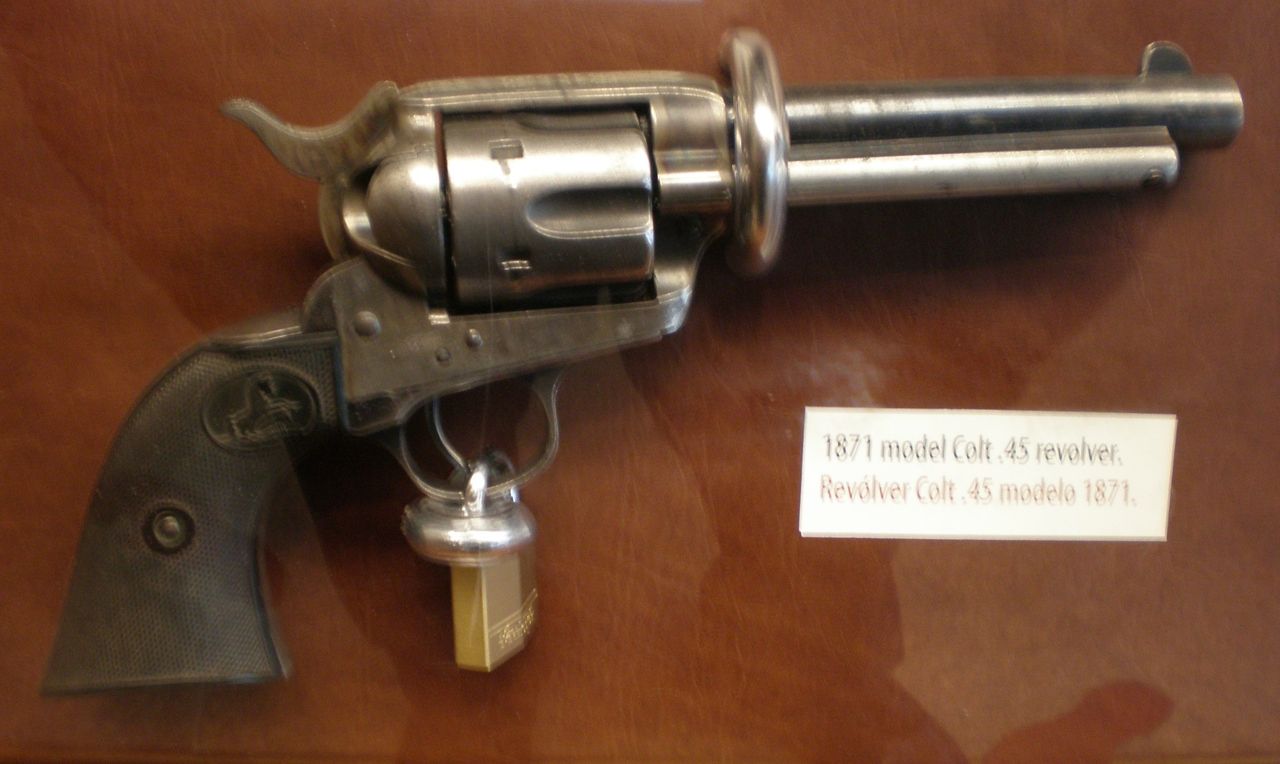
When people hear about a Wells Fargo cut-down revolver, they usually imagine a custom fighting gun made specifically for blasting away from a stagecoach seat. The truth is a little more nuanced, and in some ways more interesting. The revolver most often linked to that story is the so-called “Wells Fargo” Colt Model 1849 Pocket, a compact .31 caliber percussion revolver that collectors have long associated with the company.
Examples in major museum collections show the pattern clearly. The Metropolitan Museum of Art identifies a “Wells Fargo” Colt revolver in .31 caliber, and collector literature consistently describes the type as a short-barreled pocket model, often around 3 to 4 inches, made without the loading lever found on standard 1849 Pocket Colts. That missing lever is one of the features that gives the gun its trim, almost stripped look.
What matters is that this was not simply a random barrel chop by a frontiersman with a hacksaw. It was a recognizable configuration tied to Colt pocket revolvers and later linked in popular memory to Wells Fargo use. Whether every example was shipped under a formal Wells Fargo contract is still debated by arms historians, but the gun’s compact profile absolutely fits the needs of guards, messengers, and agents working fast-moving express routes.
Why stagecoach guards wanted shorter handguns

A stagecoach guard did not fight from a parade ground. He worked from a cramped bench, around reins, strongboxes, passengers, dust, and confusion. Wells Fargo’s own historical accounts note that armed messengers rode up front with drivers to protect valuable shipments, and the company’s robbery records from the 1870 to 1884 period show just how real the threat was. A bulky sidearm was a liability in that environment.
Shortening a revolver made it easier to carry and faster to draw. A long barrel can snag on coats, blanket rolls, seat edges, and the jumble of gear that surrounds a stage line. A compact revolver also tucked more comfortably into a waistband, coat pocket, or small holster, making it a realistic backup arm instead of a burden.
That backup role is the key point. Stagecoach defense was centered on the shotgun messenger, not on winning a pistol duel at a distance. Contemporary history of Wells Fargo security work emphasizes the short double-barreled shotgun as the main weapon of express guards. The revolver existed beside it as insurance, useful if the fight collapsed into close quarters, if the shotgun was emptied, or if a man needed one hand free while scrambling around the coach.
The shotgun came first, but the revolver still mattered

The phrase “riding shotgun” survives because the shotgun was the true king of stagecoach security. Wells Fargo’s history and broad accounts of express operations both describe guards sitting beside the driver with a short double gun ready for ambushes and road holdups. In practical terms, a shotgun delivered immediate stopping power at the distances where most robberies actually happened.
So why bother with a little revolver at all? Because a messenger’s world was unpredictable. An attack might come when a man was dismounting, handling a strongbox, or separated from the coach. A sidearm stayed on the body in a way a coach gun did not. If a robber closed the distance suddenly, the handgun was the weapon that remained accessible.
This is where the cut-down format made sense. A compact Colt pocket revolver was not intended to replace the messenger shotgun. It complemented it. Even a .31 caliber percussion revolver, modest by later standards, gave a guard five shots in a package light enough to live with all day. For a company moving cash, gold dust, bonds, and payroll over rough roads, that convenience could matter as much as raw power.
What was actually cut down on these guns
The phrase “cut down” can mislead modern readers because it sounds like any long revolver could be shortened into a Wells Fargo guard gun. In collector language, the classic “Wells Fargo” revolver usually refers to a variant of the Colt 1849 Pocket rather than a crudely altered full-size Navy or Army model. Sources tied to museums and long-running gun publications describe these guns as short-barreled pocket Colts, generally lacking the loading lever, which kept the profile compact and smooth.
That distinction matters because deleting the lever did more than change the look. On a cap-and-ball revolver, the loading lever under the barrel was used to seat the ball into the chamber. Removing it reduced bulk and saved weight, but it also meant the gun was less convenient to reload in the field. In other words, it favored immediate carryover over sustained fighting.
That tradeoff makes perfect historical sense. A stagecoach guard did not expect to stand in one place and leisurely recharge cylinders during a running fight. He needed a revolver that carried easily, came out quickly, and served as an emergency weapon. The shortened form, whether factory-configured or period-altered, reflected that reality better than any romantic dime-novel image.
Why Wells Fargo valued speed over firepower
Wells Fargo was not arming cavalry troopers for open battle. It was protecting shipments in an ambush-heavy world where the first seconds of violence often decided everything. In that context, speed could beat power. A smaller revolver that cleared leather cleanly and pointed naturally at arm’s-length range offered a very real advantage, even if its caliber was not impressive beside a .36 or .44 Colt.
There is also business logic here. Express companies cared about reliability, portability, and the behavior of employees under pressure. The more practical a weapon was to carry every day, the more likely it would actually be on the guard when trouble started. A heavy belt pistol left in luggage or shifted awkwardly under a coat was no help during a sudden robbery attempt.
That same logic shaped other Wells Fargo arms’ choices. The company favored short shotguns because they handled better around coaches and in close defensive work. A compact revolver follows the same philosophy. Everything about the security problem pushed toward handier weapons, not prettier ones. The cut-down gun was about keeping a guard armed without slowing him down or tangling him up in his own gear.
The myth, the collector’s name, and the historical reality
One wrinkle in this story is that historians and collectors do not all agree that Wells Fargo officially ordered large numbers of these exact revolvers under that specific name. Some later writing has treated the “Wells Fargo” label as collector shorthand rather than proven factory nomenclature. True West-style collector discussions and museum references both reflect that uncertainty. That means it is wise to be careful with sweeping claims.
Still, the association did not appear out of nowhere. The compact Colt pocket revolver’s dimensions, leverless form, and easy concealability make it a believable fit for messengers, agents, and guards. Even where formal documentation is thin, the functional match is strong. And surviving examples with the familiar stagecoach holdup cylinder scene only reinforced the connection in the popular imagination.
So the best way to understand the gun is not as a magical one-off Wells Fargo secret weapon, but as a practical frontier sidearm that fits Wells Fargo’s working needs unusually well. The legend grew because the gun looked the part, but the design endured in memory because it answered a real defensive problem faced by men guarding money on dangerous roads.
Why the cut-down revolver still fascinates people today
This revolver remains compelling because it sits at the intersection of myth and mechanics. It carries the Wells Fargo name, the stagecoach image, and the aura of the American West, yet its appeal comes from something much simpler. It is a problem-solving gun. Every shortened line on it suggests a world where a fraction of a second and a few inches of steel could matter.
Modern readers also recognize the broader idea immediately. The same principle that favored a shorter backup revolver for a stagecoach guard still appears in later handgun design: easier carry, faster presentation, better fit in tight spaces. That continuity gives the old pocket Colt a surprisingly modern feel, even though it belonged to the percussion era.
In the end, Wells Fargo had this type of revolver cut down, adopted, or at least strongly associated with its guards for the same reason frontier companies chose any tool worth keeping. It matched the job. On dangerous express routes, the ideal handgun was not the biggest or the most ornate. It was the one a guard could actually carry, reach, and use when the road suddenly turned violent.