Some rifles become legends because they are everywhere. Others earn that status quietly, by solving hard engineering problems in ways the market never fully appreciated.
It Took a Radical Idea to Stand Out in a Crowded Rifle Market
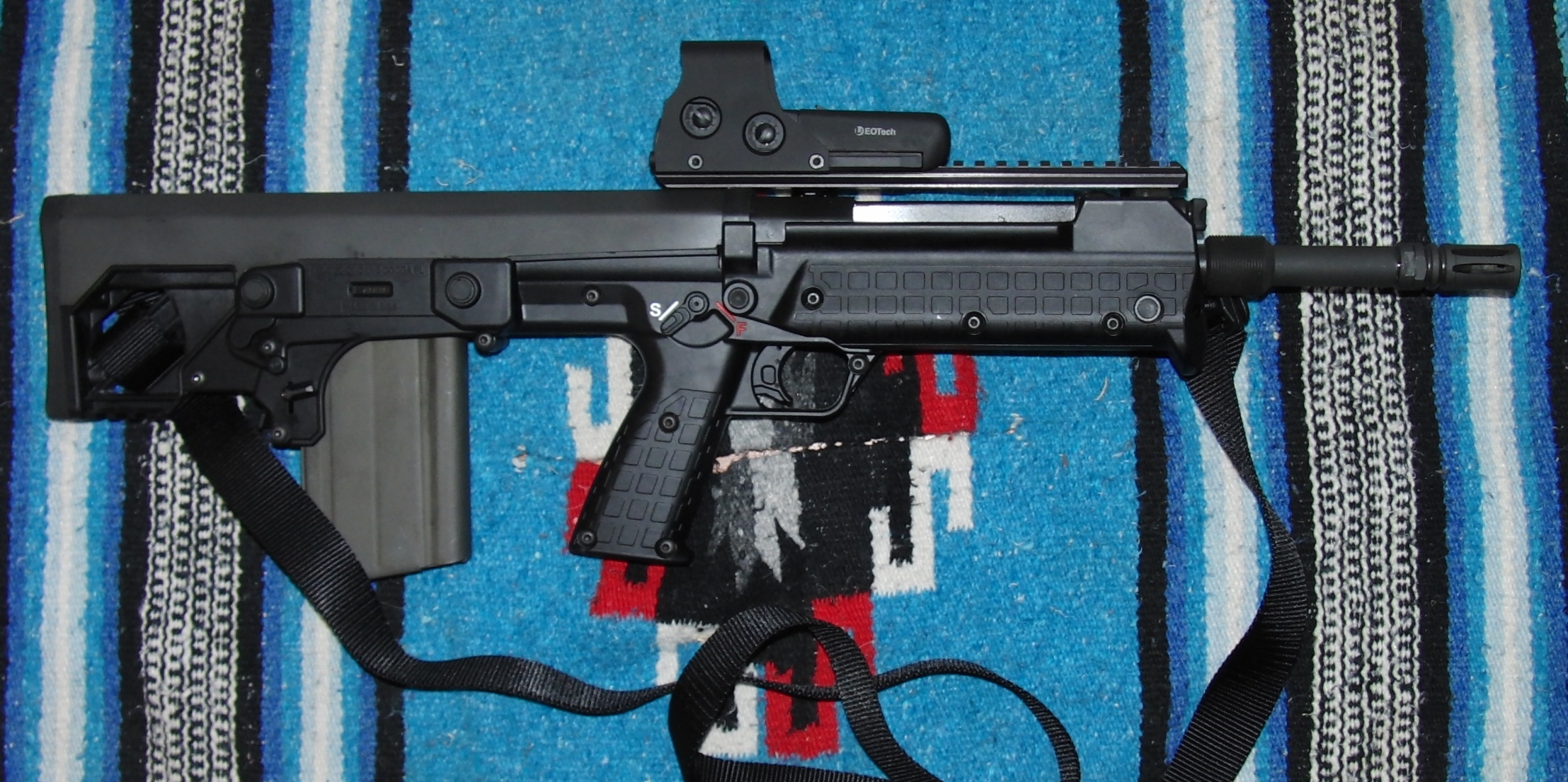
The Kel-Tec RFB arrived at a time when American shooters were deeply invested in conventional layouts. The AR-15 dominated civilian attention, the M1A still carried old-school prestige, and most bullpups available to U.S. buyers were either imported, expensive, or compromised by awkward ergonomics. Into that environment came a Florida-built rifle that looked unconventional even by bullpup standards.
Kel-Tec first showed the RFB at the 2007 SHOT Show, and according to American Rifleman, commercial shipments began in 2009 after a lengthy development cycle. That delay mattered. It suggested the company was not simply racing to market with a strange concept, but wrestling with a genuinely difficult one: making a compact 7.62×51 mm bullpup eject forward with reliable control rather than side-spitting brass near the shooter’s face.
That distinction is the heart of the RFB’s underrated status. The rifle was never just “another bullpup.” It was a serious attempt to rethink how a full-power semi-automatic rifle could be packaged for real-world use. Many firearms get attention for styling, caliber, or accessory support. The RFB deserved more credit because its basic architecture was intellectually ambitious, and in American gun design, ambition this original is rarer than people think.
The Forward-Ejection System Was More Than a Gimmick

Most bullpups force a compromise. You gain a shorter overall package without sacrificing barrel length, but you usually accept awkward ejection, less pleasant support-side shooting, or special left-hand conversions. The RFB attacked that entire problem directly. Kel-Tec’s patented system extracts the fired case, lifts it, and pushes it into a chute above the barrel, where it exits out the front rather than out the side.
Guns & Ammo described that system as maintaining control of the case throughout extraction and ejection, while American Rifleman emphasized that the RFB is fully ambidextrous down to its ejection. That is not trivial engineering language. It means the rifle was designed around bilateral use rather than retrofitted for it. In practical terms, a shooter does not need to choose between compactness and genuine shoulder-to-shoulder usability.
That innovation also addressed one of the oldest bullpup complaints: gas and brass near the face. Traditional side-ejecting bullpups can be unpleasant or even impractical for left-handed shooters. The RFB’s layout let Kel-Tec build a 7.62 NATO rifle that did not punish the user for switching sides around cover, shooting from unusual positions, or simply being left-handed.
The market often rewards familiarity more than originality. That is exactly why the RFB’s most important feature was easy to undersell. It looked exotic, but the underlying idea was deeply practical.
It Delivered Real .308 Power in a Remarkably Compact Package.

The biggest argument for the RFB has always been simple: it gives shooters genuine 7.62 NATO or .308 Winchester capability in a footprint that feels dramatically shorter than most conventional rifles in the same class. Kel-Tec’s current manual lists the 18-inch version at 27.5 inches overall and 8.6 pounds unloaded, while the 24-inch version stretches to 33.5 inches and 9.1 pounds. For a full-power rifle, those are attention-grabbing dimensions.
American Rifleman called the carbine “an astoundingly compact .308 Win. rifle,” and that praise was well earned. The bullpup format keeps the barrel length useful without forcing the rifle into the long, nose-heavy profile many shooters associate with battle rifles. That matters in vehicles, on tight ranges, moving through brush, and anywhere a long muzzle becomes more burden than benefit.
There is also a practical performance benefit here. Shooters did not have to trade down to an intermediate cartridge simply to gain maneuverability. The RFB offered the authority, range potential, and terminal performance people expect from .308 while preserving the quick handling usually associated with shorter carbines.
In a firearms culture obsessed with either tiny carbines or heavy precision rifles, the RFB lived in the neglected middle. It was a compact rifle with real reach, and that combination remains more useful than fashionable.
Kel-Tec Made the RFB More Practical Than Critics Admit
One of the RFB’s smartest choices was magazine compatibility. The rifle feeds from metric FAL-style detachable box magazines, and Kel-Tec’s manual confirms capacities of 5, 10, and 20 rounds. American Rifleman also noted that Kel-Tec intentionally chose the FAL magazine because it was affordable and readily available. That was a practical move, not a glamorous one, and practical decisions often age best.
The rifle also includes a reversible charging handle, ambidextrous safety levers, dual bolt releases, and a paddle-style magazine release. Those features are not cosmetic add-ons. They are the details that determine whether a rifle feels natural under pressure or merely interesting on a gun counter. The RFB’s controls show a company thinking seriously about user interaction, not just mechanical novelty.
Then there is the adjustable gas system. Kel-Tec and American Rifleman both highlight that the rifle can be tuned for different loads and conditions, including suppressor use with the appropriate setup. For experienced shooters, that tunability is a major advantage. It allows the rifle to be dialed for smoother operation rather than overgassed into brute-force reliability.
The downside, of course, is that tunable systems demand some understanding from the owner. The RFB is not a rifle that flatters neglect or ignorance. But that should not be mistaken for poor design. It is better understood as a sophisticated rifle asking the shooter to meet it halfway.
Its Reputation Suffered Because Original Designs Get Judged Harshly

The RFB’s biggest obstacle was never a lack of imagination. It was timing, expectations, and the harsh standard applied to any firearm that departs from convention. Some reviews were enthusiastic, but others were not. Gun Tests reported serious malfunctions with an early sample, while other evaluators praised the rifle’s handling, compactness, and engineering. That split shaped the rifle’s public image in ways the design never fully escaped.
Part of the issue was simple: novel systems are more visible when they stumble. An ordinary rifle with occasional issues is just another rifle needing tuning. A forward-ejecting bullpup that hiccups becomes evidence, in some minds, that the whole concept was flawed. That is an unfair burden, but unusual firearms often carry it.
American Rifleman reported that Kel-Tec’s own explanation for the long gestation involved the difficulty of balancing bolt velocity and extraction in the forward-ejection system. In other words, the company knew it was solving a narrow mechanical puzzle with very little margin for error. That does not excuse every complaint, but it does explain why the platform was always going to be more sensitive to setup than a simpler rifle.
Ironically, that sensitivity is part of why the RFB deserves more respect. It attempted something harder than most rifles even try. History tends to reward the safe answer. The RFB chose the difficult one.
The RFB Represents a Distinctly American Kind of Innovation
There is something deeply American about the RFB, and it goes beyond the fact that Kel-Tec manufactures it in Florida. This rifle reflects a very specific domestic tradition: a willingness to build unusual machines for civilian shooters rather than merely cloning military orthodoxy. George Kellgren’s design philosophy, as described by American Rifleman, has long centered on original mechanical solutions, and the RFB may be one of the purest examples of that approach.
Plenty of countries make excellent service rifles. Far fewer companies make a commercially viable, semi-automatic, forward-ejecting 7.62 NATO bullpup for the U.S. market and actually bring it to production. That kind of product requires engineering confidence and a willingness to accept that mainstream buyers may not immediately understand what they are seeing.
The RFB also shows that American-made does not have to mean conventional. In many consumer categories, domestic manufacturing is rhetorically tied to nostalgia. The RFB points the other direction. It is American-made in the futuristic sense: compact, mechanically inventive, and willing to challenge assumptions that older rifle layouts treat as fixed.
That matters because underrated products are often the ones that reveal a country’s strengths more clearly than its best-sellers do. The RFB is not the most copied American rifle of its era. It may be one of the most revealing.
Why the RFB Still Deserves a Second Look Today
The easiest way to dismiss the Kel-Tec RFB is to compare it to safer, simpler, more established rifles. By that standard, almost any unconventional firearm loses. But the better question is whether the RFB offered a combination that few rifles, then or now, truly match. On that point, the answer is yes: compact dimensions, full-power chambering, real ambidexterity, forward ejection, adjustable gas control, and American manufacture in one package.
Its commercial profile never matched the scale of the AR universe, and it was never going to. The rifle asks more of the buyer, and in return, it offers something far more distinctive than another familiar black rifle with a different handguard. For shooters who value engineering, packaging efficiency, and unusual but practical solutions, the RFB has always been far more significant than its market share suggests.
Underrated does not mean perfect. It means underappreciated relative to what was actually accomplished. The Kel-Tec RFB belongs in that category because it solved several bullpup problems at once, and it did so with a level of originality few American rifles can claim.
That is why the RFB still matters. It was not merely weird. It was brave, useful, and far smarter than the broader market ever gave it credit for.