Some guns get updated into something else entirely. The Ithaca 37 never really did, and that is exactly the point.
It started with a design that never wanted to be cheap

The Ithaca 37 traces its roots to John Browning’s bottom-eject pump shotgun design, first developed for what became the Remington Model 17. After Browning’s original work and later development tied to John Pedersen, Ithaca put its own version into production in 1937, which is why the gun carries the Model 37 name. According to Ithaca Gun’s company history, that date is still the key turning point in the shotgun’s identity.
That origin story matters because the gun was born in an era when repeating shotguns were expected to be machined steel tools, not assembly-line products optimized around disposable labor or stamped parts. The receiver shape, the internal geometry, and the loading and ejection system all came from a design philosophy that assumed precision metalwork from the beginning.
In other words, the Ithaca 37 was not created to be simplified later. It was created to work elegantly first. That sounds romantic, but it has practical consequences. A gun designed around deep machining operations and tight relationships between moving parts tends to resist the kind of cost-cutting that turns complicated mechanical objects into commodity goods.
That is why the Ithaca 37 still feels like a holdover from another manufacturing century. Modern machines can speed up some operations, but they do not change the basic fact that the gun’s DNA was never built around shortcuts. The people making it today in Upper Sandusky, Ohio are still dealing with the same essential architecture that made the shotgun famous in the first place.
The bottom-eject system is a big reason the gun stayed old-school
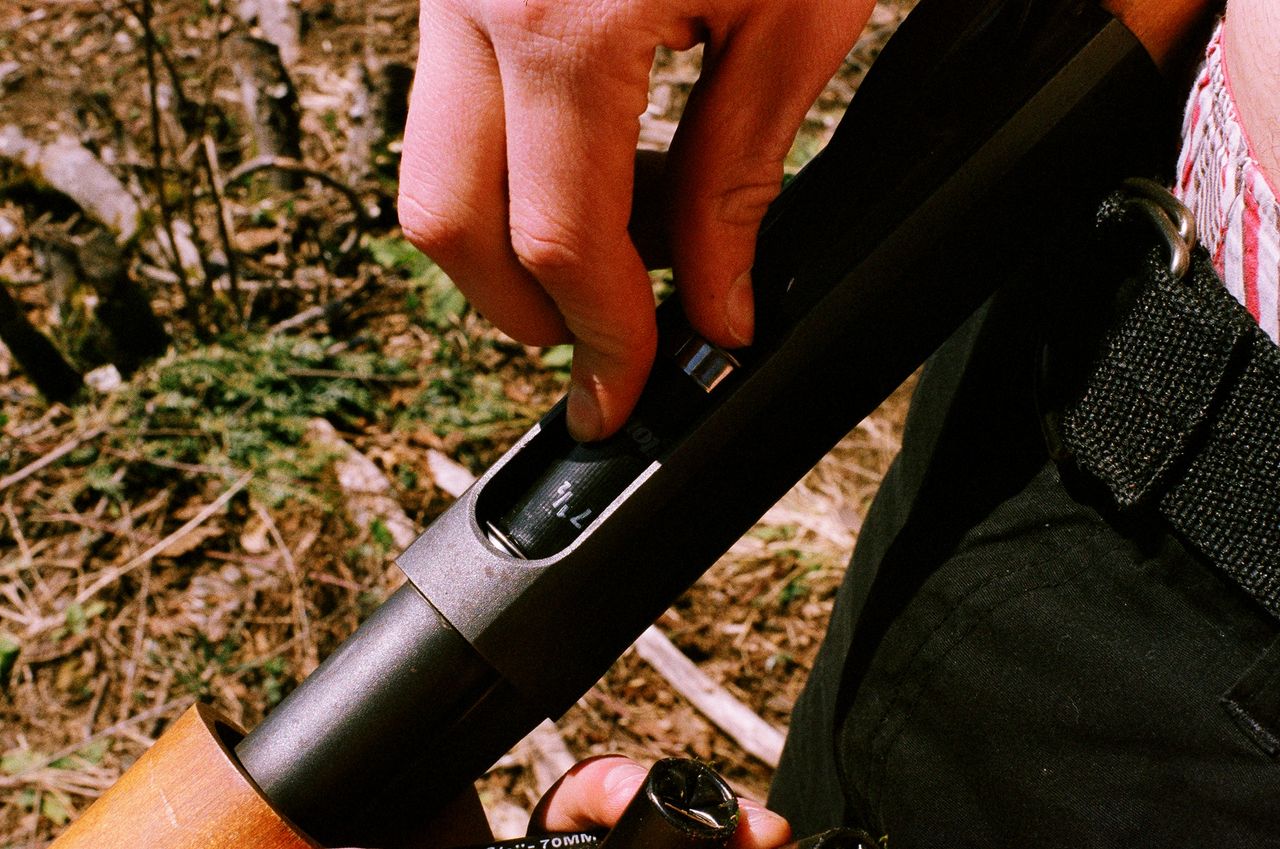
Most pump shotguns are easy to visualize because they load from the bottom and throw empty shells out a side ejection port. The Ithaca 37 does both jobs through the same opening on the bottom of the receiver. American Rifleman and American Hunter have both highlighted that feature as the shotgun’s defining mechanical trait, and it remains one of the clearest reasons the gun stands apart.
That bottom-eject layout brings genuine benefits. It is naturally friendly to right-handed and left-handed shooters, and it also leaves the receiver without a large side opening where brush, grit, and debris can enter. For hunters walking fencerows, duck blinds, or snowy timber, that is more than a neat historical quirk. It is a practical field advantage.
But that same layout also makes the gun harder to reduce into a crude, low-cost package. The shell handling has to be timed correctly. The relationship between extractors, carrier, bolt movement, and the bottom port has to stay precise for the system to work as smoothly as Ithaca owners expect. One reason the gun earned such a loyal following is that, when correctly built, it runs with a slickness people remember for decades.
So while the bottom-eject action looks simple from the outside, it is one of the main reasons the gun still rewards careful assembly. It is not difficult because it is outdated. It is difficult because it is specialized, and specialized mechanisms usually survive best when experienced hands are still part of the build process.
The receiver and barrel relationship still favors fitting over shortcuts
One of the most revealing details about the Ithaca 37 is how much attention has traditionally gone into the way the barrel and receiver mate together. Older Model 37s were well known for individually fitted barrels, and gun parts specialists and long-running enthusiast references still note that many earlier guns do not treat barrel swapping like a casual plug-and-play job. That is one of the classic signs of a shotgun built with fitted tolerances instead of broad, forgiving clearances.
American Hunter described the modern manufacturing process as beginning with a steel billet machined into a receiver, while the barrels are formed through cold-hammer forging. That means the current gun does use updated equipment, but the important point is what happens after the machines do their part. The Ithaca is still not a design where every meaningful surface can simply be left to coarse tolerances and rushed down an assembly line.
Writers at Shooting Illustrated and Guns Magazine have long pointed out that the Model 37 retained a level of hand fitting and finishing because its construction rewards exact relationships between parts. Even among owners, one of the recurring observations is that these guns feel unusually solid and carefully mated compared with many mass-market pumps.
That does not mean every modern Ithaca is made exactly as it was in 1937. It is not. CNC machining has improved consistency dramatically. But consistency is not the same thing as simplification. The Ithaca 37 still asks its makers to finish a precise mechanical relationship that the original design never surrendered to pure interchangeability.
Hand work survives because the gun’s feel depends on it

People often hear “hand-built” and imagine ornate engraving or old-fashioned sentimentality. With the Ithaca 37, the more important issue is feel. This shotgun has long been prized for the way the action cycles, the way the fore-end tracks, and the way the whole gun balances in the hands. Those qualities are not accidents. They come from a design that depends on smooth surfaces, proper timing, and careful finishing.
Ithaca’s own FAQ makes an interesting admission by noting that in the past the company depended on hand filing for hammer and trigger fit. That tells you something important. Even when modern production methods improve repeatability, the company is still dealing with a gun whose reputation was built on attention paid to how parts actually engage, not just whether they technically fit.
That old reputation also explains why buyers still seek out the Model 37 in configurations like the Featherlight, Deerslayer, and Defense guns. They are buying more than a specification sheet. They are buying a certain sensation, the kind of mechanical polish that is easy to recognize and hard to fake. Anyone who has handled a worn-in older 37 beside a budget pump gun knows the difference immediately.
In that sense, hand work remains part of quality control, but it is also part of brand identity. If Ithaca built the 37 with rougher tolerances and a purely industrial finish, it might be cheaper. It would also stop feeling like an Ithaca 37, and that would defeat the whole reason the gun still has a following.
Small-scale production actually helps preserve the old method
Another reason the Ithaca 37 is still built in a traditional way is that Ithaca is not trying to flood big-box shelves with the shotgun at the volume of the largest firearm manufacturers. The company’s modern history, including the move to Upper Sandusky, Ohio and the continuation of factory service there, shows a business that has survived by focusing on a specific kind of product rather than chasing the broadest possible market.
That smaller scale changes the economics. A company producing millions of units has powerful incentives to redesign every part for speed, automation, and low-skill assembly. A smaller maker serving enthusiasts, hunters, and loyal repeat buyers can justify keeping a more labor-intensive process if that process is exactly what distinguishes the product from everything else in the rack.
This is where the Ithaca 37’s longevity becomes a business story as much as a gun story. It has endured bankruptcy cycles, ownership changes, and relocation, yet the core product kept coming back looking unmistakably like itself. Ithaca’s official history makes clear that modern techniques were adopted in Ohio, but the company did not use them to erase the shotgun’s character.
That is a crucial difference. Plenty of old firearms survive only as names attached to heavily altered products. The Ithaca 37 survived because the people reviving it understood that its value was tied to continuity. They modernized enough to keep building it, but not so much that they turned it into just another generic pump.
Its reputation in the field keeps the pressure on makers

Shotguns that last this long usually do so because generations of users keep finding real utility in them. The Ithaca 37 earned that kind of practical reputation in bird fields, deer woods, police racks, and military variants. American Rifleman has documented the World War II trench gun version, while other coverage has noted the shotgun’s long law-enforcement use and broad sporting life.
That track record matters because it creates expectations modern builders cannot ignore. People who buy a Model 37 are often buying into stories told by fathers, grandfathers, old cops, slug hunters, or upland hunters who carried one for years. Those buyers expect a certain reliability, balance, and trimness. If the gun arrives feeling cheap, the brand loses the one thing that kept it alive.
The Model 37 also benefits from being genuinely distinctive in use. Its receiver stays slender. Its ejection pattern does not punish lefties. Its lines remain sleek in a way that many heavier, bulkier pumps are not. The old Featherlight idea still resonates because a lively shotgun carries differently than a clunky one, especially after a long day in the field.
That creates a feedback loop. The shotgun’s old virtues keep attracting people who appreciate old virtues. Those customers, in turn, are precisely the kind who notice machining quality, wood fit, action smoothness, and trigger feel. In a strange but fitting way, the audience for the Ithaca 37 helps preserve the way it is built.
The real answer is simple: changing it too much would ruin the reason it exists

At bottom, the Ithaca 37 is still hand-built nearly the same way because the market for it is not asking for the cheapest possible pump shotgun. It is asking for an Ithaca 37. That sounds obvious, but many historic gun brands forgot that lesson and paid for it by turning signature designs into watered-down imitations of their former selves.
The current Ithaca operation clearly uses modern machining where it makes sense. Receivers are machined with contemporary methods, and the company has spent years blending new manufacturing with old patterns. But the final product still reflects an older philosophy: steel parts, careful fitting, familiar lines, and a mechanism whose personality depends on more than just dimensions on a print.
There is also a cultural reason the gun remains the way it is. In an age of polymer frames, modular rails, and disposable consumer goods, the Model 37 offers something many shooters find increasingly rare: continuity. It feels like an object made by people who believe an old design can still be worth the trouble if it keeps doing its job exceptionally well.
That is why the Ithaca 37 endures. Not because nobody could modernize it, but because a fully modernized version would lose the very traits that made the shotgun survive almost a century in the first place.