Some dives are tests. This one was a wager against physics.
In January 1960, the bathyscaphe Trieste dropped into the deepest known part of the ocean and survived a depth that seemed almost designed to destroy it.
The Dive That Looked Impossible
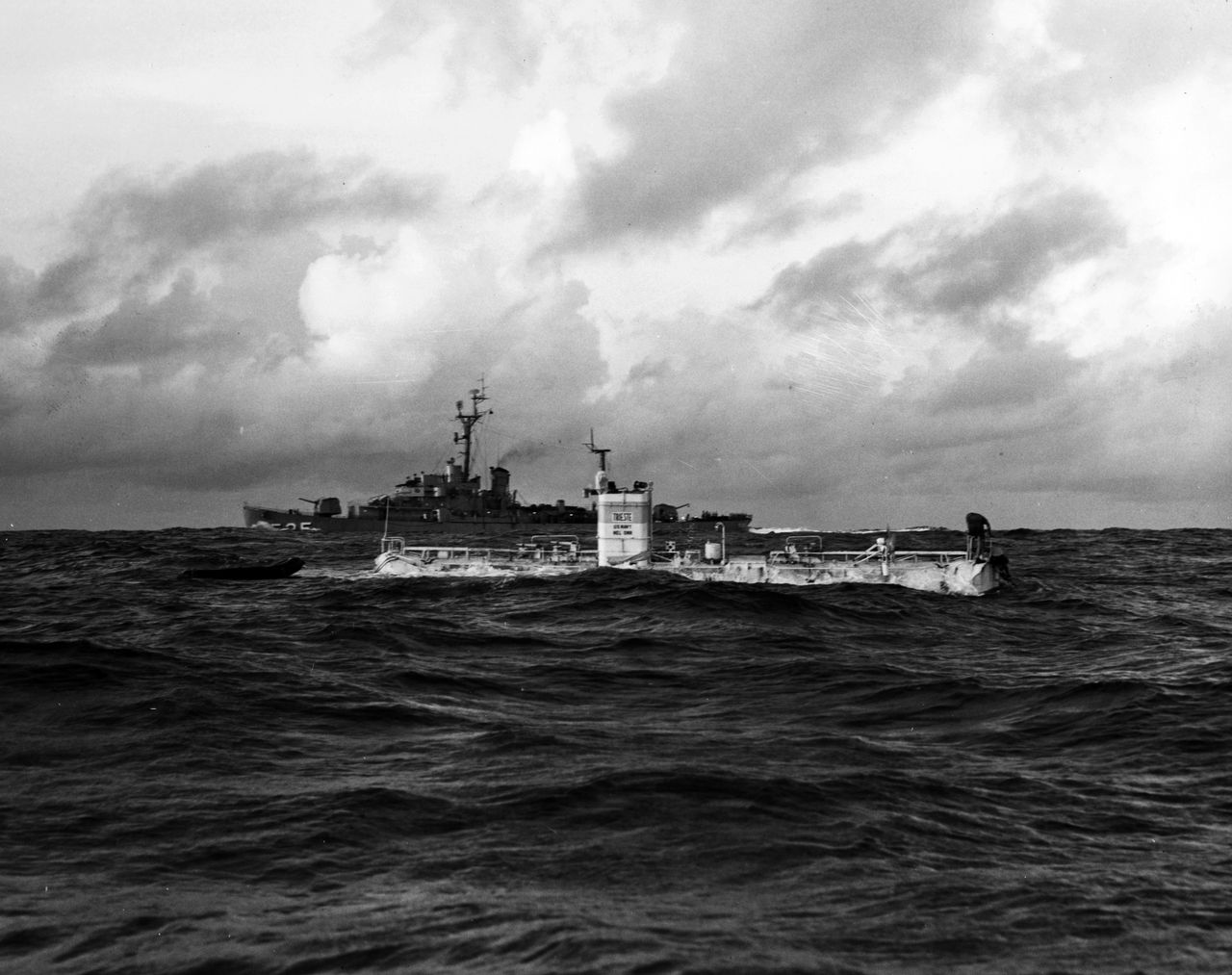
On January 23, 1960, Trieste carried Jacques Piccard and U.S. Navy Lieutenant Don Walsh to the Challenger Deep in the Mariana Trench. According to the Naval History and Heritage Command, the vehicle reached roughly 35,814 feet, putting two men deeper underwater than anyone had ever gone before. At that depth, the pressure was so extreme that any weakness in the craft would have meant catastrophe almost instantly.
What made the feat feel impossible was not just the number on the depth gauge. It was the reality behind it: miles of water overhead, no quick rescue, and almost no margin for error. Trieste was not a sleek attack submarine in the military sense most people imagine. It was a specialized research and deep-submergence vessel built for one purpose: getting humans to a place that could easily crush steel and shatter glass.
The dive also mattered beyond spectacle. The U.S. Navy had strong practical interest in deep submergence, submarine rescue, and understanding what kinds of craft could survive the ocean’s harshest environments. That gave Trieste’s descent a strategic edge as well as a scientific one.
What Trieste Actually Was
Trieste was a bathyscaphe, a very different machine from a conventional submarine. Instead of relying mainly on a pressure hull shaped for horizontal travel, it used a gasoline-filled float for buoyancy and a small, extremely strong spherical crew compartment suspended beneath it. The sphere was the heart of the whole idea, because a sphere distributes external pressure more evenly than many other shapes.
The Naval History and Heritage Command notes that after the craft was acquired for U.S. operations, its original sphere was replaced with a Krupp-built steel sphere rated for about 36,000 feet. That detail matters, because survival at full-ocean depth was never about luck alone. It was about building a pressure chamber with enough structural integrity to tolerate enormous compressive force.
Inside, conditions were cramped, cold, and psychologically intense. Piccard and Walsh had little room to move, limited visibility, and no realistic backup plan if the sphere failed. Trieste survived because its designers reduced the problem to essentials and overbuilt the one component that absolutely could not fail.
The Moment Things Turned Dangerous
Even a well-designed craft can sound terrifying when the deep starts talking back. During the descent, one of Trieste’s outer Plexiglas window panes cracked with a loud bang. Accounts preserved in Navy histories describe the noise as alarming enough to make the crew think seriously about whether they should continue. At those depths, a sharp acoustic shock is not just unsettling. It is a direct question about whether the vehicle is still intact.
This is the point where the story becomes more than a record-setting stunt. A lot of machines survive harsh conditions right up to the moment they do not. Trieste’s crew had to judge whether the damage involved a critical pressure boundary or a nonessential outer layer. That distinction is the difference between controlled risk and immediate death.
They continued downward, and that decision has defined the dive ever since. Surviving what looked like a fatal depth depended not only on engineering strength, but on trained judgment under stress when retreat would have seemed entirely reasonable.
Why The Ocean Should Have Crushed It
At Challenger Deep, the pressure is often described in simple terms because the true numbers are hard to picture. There are thousands of pounds of force pressing on every square inch of exposed surface. In ordinary language, that means the ocean is trying to collapse the craft from every direction at once.
A conventional submarine is not built for that environment. Military submarines operate deep, but not remotely that deep. Trieste’s mission pushed into a realm where material flaws, imperfect seals, and tiny design miscalculations could become fatal. According to Navy and ocean-history accounts, the descent took about five hours, with only a short stay on the bottom before the long ascent.
That timeline reveals something important. The challenge was not just touching bottom; it was enduring sustained exposure and then returning safely. A vehicle can fail on descent, at rest, or during ascent as stresses shift. Trieste survived because every part of the mission profile had been thought through with unusual care.
Engineering, Not Magic, Saved The Crew
Trieste’s survival came from a chain of deliberate engineering decisions. The float was filled with gasoline because it is less dense than water and relatively incompressible compared with air-filled spaces. For descent and ascent control, the craft used iron shot ballast that could be released to become lighter. It was simple, almost brutally so, and that simplicity was one reason it worked.
The crew sphere, with walls about 5 inches thick according to Navy historical material, was the true life-preserver. Thick steel alone was not enough; geometry, metallurgy, and conservative design margins all mattered. The craft did not need speed, elegance, or combat capability. It needed to resist collapse.
That single-minded design philosophy is why Trieste can seem ungainly in photographs yet brilliant in concept. Many engineering failures happen because systems try to do too much at once. Trieste survived because it focused relentlessly on one job and accepted tradeoffs everywhere else.
What The Crew Found At The Bottom
When Trieste reached the seafloor, Piccard and Walsh spent only about 20 minutes there before beginning the climb back. Proceedings accounts and Navy histories describe a silty bottom and a landing that stirred sediment, reducing visibility. Even that brief stay had scientific and symbolic importance. It showed that human observers could directly reach full-ocean depth and return useful observations.
The dive also challenged old assumptions about the deep sea as a lifeless void. Reports from the era discussed signs that life existed even under tremendous pressure, feeding a broader shift in ocean science. For the public, though, the strongest image was simpler: two men sitting in a steel sphere at the bottom of the world.
That image still works because it captures the raw human side of exploration. The crew did not conquer the ocean in any permanent sense. They visited, endured, and came home, which was victory enough.
The Legacy Of A Near-Unthinkable Survival
Trieste’s 1960 dive remained unmatched by another crewed descent to Challenger Deep for decades. That long gap says a lot. This was not a stunt others casually repeated; it was a specialized achievement at the edge of what technology then allowed. According to the Office of Naval Research and Navy historical accounts, the mission helped shape later deep-submergence thinking in both science and naval operations.
Its deeper legacy is the lesson that survival at extreme depth comes from humility before the environment. The ocean does not care about ambition, only design margins and disciplined execution. Trieste succeeded because its builders respected that reality.
So when people ask how one submarine survived what should have been a fatal depth, the answer is not romance alone. It survived because smart people built for the worst case, two calm men trusted the machine, and on January 23, 1960, the machine proved worthy of that trust.