The fight over handgun regulation in New York just got a lot more serious. What looks like a narrow dispute over Glock-style pistols could become a major constitutional showdown with national consequences.
Why This Lawsuit Matters Right Away

A coalition of gun rights organizations has filed suit in the U.S. District Court for the Western District of New York, aiming to block a state law that bans the sale and transfer of Glock and Glock-style handguns. The plaintiffs include the Second Amendment Foundation, the National Rifle Association, the Firearms Policy Coalition, a licensed firearms dealer, and two private citizens, exactly the lineup you would expect in a case designed to test the outer limits of modern gun regulation. The legal theory is straightforward: New York has targeted a broad category of ordinary semiautomatic pistols that are widely owned across the country.
What gives the case real weight is the kind of firearm at issue. Glock-pattern pistols are not obscure specialty guns or exotic hardware with tiny civilian followings. They are among the most common handguns in America, used for self-defense, sport shooting, law enforcement, and routine concealed carry. That matters because modern Second Amendment cases increasingly turn on whether an arm is in common use for lawful purposes.
The plaintiffs are trying to frame this as more than a policy disagreement. In their view, the state has effectively declared an enormously popular class of handguns off-limits in the commercial market, even though the underlying conversion devices that concern lawmakers are already banned under federal law and heavily restricted elsewhere. That tension is likely to sit at the center of the litigation.
What New York’s Law Actually Does
New York’s 2026 law does not name Glock directly, but it has widely been described by lawyers, law enforcement groups, and firearms advocates as a Glock ban because of the design features it targets. According to the New York State Association of Chiefs of Police, the statute regulates so-called “convertible pistols” and focuses on semiautomatic pistols with a cruciform trigger bar that can allegedly be converted into a machine gun by adding a pistol converter. The law ties enforcement to a state police list of covered models.
The statute creates a phased structure that matters a lot for gun owners, dealers, and future plaintiffs. As described by the chiefs association and New York legislative materials, a convertible pistol equipped with a converter is treated as a machine gun under state law effective August 25, 2026. After May 31, 2027, dealers and gunsmiths face felony exposure for selling, transferring, shipping, or otherwise moving covered convertible pistols as merchandise.
That future effective date is important because the law is not just punishing illegal modifications. It reaches the ordinary commercial pipeline for pistols that remain lawful and common in most of the country. The state’s theory is that certain design characteristics make these handguns unusually susceptible to unlawful conversion. Opponents answer that the law punishes the firearm itself rather than the criminal misuse or the black-market conversion device.
The Plaintiffs’ Core Constitutional Argument
Expect the complaint to lean heavily on the Supreme Court’s Bruen framework, even if the case will also turn on lower-court interpretation and factual development. Under that approach, once conduct falls within the plain text of the Second Amendment, the burden shifts to the government to justify its regulation through historical tradition. For the plaintiffs, the biggest advantage is the sheer prevalence of Glock-style pistols in lawful civilian hands.
That “common use” argument is the beating heart of the challenge. Courts have long treated common ownership as highly relevant when deciding whether a firearm can be banned outright. The gun rights groups will almost certainly argue that New York is trying to outlaw a modern subclass of semiautomatic pistols that millions of Americans lawfully possess, purchase, carry, and keep for self-defense. If a judge accepts that framing, the state’s job becomes much harder.
The state, however, is unlikely to concede the point. New York will probably argue that it is not banning handguns in general, but regulating a narrower category of pistols defined by convertibility risk. That distinction may sound technical, but it could become the entire case. If the court views the law as a safety regulation aimed at machine-gun conversion rather than a handgun ban in disguise, the litigation takes a different shape.
Why Glock-Style Pistols Are At The Center Of The Debate
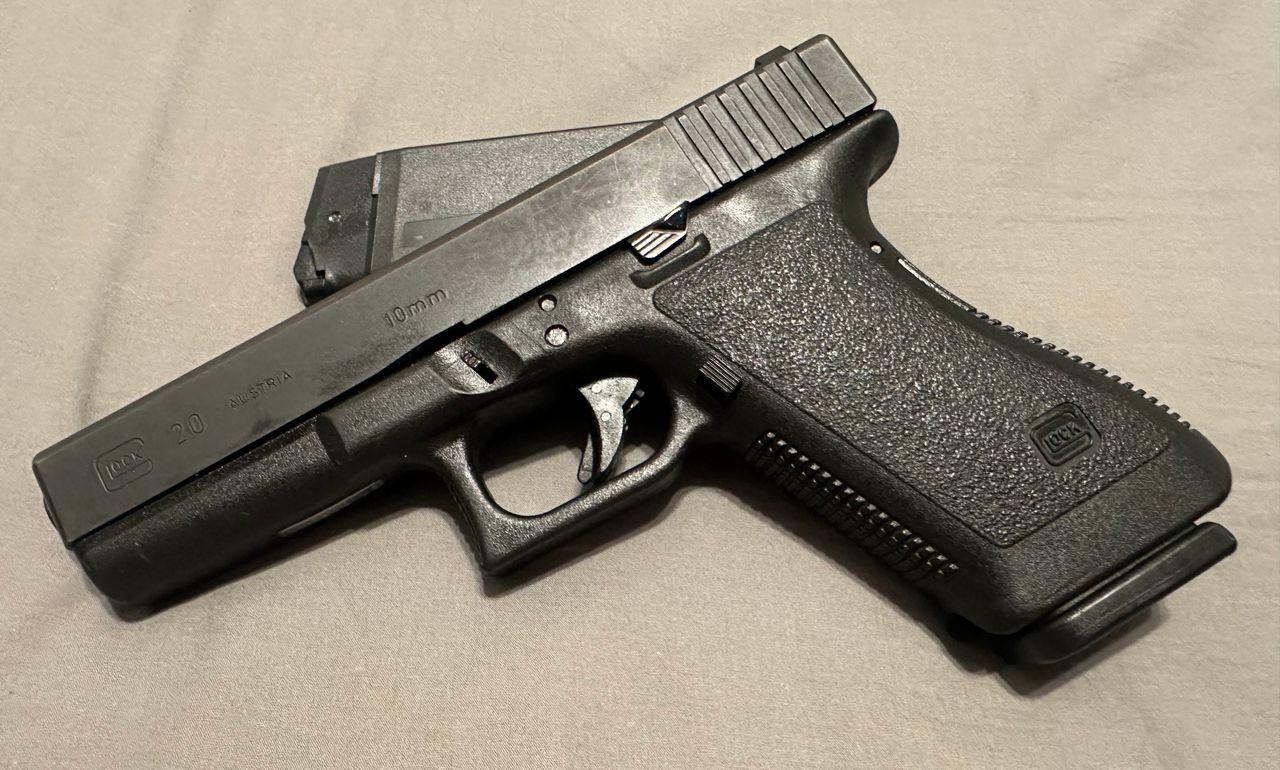
This case is not happening in a vacuum. Similar “Glock ban” fights have surfaced in other states, especially as lawmakers respond to the rise of illegal auto sears and other conversion devices that can turn semiautomatic pistols into fully automatic weapons. The Second Amendment Foundation’s own litigation pages show parallel challenges in California and Maryland, where laws targeted Glock-pattern or similarly defined convertible pistols.
What makes Glock-style pistols such a legal flashpoint is their dominance in the market. Glock’s basic design, especially after earlier patents expired, influenced a huge swath of the striker-fired handgun industry. That means a law written around specific internal features can sweep in not just Glock-branded pistols, but many lookalike or derivative models sold by other manufacturers. Critics say that is evidence of overbreadth, while supporters say it reflects the practical reality of how these guns are engineered.
There is also a political logic here. States have struggled to stop the spread of tiny illegal conversion devices, often called “switches,” that can be installed quickly. Lawmakers increasingly argue that going after the host firearm is necessary because the devices themselves are too easy to traffic and conceal. Gun rights groups counter that such reasoning turns lawful consumers and dealers into scapegoats for crimes committed by people already violating multiple laws.
The Dealer And Private Citizens Could Be Crucial
The organizations may be the headline plaintiffs, but the licensed firearms dealer and the two private citizens could prove just as important. In constitutional litigation, standing is everything. Courts want to see a concrete injury, not just ideological disagreement. A dealer facing the loss of inventory, future sales, and possible criminal liability offers exactly the kind of real-world harm that can help keep a case alive.
The private citizens matter for a different reason. They put a human face on the argument that ordinary, law-abiding adults are being denied access to handguns that are commonly sold nationwide for lawful purposes. If they can show they want to buy or transfer covered pistols and are blocked solely because of the new statute, that sharpens the claim that the law burdens the right to acquire arms, not merely possess them.
That acquisition question has become more important in recent gun cases. A right that exists only in theory, but cannot be exercised through normal commerce, is a thin right indeed. The plaintiffs will likely press that point hard, arguing that banning sale and transfer is not some minor logistical rule. It is the mechanism by which the state can effectively dry up access to an entire category of handguns over time.
What New York Is Likely To Say In Response
New York is not walking into this fight without legal ammunition. The state will almost certainly emphasize public safety and the specific threat posed by illegally converted pistols. Law enforcement groups and prosecutors have repeatedly highlighted the danger of handgun conversion devices, which can transform concealable firearms into machine-gun-like weapons in a matter of seconds. The state will argue that waiting until after conversion occurs is too late.
The defense is also likely to stress that the law is more targeted than opponents claim. Rather than banning all semiautomatic pistols, New York can argue it singled out models with design characteristics lawmakers believe make unlawful conversion unusually easy. The existence of substitute handguns, revolvers, and other semiautomatic pistols outside the statute may be used to show that residents still retain options for self-defense.
Still, that argument has weaknesses. The more common the affected pistols are, the harder it becomes to portray the law as a modest safety measure. And if the state police list grows broad enough to cover a major share of the striker-fired handgun market, the plaintiffs’ narrative gets stronger. In that sense, the details of implementation may matter almost as much as the black-letter statute itself.
What Happens Next And Why The Outcome Could Reach Beyond New York
The first key battle will likely involve a request for preliminary relief. If the plaintiffs ask the court to pause enforcement before the law’s later commercial penalties fully kick in, the judge will have to weigh immediate harm, the merits of the constitutional claim, and the public interest. Because the law’s effective dates stretch into 2026 and 2027, timing will shape the litigation strategy on both sides.
No matter what happens in the district court, this case has the feel of appellate litigation from day one. The Western District of New York is only the opening stage. A ruling for either side could head to the U.S. Court of Appeals for the Second Circuit, and from there, potentially into a broader national conversation already fueled by similar cases in California and Maryland.
The deeper question is whether states can ban a commercially significant class of ordinary handguns by tying them to potential criminal conversion. If courts bless that approach, lawmakers elsewhere may copy it. If courts reject it, the decision could become one of the most important gun-rights rulings since Bruen for defining how far governments can go when a weapon is common, legal, and susceptible to unlawful misuse.