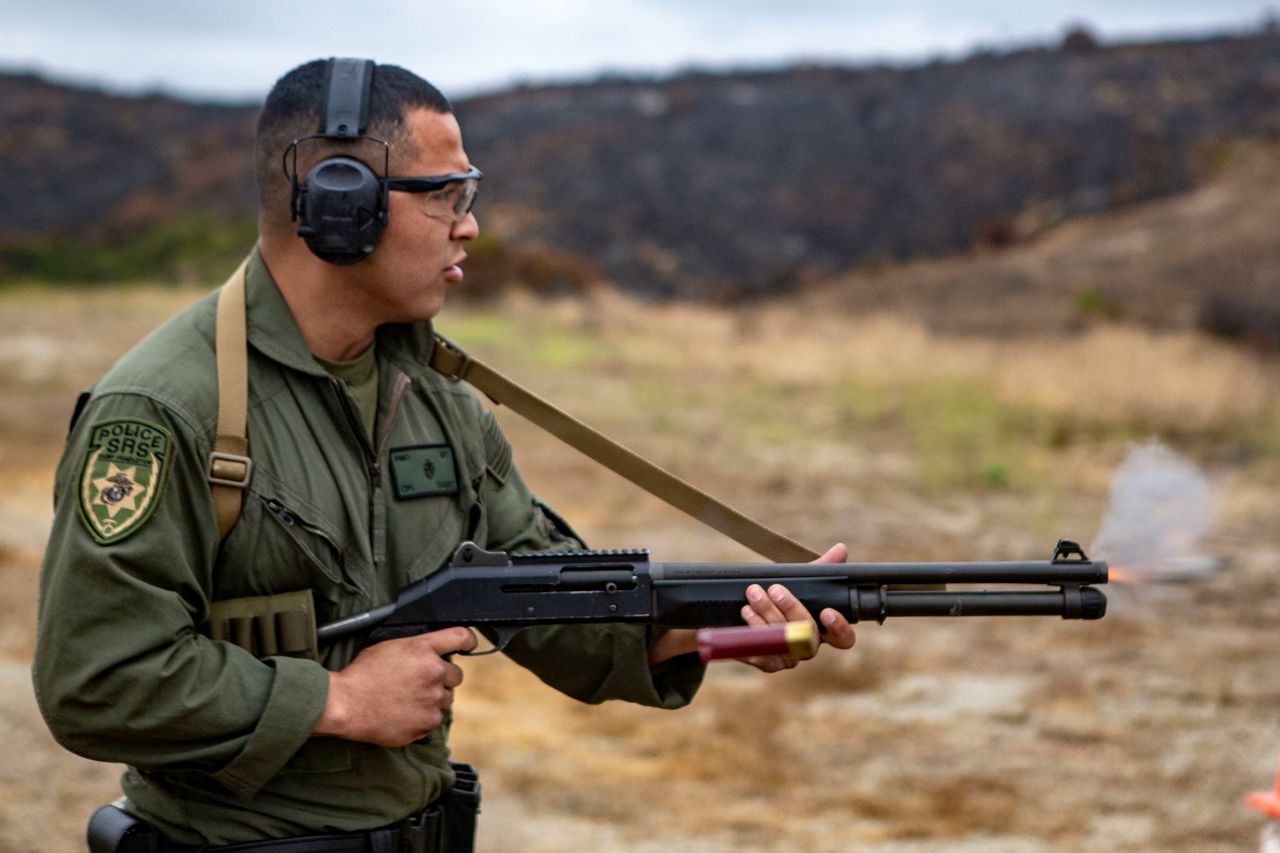
When people argue about combat shotguns, these two names come up fast. And for good reason, because both have earned serious trust where failure is not an option.
Two legends built for the same mission

The Benelli M4 and Mossberg 590 occupy the same broad category, but they come from very different design philosophies. The M4 is a semi-automatic, gas-operated shotgun developed to meet U.S. military requirements, and it carries that pedigree with pride. The 590 is a pump-action descendant of one of America’s best-known fighting shotgun families, built around simplicity, durability, and straightforward manual control.
The Benelli M4 became especially famous after the U.S. Marine Corps adopted a version of it as the M1014. That gave it a reputation not just as a premium tactical shotgun, but as a combat-proven system trusted in harsh environments. Benelli’s Auto-Regulating Gas-Operated system was designed to run reliably while reducing felt recoil and maintaining speed in follow-up shots.
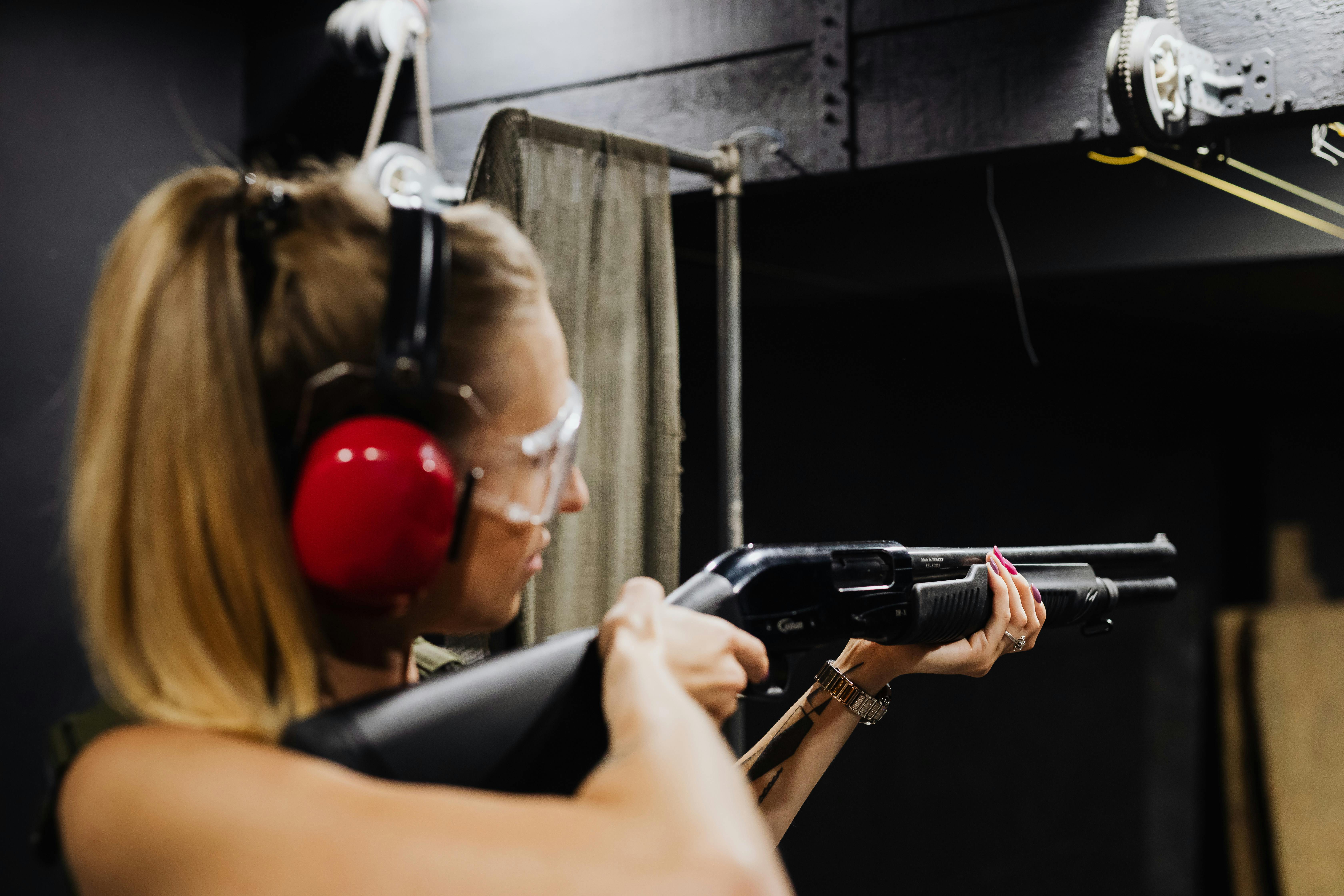
The Mossberg 590 built its own reputation through police, military, and civilian defensive use over decades. Variants of the 590 and 590A1 have passed demanding military test protocols, and the platform has become almost synonymous with pump-gun ruggedness. If the M4 feels like a specialized modern fighting tool, the 590 feels like a blunt instrument that keeps working no matter who is running it.
That is what makes this comparison interesting. This is not a contest between good and bad. It is a choice between refined performance and mechanical simplicity, and that distinction matters a lot when your life may depend on the gun in your hands.
Reliability under stress is the real test

If I had to rank the most important trait in a combat shotgun, reliability would sit at the top without debate. The Mossberg 590 has an immediate advantage in one respect: a pump-action is less sensitive to ammunition power levels. As long as the shell fires and the shooter runs the action properly, the gun is likely to keep going through birdshot, buckshot, slugs, reduced recoil loads, and many specialty rounds.
That said, pump guns are not immune to failure. Under adrenaline, short-stroking is real, and it is one of the classic user-induced stoppages in defensive shotgun work. A skilled shooter can avoid it with training, but under chaos and fatigue, human error becomes part of the reliability equation. The 590 is mechanically forgiving, but it asks more from the person behind it.
The Benelli M4 flips that equation. It demands less manual input between shots, and with full-power defensive loads it has a strong reputation for running cleanly and consistently. In law enforcement and military circles, the M4 is often praised for functioning in dirt, sand, rain, and high round-count use better than many older semi-auto designs.
Still, the M4 is a semi-automatic shotgun, and all semi-autos are at least somewhat ammunition-sensitive compared with a pump. If your survival plan includes oddball low-recoil shells or specialty munitions, the 590 may be the safer bet. If your load choice is standardized and tested in advance, the M4 delivers excellent reliability with a major speed advantage.
Speed, recoil, and how they affect survival

In a real defensive encounter, speed is not just about shooting fast. It is about making effective hits quickly while maintaining control. Here the Benelli M4 has a clear edge. Its gas system spreads recoil impulse in a way that makes buckshot and slug loads feel noticeably more manageable than they do in many pump guns, and that reduction helps shooters recover sights faster.
That matters because shotguns are powerful, but they are not magic. Defensive distances can still require deliberate shot placement, especially with slugs or tighter-patterning buckshot. The M4’s self-loading action lets the shooter stay focused on the target and the trigger press instead of adding a manual pump cycle after every shot. In practical terms, that usually means faster split times and fewer disruptions to sight picture.
The Mossberg 590 hits hard and works hard, but it transfers more of that workload back to the shooter. Pumping the action under recoil takes practice if you want to stay quick and smooth, and many casual owners never build that level of skill. In training classes, it is common to see newer shooters lose tempo, lose cheek weld, or induce handling errors once the pace increases.
None of that makes the 590 ineffective. In experienced hands it is absolutely formidable, and some shooters prefer the rhythm and control of a pump. But if I were betting on who can deliver multiple accurate rounds faster under pressure, the M4 gives the average shooter a meaningful advantage.
Capacity, handling, and real-world usability
Combat shotguns are often judged by raw power, but handling is what determines whether that power is usable in confined spaces. The Benelli M4 is not a featherweight, but it balances well for a semi-auto with a robust operating system. Its controls are generally positive, and once set up properly with a suitable stock and optic arrangement, it can feel surprisingly modern for such a heavy-duty platform.
The Mossberg 590 has its own ergonomic strengths. The tang-mounted safety on many models is intuitive, especially for right-handed shooters using a conventional stock, and the pump layout is familiar to generations of American gun owners. Depending on the exact variant, the 590 can also offer generous magazine capacity, often in a package that feels long but straightforward.
Where the 590 can become awkward is during prolonged manipulations. Loading, cycling, and keeping the gun topped off all demand more hand movement than the M4, and that becomes more obvious when moving through cover or working from less-than-ideal shooting positions. The Benelli reduces some of that workload by simply firing the next round with another press of the trigger.
On the other hand, the 590 is easier to understand at a glance and easier to keep running with minimal familiarization. If you hand both guns to a moderately trained user, the M4 may perform better once learned, but the 590 often feels less intimidating mechanically. That simplicity has survival value of its own.
Maintenance, durability, and cost of ownership
There is no getting around the price difference, because it shapes the whole buying decision. A Benelli M4 typically costs dramatically more than a Mossberg 590, and once you add accessories, ammunition for testing, and support gear, the gap can become enormous. For many buyers, that alone settles the matter long before performance enters the conversation.
But price is not the same thing as value. The M4 gives you a premium semi-automatic operating system, excellent build quality, and a long record of service use. It is engineered to absorb serious abuse, and many owners report strong long-term durability with proper cleaning and quality ammunition. In practical terms, it is a high-end fighting gun that usually behaves like one.
The Mossberg 590 is valuable in a different way. It is far less expensive to acquire, easier to repair or replace parts for, and generally less emotionally painful to beat up through hard use. That matters for people who actually train. A gun you can afford to shoot heavily, maintain simply, and trust without babying may end up being the more realistic defensive tool.
Maintenance also favors the 590 in sheer simplicity. The M4 is not difficult to maintain, but it is still a gas-operated semi-auto with more complexity. The 590 is almost brutally uncomplicated, and that straightforward durability is one reason pump guns remain relevant despite the rise of better semi-autos.
Training matters more than internet mythology
A lot of shotgun debates get lost in mythology. People repeat lines like pump guns are always more reliable or semi-autos are too finicky for real combat, but modern evidence paints a more nuanced picture. High-quality semi-autos like the Benelli M4 have proven that they can be exceptionally dependable when fed proper loads and maintained correctly.
At the same time, people often romanticize the pump gun as foolproof. It is not foolproof. It is mechanically robust, yes, but it requires consistent user input under pressure. In force-on-force style training and high-tempo range work, operator mistakes with pump actions show up often enough to be taken seriously. Reliability is always a partnership between machine and shooter.
Expert instructors frequently make the same broader point: the best defensive shotgun is the one you have tested extensively with your chosen ammunition and practiced with until manipulations are second nature. That includes recoil control, reloads, malfunction clearance, and patterning at realistic distances. A premium shotgun with no training behind it is less reassuring than a simpler gun that has been mastered.
So if someone asks which model is best in theory, I can answer that. But theory is only part of the equation. In real life, confidence comes from repetition, verification, and knowing exactly how your shotgun behaves when the timer starts and your heart rate spikes.
Which one would I trust when it really counts
If I had unlimited budget, good ammunition, and enough time to validate the gun thoroughly, I would choose the Benelli M4. It offers faster follow-up shots, softer recoil, less shooter-induced disruption between rounds, and a service record that has earned genuine respect. In a life-or-death fight, those advantages are not cosmetic. They translate into better practical performance for most shooters.
The Mossberg 590 remains a deeply credible answer, especially for someone who values simplicity, lower cost, and broad ammunition compatibility. If I expected to run mixed loads, operate in austere conditions with minimal support, or equip multiple people affordably, the 590 would be extremely hard to dismiss. It is not glamorous, but combat tools do not need glamour to save lives.
If you forced me to bet my life on one shotgun with no other context, I would still lean Benelli M4. It simply gives more performance to the shooter while asking less in return during the firing cycle. That edge matters when stress degrades fine motor skills and time feels brutally short.
But if you told me the shooter trains constantly with a Mossberg 590 and knows it inside out, I would sleep just fine behind that choice too. The honest answer is that both are serious fighting shotguns. The final decision comes down to whether you value maximum capability or maximum simplicity, and how much discipline you bring to the weapon you trust.