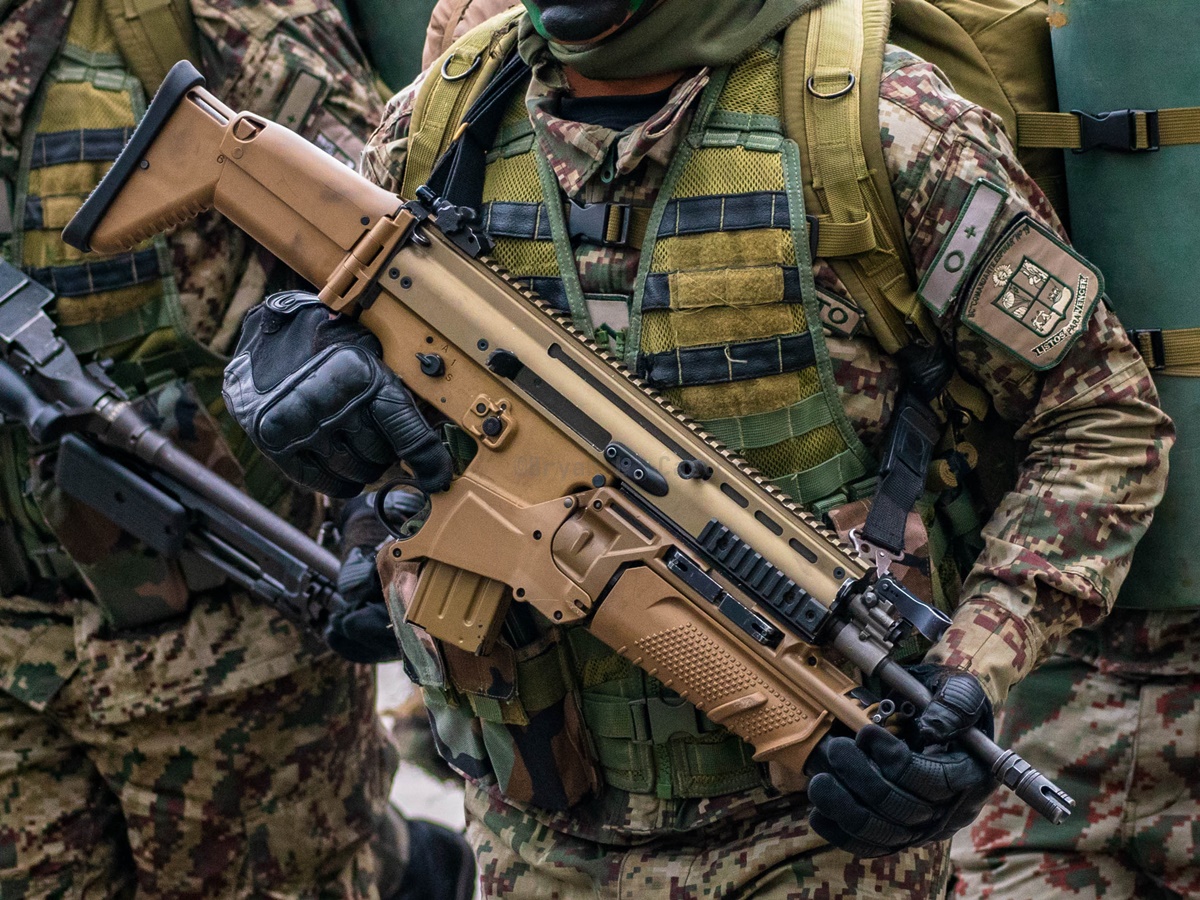
Few firearm comparisons spark stronger opinions than this one. The AK-47 and the SCAR are not just rifles; they are philosophies.
Two rifles built for different eras
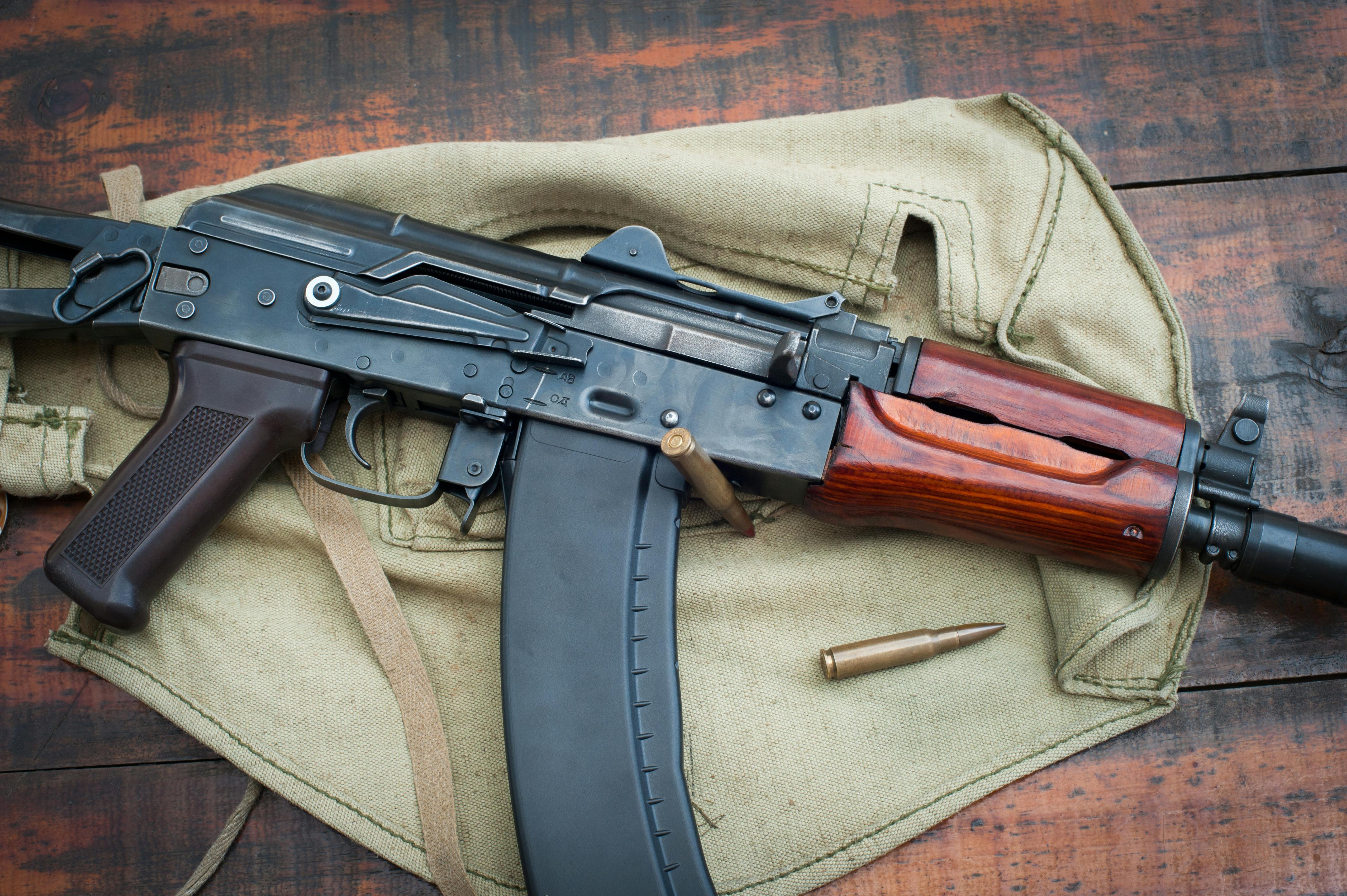
The AK-47 was born from the Soviet Union’s postwar need for a simple, durable infantry rifle that could be produced in huge numbers. Mikhail Kalashnikov’s design favored loose tolerances, uncomplicated controls, and a long-stroke gas piston system that kept the gun running in mud, dust, and neglect. Over time, the AK platform spread across continents and conflicts, becoming one of the most recognizable rifles ever made.
The SCAR, developed by FN Herstal for U.S. Special Operations Command in the 2000s, stemmed from a very different set of requirements. Operators wanted a modular, lighter, optics-friendly platform with modern ergonomics and mission adaptability. That meant rails, adjustable stocks, ambidextrous controls, and a design built around accessories from the start rather than as an afterthought.
This is why direct one-to-one arguments often miss the point. The AK was created to arm masses under brutal field conditions at low cost, while the SCAR was designed for elite users who expected precision, flexibility, and integration with modern optics and suppressors. Comparing them makes sense, but only if you admit they are solving different problems.
Even within each family, there is enormous variation. A stamped-receiver AKM in 7.62×39 is not the same thing as a modernized AK-103 or a premium U.S.-built clone. Likewise, the SCAR-L and SCAR-H have different recoil characteristics, weight profiles, and roles. Broad claims are easy, but the details matter.
Reliability is where the AK earned its legend.

If the debate starts with reliability, the AK has a stronger cultural reputation, and not without reason. The platform became famous for functioning after abuse that would sideline more tightly fitted rifles. Battlefield reports from Afghanistan, Africa, and the Middle East repeatedly reinforced the image of the AK as a rifle that keeps cycling with poor maintenance and inconsistent ammunition.
Mechanically, that toughness comes from generous clearances, a robust bolt carrier, and a system that does not mind fouling as much as more refined rifles. The downside is that this very tolerance can work against ultimate accuracy. Still, for a conscript army, militia force, or rural owner who values dependability over refinement, that tradeoff has always looked smart.
The SCAR is also a highly reliable rifle, and it should be said clearly that modern SCARs are not fragile. In military testing and field use, the rifle proved dependable under hard use, especially in harsh environments where piston-driven systems shine. Its reputation is different not because it fails easily, but because it was never mythologized as the rifle that can be buried, kicked, and forgotten for months.
What separates the two is the kind of reliability people mean. With the AK, they usually mean survival-level function under neglect. With the SCAR, they mean dependable performance under sustained professional use with optics, suppressors, and tuned ammunition. Both are reliable, but the AK’s version of reliability is more primitive, more forgiving, and more famous.
Accuracy and refinement tilt toward the SCAR

This is where the SCAR starts to justify its price, at least on paper and often in the range. The platform was built with modern optics use in mind, featuring a full top rail, more consistent stock geometry, and better out-of-the-box triggers than the average military-pattern AK. Many shooters find it easier to mount a quality optic on a SCAR and get immediate practical precision at distance.
The SCAR-H in 7.62×51 especially gained respect as a battle rifle capable of strong accuracy while staying relatively portable. In trained hands, 1.5 to 2 MOA performance is common with good ammunition, and some setups do even better. That matters for designated marksman roles, longer-range engagements, and hunting applications where shot placement matters more than brute ruggedness.
The AK can be accurate enough, but the average example rarely competes here without upgrades. Traditional side-mount optics systems, shorter sight radius on some variants, heavier triggers, and ammunition variability all hold it back. A good AK with quality ammo can still perform impressively inside practical combat distances, but precision is not the platform’s native language.
That said, context matters. Most real-world rifle use by ordinary owners happens inside 300 yards, often much closer. At those distances, the AK’s limitations shrink, and the conversation shifts from benchrest numbers to speed, familiarity, and confidence. The SCAR still feels more refined, but not everyone needs refinement badly enough to pay for it.
Cost is the heart of the argument.
If the AK wins one category with ease, it is valuable. Historically, AK-pattern rifles and magazines have been far cheaper than SCAR rifles, and that price gap changes the entire ownership experience. A shooter can often buy an AK, a stack of magazines, a sling, ammunition, and spare parts for less than the price of a bare SCAR before optics are added.
That budget advantage has always been central to the AK’s appeal. It is the working person’s rifle, the truck gun archetype, the practical choice for someone who wants durability without entering premium-price territory. Even with import restrictions, market fluctuations, and rising quality premiums for certain builds, the AK still usually lands closer to attainable than the SCAR.
The SCAR, by contrast, lives in a price bracket where scrutiny becomes brutal. Buyers expect not just reliability and decent accuracy, but excellence in fit, recoil behavior, modularity, and long-term support. Critics argue that plenty of AR-10 and AR-15 style rifles can now offer comparable or better performance for less money, which makes the SCAR look expensive rather than elite.
That is the real pressure point. The SCAR is not merely judged against the AK; it is judged against every premium modern rifle in its category. The AK mostly has to prove it still works and still offers solid value. The SCAR has to prove it deserves luxury pricing. Sometimes it does. Sometimes it looks like a status symbol with military branding.
Ergonomics, recoil, and day-to-day handling

Pick up both rifles, and the difference is immediate. Most SCAR variants feel modern in the way controls are placed, stocks adjust, and optics mount naturally. For many shooters raised on contemporary carbine layouts, the SCAR feels intuitive from the first magazine, with charging handle placement and accessory compatibility that support current training methods.
The AK can feel charmingly rugged or awkward, depending on your background. Its safety lever is large and sturdy but not especially elegant. Magazine insertion often requires the classic rock-and-lock motion, and on traditional models, optic mounting solutions can be less straightforward than on a rifle built around a continuous rail.
Recoil is another area where broad statements get messy. A 7.62×39 AK has a distinct impulse, often described as a push with some muzzle movement, while the SCAR’s recoil depends heavily on whether you mean the 5.56 SCAR-L or the 7.62 SCAR-H. The SCAR-H, in particular, has a reputation for sharp movement despite its effectiveness, and some users report that it feels more violent than expected for such a premium rifle.
Handling is therefore not a clean win for either side. The SCAR generally offers better ergonomics and modern adaptability, but the AK’s controls become very fast in practiced hands. People often confuse familiarity with superiority. In reality, the better-handling rifle is often the one your training has made second nature.
Military and civilian use tell different stories.s
The AK’s combat history is vast enough to be almost impossible to summarize cleanly. It has appeared in national armies, insurgencies, revolutions, and private collections for decades. Its endurance in the developing world says a lot about logistics and affordability, since a rifle that can survive poor maintenance and mixed-quality ammunition has obvious appeal where support systems are weak.
The SCAR’s military story is narrower but still meaningful. It was designed for special operations users, not mass conscript armies, and that shapes how it should be judged. In some circles, the SCAR-H in particular earned a serious following for delivering portability and power in a package suited to specialized roles, even if adoption was never universal across all units.
For civilian shooters, the divide becomes even more interesting. The AK often attracts buyers who want rugged simplicity, historical significance, and lower entry cost. The SCAR attracts enthusiasts who value premium engineering, modularity, and the prestige of owning a rifle associated with elite military use.
Those motivations are not trivial. Firearm purchases are rarely about performance alone. They are also about identity, aesthetics, maintenance habits, intended use, and whether the owner wants a hard-use tool or a high-end machine. In that sense, the AK and SCAR speak to different personalities as much as different tactical needs.
So which one makes more sense?
If your priority is affordable reliability, simple maintenance, and proven durability, the AK remains one of the strongest arguments in the rifle world. It is not the most elegant platform, and it will not usually deliver the cleanest trigger or easiest optics experience. But as a practical tool that asks little and gives a lot, it still earns its legendary status.
If your priority is modularity, better out-of-the-box ergonomics, stronger optics integration, and more refined practical accuracy, the SCAR has a real case. It offers a polished shooting experience and serious capability, particularly in configurations built for longer-range or specialized work. The problem is not that it is bad. The problem is that it is expensive enough to invite every possible criticism.
So is the AK the budget workhorse and the SCAR the overpriced precision machine? The AK absolutely is a workhorse, and proudly so. The SCAR can be a precision-oriented modern rifle, but overpriced, depending on what you demand from it and what alternatives you are willing to consider.
For most general owners, the AK makes more financial sense and covers real-world needs with fewer demands. For shooters who truly value the SCAR’s specific strengths and will actually use them, the price can be defensible. The smartest answer is less romantic than the internet wants: buy the rifle that matches your mission, not the one that wins arguments.