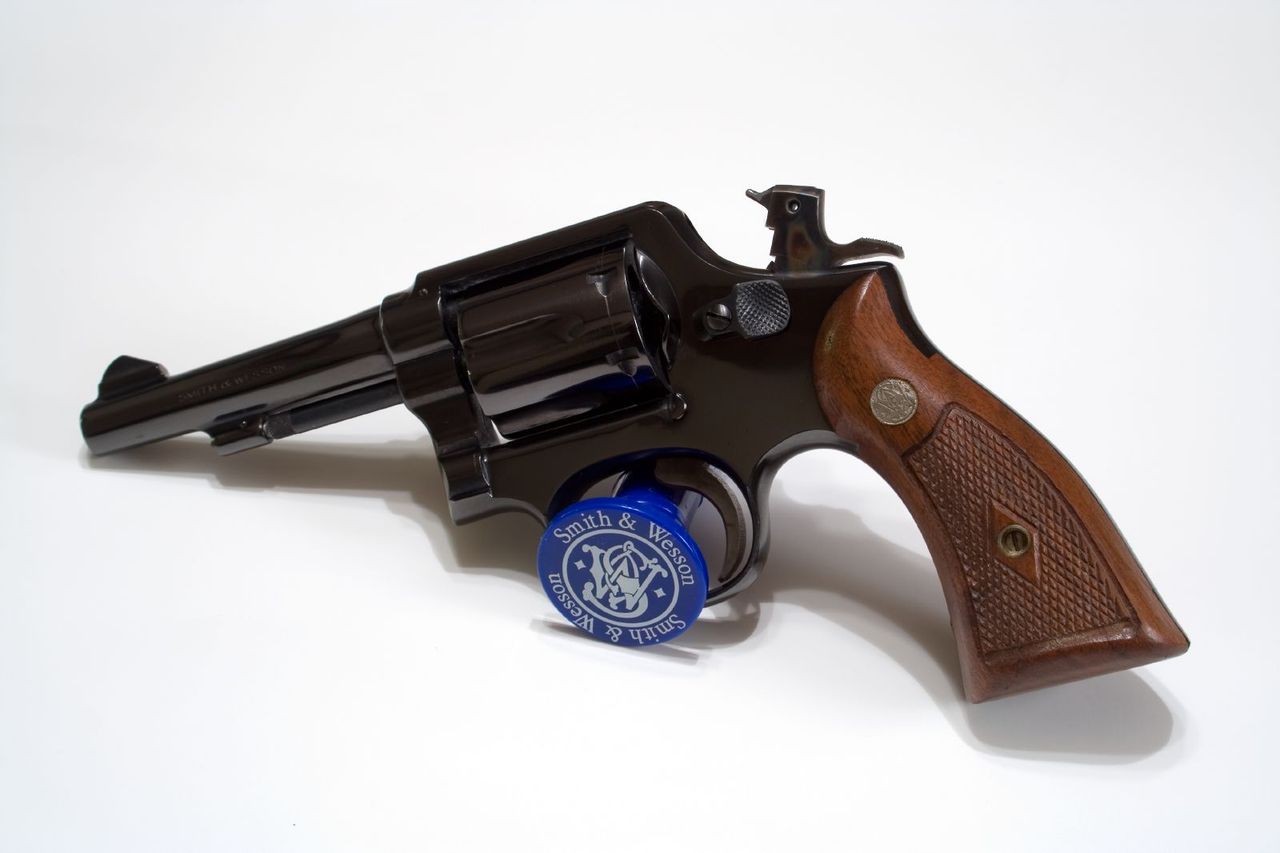
Some firearms become famous. The Smith & Wesson Model 10 became something bigger: a tool so dependable and so widely accepted that it turned into a global standard.
It arrived at exactly the right moment
When Smith & Wesson introduced the gun in 1899 as the .38 Military & Police, the timing was almost perfect. American law enforcement was modernizing, cities were growing, and agencies wanted a sidearm that was more capable than the weaker service revolvers then in circulation. According to Smith & Wesson’s own company history, this revolver would go on to become its most successful wheelgun, with production eventually topping six million.
The new revolver also debuted alongside the .38 Special cartridge, a pairing that mattered enormously. The cartridge offered a stronger and more confidence-inspiring option than the .38 Long Colt, which had earned criticism after poor battlefield performance in the Philippines. Period gun historians and publications such as American Rifleman have long treated that combination of new frame, new cartridge, and new controls as a turning point in service-handgun history.
Just as important, the gun was built on Smith & Wesson’s K-frame, a medium-size layout that hit a sweet spot. It was large enough to be controllable and durable, yet compact enough for daily carry. That balance made the revolver appealing to the two groups named in its original title: military users and police officers.
The design was simple, durable, and easy to live with

The Model 10’s success starts with a plain truth: it worked. This was a six-shot double-action revolver with a swing-out cylinder, straightforward manual of arms, and a reputation for mechanical steadiness. For officers and armorers, that meant less drama, less downtime, and fewer training headaches.
It was also easy to maintain in the real world. A service sidearm does not need to impress collectors first; it needs to survive weather, lint, neglect, rough holsters, and inconsistent ammunition over years of carry. The Model 10 earned that reputation early, and once a firearm gets known as the gun that rarely causes trouble, procurement decisions start reinforcing themselves.
Smith & Wesson kept refining it without changing its basic identity. Different barrel profiles, sight configurations, stocks, finishes, and engineering changes allowed departments to choose what fit their needs while preserving the same core system. That continuity mattered because agencies could update inventories without retraining everybody from scratch.
There is a lesson in that. Revolutionary products often get headlines, but evolutionary products often win markets. The Model 10 stayed familiar while steadily improving, which is one reason it lasted so long.
Police adoption turned it into an institution

The revolver’s very name, Military & Police, was not empty marketing. Through much of the 20th century, the Model 10 became the standard American police sidearm, and that institutional adoption created a production machine. Smith & Wesson, the Library of Congress research guide, and museum collections all point to the gun’s extraordinary use by law-enforcement agencies across the United States and abroad.
Police work rewarded exactly the virtues the Model 10 offered. Officers needed a sidearm that could ride daily in a duty holster, fire reliably under stress, and remain manageable for shooters with widely varying skill levels. The medium K-frame and the mild but effective .38 Special made the gun easier to qualify with than many harder-kicking alternatives.
The FBI used the Model 10 as well, and American Rifleman has noted that agents were issued 4-inch examples in one period of bureau history. That kind of official use mattered far beyond the agencies directly involved. When local departments looked for what to buy, they often chose what already had a reputation for serious professional service.
Police culture amplified this further. Once holsters, training courses, qualification routines, spare parts, and armorer knowledge all centered on one model, switching became costly. The Model 10 became not just a gun, but part of the system around the gun.
War orders and global service multiplied production
Civilian and police sales alone do not explain numbers this large. Wars accelerated the Model 10’s spread dramatically. During both world wars, Smith & Wesson produced large quantities of related Military & Police revolvers for government contracts, and wartime demand pushed the design into even broader circulation, according to NRA Museums and multiple historical overviews.
The best-known wartime version is the Victory Model from World War II. These revolvers, marked with a V-prefix serial range, were supplied in major numbers for military and security use. Even when exact contract variants differed from peacetime commercial guns, they still belonged to the same broad family that made the Model 10 line so prolific.
War does something manufacturers never forget: it tests a design under extreme pressure. If a handgun survives mass issue, rough transport, inconsistent maintenance, and hard field use, its reputation strengthens afterward. The Model 10 family benefited from that cycle. Postwar buyers were not looking at a theoretical service revolver. They were buying a design already proven at scale.
International service widened the story further. Variants were used far beyond the United States, and that overseas footprint reinforced the revolver’s image as a dependable, universal sidearm rather than a purely domestic success.
It was affordable enough to buy in huge numbers

A firearm can be admired and still fail commercially if it is too expensive for mass issue. The Model 10 avoided that trap. It was practical to manufacture, practical to maintain, and practical for departments to buy by the crate. That made an enormous difference in an era when many police officers and smaller agencies had to watch costs closely.
This was especially important in the first half of the 20th century, when municipal budgets were tight and standardization mattered. Departments did not need a luxury sidearm. They needed a revolver that delivered dependable service without punishing procurement budgets. The Model 10 fit that role better than many more specialized or premium alternatives.
Its popularity also fed a healthy aftermarket of grips, holsters, loaders, parts, and repair knowledge. That lowered lifetime ownership costs. A department armorer who already knew the gun, already stocked springs and screws, and already had compatible leather gear had every incentive to keep ordering the same basic revolver.
Cost efficiency rarely sounds glamorous, but it wins contracts. The Model 10 became the revolver equivalent of a trusted fleet vehicle: not flashy, not exotic, just extremely good at doing a necessary job for a very long time.
The revolver kept adapting without losing its identity
One of the smartest things Smith & Wesson ever did with the Model 10 was to let it evolve in small, useful steps. Over the decades, the line appeared with different barrel lengths, heavy barrels, tapered barrels, round-butt and square-butt frames, blued and nickel finishes, and numerous engineering revisions. Collectors may obsess over dash numbers, but institutions cared about something simpler: the gun remained recognizably the same tool.
That continuity gave the Model 10 unusual staying power. A police department could move from one contract lot to another without discarding its entire training doctrine. An officer familiar with one version could pick up another and still understand it immediately. Few sidearms balance adaptation and continuity that well.
It also helped that the revolver never tried to be everything. The Model 10 stayed centered on a manageable service role. It did not depend on novelty or marketing reinvention. Even after semi-automatic pistols began taking over police holsters, the Model 10 remained in reserve service, security work, home defense, and training roles because its basic formula still made sense.
That kind of long usefulness compounds production totals. A gun does not reach historic numbers only by selling fast. It gets there by selling steadily for generations.
Its legend comes from trust, not hype
In the end, the Model 10 became the most produced revolver in history because it solved the right problem for the right people over an extraordinarily long span of time. Smith & Wesson says the line has been in continuous production since 1899, and major firearms histories consistently place total production above six million. Those are not collector-myth numbers. They reflect institutional demand on a huge scale.
More importantly, the revolver built trust across different worlds at once. Police officers trusted it on duty. Military organizations trusted related versions in wartime. Civilian shooters trusted it for home protection, target practice, and plain familiarity. That kind of broad trust is rare, and once established, it becomes self-perpetuating.
The Model 10 also benefited from being understandable. People knew what it was for, how it worked, and what to expect from it. In technology markets, clarity can be as powerful as innovation. A product that is easy to explain is often easy to issue, easy to train with, and easy to keep in service.
That is why the Model 10 lasted. It was not the fanciest revolver ever made. It was the revolver that institutions, professionals, and ordinary users kept choosing, year after year, because it consistently justified their confidence.