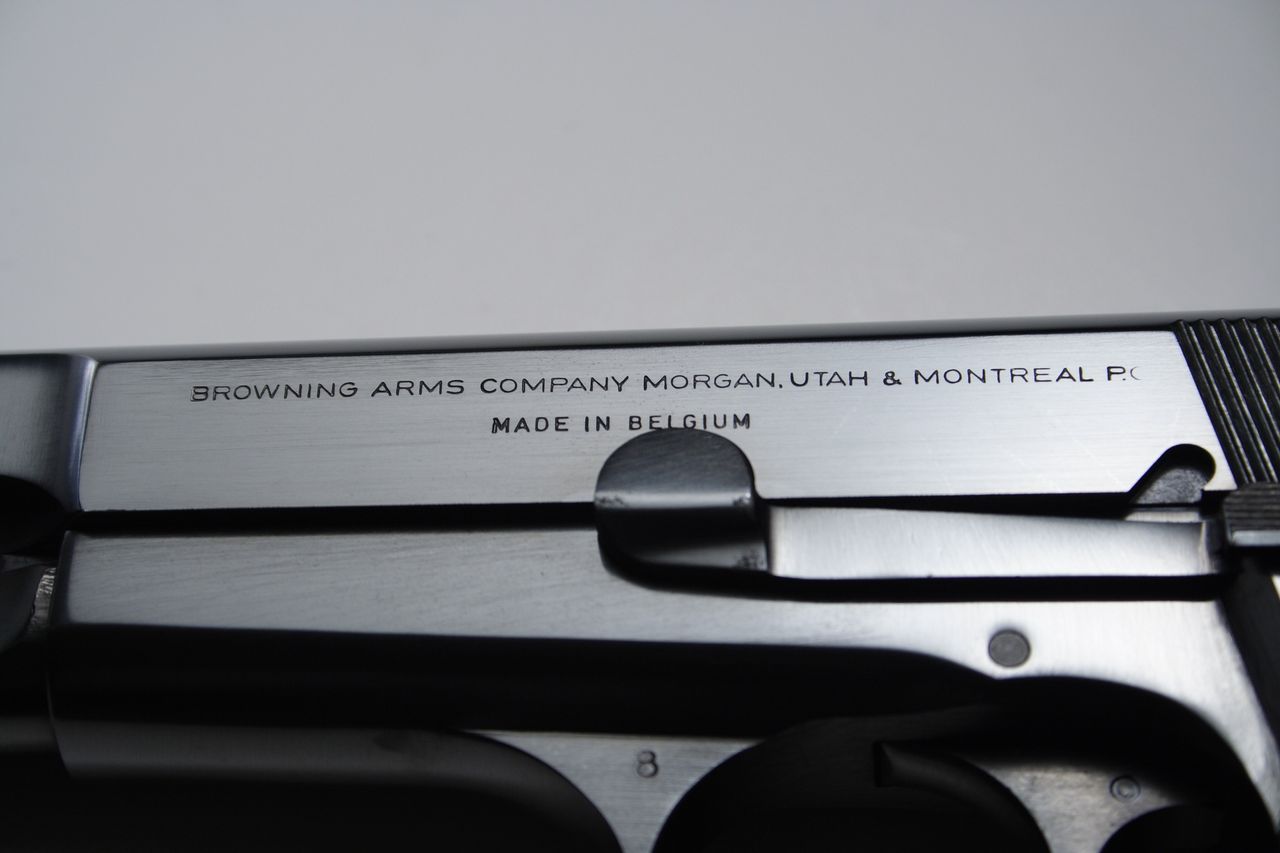
Some handguns earn a place in history. The Browning Hi-Power earned loyalty from armies on both sides of a world war.
A pistol born from a new idea of combat

The Browning Hi-Power did not appear by accident, and it was not simply a dressed-up version of the Colt 1911. Its roots go back to a French military requirement in the early 1920s for a modern sidearm that would be compact, reliable, easy to fieldstrip, and able to hold at least 10 rounds. According to American Rifleman, John Browning began the project, and after his death in 1926, FN designer Dieudonné Saive carried it across the finish line.
What emerged by 1935 was the GP-35, also known as the Grande Puissance, or High Power. Saive’s double-stack magazine was the real breakthrough. In an era when many service pistols carried 7 or 8 rounds, the Hi-Power’s 13-round magazine looked almost futuristic. That capacity was not a gimmick. It was a serious battlefield advantage in a sidearm meant for officers, paratroopers, vehicle crews, and specialists who might need a lot of pistol fire in very little time.
The pistol was chambered in 9×19 mm, already one of the most widely used military handgun cartridges in Europe. It used a locked-breech, short-recoil action and a single-action trigger, blending proven mechanics with modern packaging. The result was a slim, well-balanced handgun that carried more ammunition than its rivals without becoming clumsy or oversized.
That combination mattered because military pistols are rarely judged by romance. They are judged by what they do under stress, with mud on the slide and fear in the hands of the shooter. The Hi-Power gave soldiers more chances before reloading, manageable recoil, and handling that inspired confidence. Those traits help explain why so many militaries wanted it before the war, and why nobody forgot it afterward.
How occupation put the same pistol in German hands
The strangest part of the Hi-Power story is that both sides got it for entirely logical reasons. When Germany occupied Belgium in 1940, it also took control of FN’s factory at Herstal. That meant the pistol already in production for Belgium could now be produced for the occupier. American Rifleman notes that the Germans designated the weapon Pistole 640(b), the letter indicating Belgian origin.
This was not unusual in wartime Europe. German forces used many captured or foreign-made arms if they were dependable and available in quantity. The Hi-Power qualified on both counts. Early occupation-made pistols retained strong machining and finish, while later examples reflected wartime shortcuts, but the design itself remained good enough that German military and police units continued to issue it.
Some of these pistols bore Waffenamt inspection marks, making their wartime identity unmistakable today. They saw service with German troops, including formations that valued a compact, high-capacity sidearm. In a war defined by industrial improvisation, a pistol already too useful to ignore simply kept getting built under new management.
That is the key point. The Germans did not adopt the Hi-Power because of sentiment, and they did not keep making it out of curiosity. They kept it because it worked. In wartime procurement, reliability beats ideology. A good pistol is a good pistol, even when it comes from a factory in occupied territory.
Why the Allies kept the design alive in Canada

While the Germans were making Hi-Powers in occupied Belgium, the Allies made sure the design would survive outside Axis control. Dieudonné Saive escaped and Allied production eventually centered on John Inglis and Company in Toronto. Canadian wartime histories and later research on Inglis production show that the pistol was first tied to contracts intended for China, then became important for Commonwealth and other Allied forces as the war widened.
This Canadian chapter is one of the most important reasons the Hi-Power became a truly global war pistol rather than a regional one. Inglis produced versions with fixed sights and versions with tangent rear sights and stock slots, reflecting different intended users and contracts. That gave the pistol flexibility across several military roles, from standard issue sidearm to a more specialized weapon for troops needing compact firepower.
The Commonwealth had every reason to like it. It used common 9 mm ammunition, offered much greater magazine capacity than the .38 revolvers still common in British service, and could be manufactured in meaningful numbers once production settled in. For airborne troops, commandos, and officers, that extra firepower in a holster-sized package was hard to dismiss.
Canada’s role also ensured that the Hi-Power was not just a wartime curiosity trapped inside occupied Europe. It became an Allied weapon with its own production base, its own supply chain, and its own combat record. Once that happened, the pistol’s long future was almost guaranteed. It was no longer just FN’s creation. It had become a shared wartime tool of the Allied arsenal.
The 13-round magazine changed expectations forever

If one feature explains the Hi-Power’s reputation in the simplest terms, it is the magazine. Thirteen rounds in a service pistol magazine was a remarkable figure in the 1930s and still impressive in World War II. American Rifleman has described the design as the world’s first high-capacity handgun in practical military use, and that is not just collector talk. It represented a real shift in what soldiers could expect from a sidearm.
More rounds meant more staying power before reloading. That sounds obvious now, but at the time it was transformative. Pistols were often secondary weapons, carried by people whose primary role was not fighting with a handgun. Tank crews, airmen, military police, and officers benefited from a pistol that gave them more immediate firepower without the bulk of a submachine gun.
The Hi-Power also carried those rounds in a grip that many shooters found surprisingly comfortable. Saive’s double-stack magazine did not create a brick-like handle. The pistol still pointed naturally, sat well in the hand, and balanced in a way that helped practical shooting. That made the extra capacity useful rather than theoretical.
Later generations of military and police pistols would make high-capacity 9 mm magazines standard. The Hi-Power helped teach armies to want that. Once users experienced 13 rounds on tap in a reliable, service-grade pistol, going back to 7 or 8 felt like accepting less. That is one reason the design cast such a long shadow over the second half of the 20th century.
Reliability, handling, and the feel soldiers remembered
Capacity alone does not create devotion. The Hi-Power endured because it handled well in the real world. It was relatively slim, fast to point, and controllable in recoil. For many shooters, it simply felt right. Even critics of its magazine disconnect or sometimes heavy trigger usually admitted the pistol had excellent natural balance and a profile that sat low and secure in the hand.
That mattered more than many people realize. Military sidearms are often used under bad conditions by people who are not handgun specialists. A pistol that aligns naturally, reloads simply, and cycles reliably is worth more than one with paper advantages but poor manners. The Hi-Power built its reputation not from a single miracle feature, but from having very few weak ones for its era.
It also fit the military taste of the time. The 9 mm cartridge was increasingly attractive because it offered manageable recoil, decent magazine capacity, and broad logistical compatibility. The Hi-Power packaged that cartridge in a form that was easier to carry than many full-sized alternatives while still providing serious combat utility.
Soldiers tend to remember tools that make them feel competent. The Hi-Power did exactly that. It pointed quickly, fired a widely available cartridge, and offered reassuring reserve in the magazine. Those are not glamorous qualities, but they are the ones that keep a weapon in service long after newer designs appear.
Why armies after 1945 kept coming back to it
The phrase “never looked back” fits because the Hi-Power did not vanish with victory parades and demobilization. It remained in service across dozens of countries after 1945. American Rifleman has noted that the pistol served with the militaries of more than 50 nations, which speaks to more than simple availability. It speaks to trust built over time.
Postwar armies were not sentimental museums. They kept weapons that balanced cost, performance, training value, and logistical common sense. The Hi-Power checked those boxes unusually well. It was powerful enough for service use, compact enough for broad issue, and familiar enough that armorers and troops could keep it running without heroic effort.
It also arrived at the right moment in handgun history. Before the age of polymer frames and striker-fired pistols, the Hi-Power represented a mature vision of the combat sidearm. It combined a proven steel frame, a potent and standard military cartridge, and a magazine capacity that many competitors would not match for decades.
That long service life is really the final verdict on its World War II performance. A weapon can be adopted in wartime because of emergency conditions. It does not remain in use for generations unless it proves itself again and again. The Hi-Power did, which is why police forces, special units, and regular armies kept it close long after the war that made it famous.
The real reason both sides trusted the same handgun

At first glance, the Hi-Power’s World War II story seems ironic. How could one pistol serve both occupier and opponent, Germany and the Allies, without losing its identity? The answer is brutally simple. The design solved real military problems better than many alternatives. It offered high capacity, good ergonomics, reliable function, and the logistical advantage of the 9 mm cartridge.
That made it bigger than politics. Germany used it because FN production fell into German hands and the pistol was too effective to waste. The Allies used it because Canada put the design back into friendly production and because troops quickly recognized its advantages. In both cases, battlefield practicality overruled everything else.
There is also a broader lesson here about weapons history. The most successful arms are not always the flashiest or the most technically exotic. Often they are the ones that combine several solid ideas into a package that users immediately understand and trust. The Hi-Power was exactly that kind of weapon, and that is why its appeal survived changing uniforms and shifting front lines.
So when people say both sides carried the Browning Hi-Power in World War II and never looked back, they are not just repeating a dramatic line. They are describing a rare kind of engineering success. The pistol was so well judged that once soldiers got their hands on it, the future of service handguns started moving in its direction.