Some guns became stars without ever becoming common. Hollywood made them unforgettable, but real shooters usually chose something else.
Walther PPK

No pistol is more tightly welded to a movie persona than the Walther PPK and James Bond. Across decades of 007 films, the little Walther came to symbolize sophistication, cold efficiency, and European cool. It is one of those guns even non-gun people recognize by silhouette alone, which is a rare achievement for any firearm.
In the real world, though, the PPK has always been more of a style piece than a mainstream American carry gun. It is small, slim, and elegant, but it was designed around an older double-action blowback system that tends to feel snappier than many modern compact 9mm pistols. That makes it iconic, yes, but not necessarily the pistol most buyers pick after actually handling one.
The market has moved hard toward lighter polymer handguns with greater capacity, better sights, and easier recoil control. Walther itself announced a multi-year pause in production of the PPK, PPK/S, and PP legacy lines in late 2025, which says a lot about where demand sits today. The Bond gun still has mystique, but mystique does not automatically create mass ownership.
That gap between image and ownership is exactly why the PPK belongs here. It is beloved by collectors, Bond fans, and traditionalists, yet almost nobody treats it as the obvious practical choice anymore. On screen it is eternal. At the gun counter, it is a niche classic.
Smith & Wesson Model 29
(Original text: kaltduscher)/Wikimedia Commons
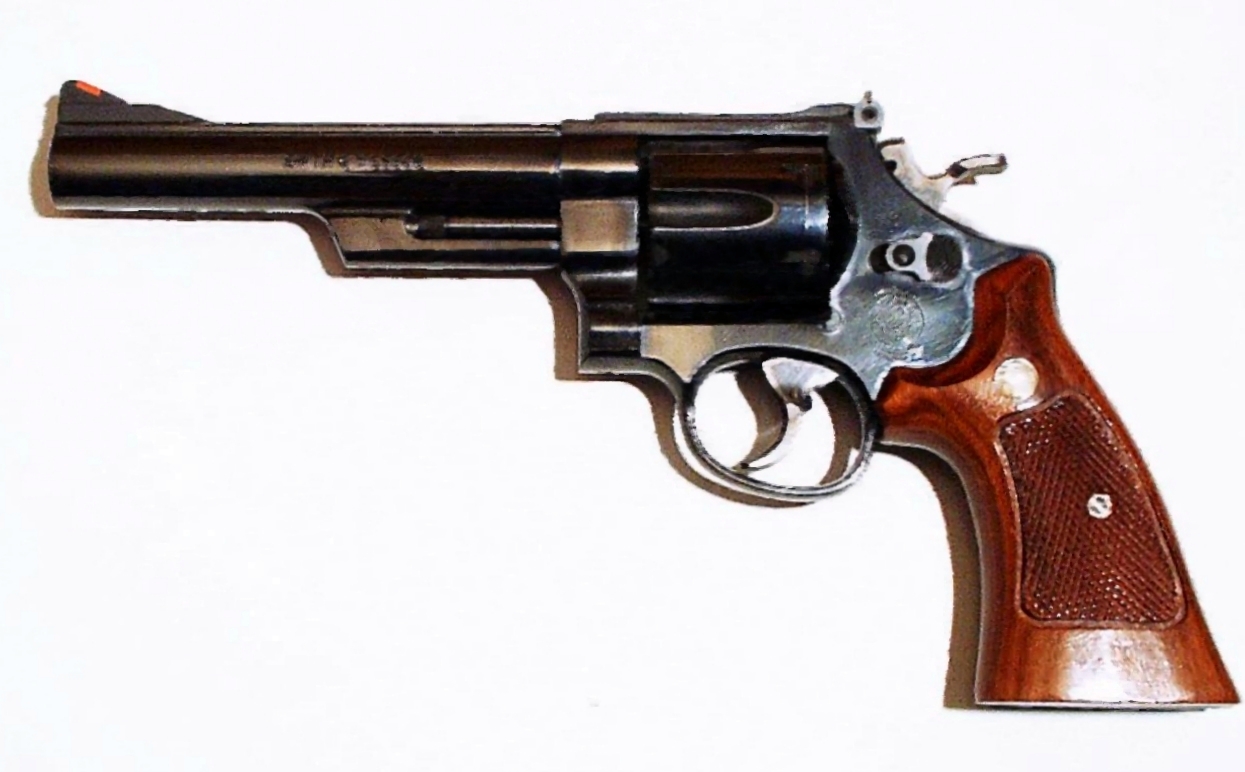
If one movie handgun ever changed public perception overnight, it was the Smith & Wesson Model 29 in Dirty Harry. Clint Eastwood’s delivery turned the .44 Magnum revolver into a cultural event. According to firearm historians and long-running movie gun references, the film did not just feature the gun, it effectively branded it as the ultimate hand cannon for an entire generation.
What movies did not show very well is how specialized the Model 29 really is. It is a large N-frame revolver chambered in a powerful cartridge that produces serious recoil, muzzle blast, and cost per shot. For hunting, backcountry defense, or pure revolver enthusiasm, it makes sense. For ordinary ownership, concealed carry, home defense, or high-volume range use, it is a demanding choice.
That is why the real market stayed much smaller than the myth. Many gun owners have fired a .44 Magnum once, grinned, and handed it back. Few decide they need one as a regular-use handgun. Even people who love revolvers often settle into .357 Magnum or .38 Special platforms because they are cheaper, easier to shoot, and more versatile.
The Model 29 remains one of the most famous handguns ever filmed, but its fame masks its reality. It is too big, too loud, and too specialized to become a normal household firearm. Dirty Harry made it legendary. Practical ownership kept it rare by comparison.
Desert Eagle Mark XIX
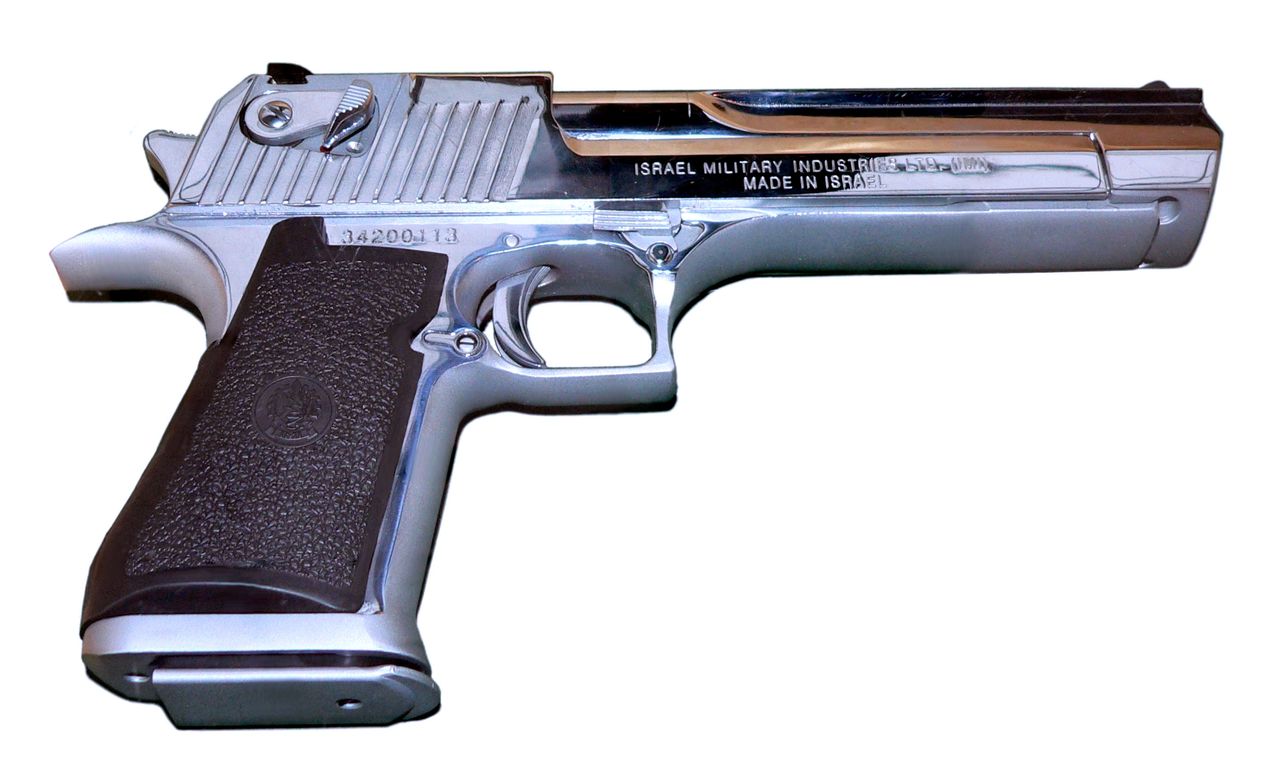
The Desert Eagle may be the purest example of a gun that became larger in pop culture than in real life. Movies, television, and video games turned it into instant shorthand for excess, intimidation, and villain energy. Magnum Research openly leans into that reputation, describing the Desert Eagle as a pop culture icon and continuing to offer the Mark XIX in magnum calibers including .357 Magnum, .44 Magnum, .429 DE, and .50 A.E.
The reason almost nobody actually owns one is simple the moment you pick it up. It is huge, heavy, expensive, and overbuilt for ordinary handgun tasks. Unlike most semi-auto pistols, it uses a gas-operated rotating-bolt system, which is mechanically fascinating but adds bulk. It is not the kind of pistol people casually slip into a holster for daily use.
There is also a mismatch between cinematic image and practical utility. On screen, the Desert Eagle looks like unstoppable power. Off screen, many shooters discover it is a range novelty, hunting sidearm, or collector’s conversation piece. Ammunition cost alone pushes plenty of interested buyers back toward normal 9mm or .45 ACP pistols they can actually afford to train with.
That does not make the Desert Eagle bad. It makes it honest. It was never supposed to be a mainstream defensive pistol. It was built to be dramatic, distinctive, and mechanically unusual, which is exactly why Hollywood loved it and ordinary owners mostly admired it from a distance.
Beretta 93R Auto 9

RoboCop gave the world one of the greatest sci-fi sidearms ever put on screen, the Auto 9. Under the shell, it was a heavily modified Beretta 93R, and the finished prop looked futuristic without losing the feel of a real machine pistol. That balance made it instantly memorable, and it still ranks among the most recognizable movie handguns ever built.
In ownership terms, though, the Beretta 93R sits in fantasy territory for most civilians. It is a selective-fire machine pistol, and that instantly pushes it into a legal category governed by the National Firearms Act and later federal restrictions. ATF states that machine guns lawfully possessed before May 19, 1986 may still be transferred under the NFA process, but post-1986 civilian machine gun ownership is broadly prohibited under federal law.
That means even when legal examples exist, they are rare, expensive, and far beyond what the average enthusiast will ever buy. And that is before you get to the fact that machine pistols are notoriously difficult to control in full-auto fire. They are fascinating pieces of firearms history, but they are not common working guns for ordinary people.
So the Auto 9 became a giant movie legend built around a platform that was almost destined to remain scarce. The design looked incredible, the concept was cinematic gold, and the base gun was real. But real-world ownership was never going to catch up with that level of screen fame.
M41A Pulse Rifle
The M41A Pulse Rifle from Aliens may be fictional, but it absolutely belongs on this list because it is one of the most famous movie guns ever created. It looked so convincing that many viewers assumed it was some exotic military weapon from the future. In reality, the original prop armorers built it around a real M1A1 Thompson with a cut-down Remington 870 and SPAS-12 furniture wrapped inside a custom shell.
That hybrid origin is exactly why almost nobody owns anything truly equivalent. You are not talking about a factory firearm with a catalog number and dealer network. You are talking about a film prop system assembled from multiple guns and purpose-built components to achieve a visual effect. The famous version was a movie object first and a practical firearm second.
Collectors and replica builders have spent years chasing that look, but most end up with non-firing reproductions, airsoft versions, or heavily customized cosmetic builds. The original functional concept is awkward, expensive, and legally complicated depending on the exact parts involved. It is also far less useful than the clean futuristic appearance suggests.
What Aliens did brilliantly was create the illusion of a perfect combat rifle by blending real gun anatomy into a fictional package. That package became a cult object. But as an actual thing people would buy, store, train with, and maintain, it was always destined to remain a rare enthusiast obsession.
AMT Hardballer Longslide
The Terminator turned the AMT Hardballer Longslide into one of cinema’s great cold-blooded sidearms. Arnold Schwarzenegger’s gun store scene permanently burned the phrase “.45 Longslide” into movie history. The specific pistol seen in the film was an AMT Hardballer Longslide with a 7-inch barrel and an early laser sight, a setup that looked futuristic and predatory in 1984.
Outside the theater, however, this was never a mainstream pistol. The longslide 1911 format is specialized to begin with, favoring sight radius and style over compactness or everyday practicality. Add in an early-generation laser system and you had a flashy package that worked much better as screen iconography than as an ordinary consumer purchase.
The manufacturer itself never built the kind of broad, stable legacy that would keep the model in common circulation for decades. So while the Terminator’s pistol became famous, the actual gun remained a niche artifact tied to collectors, 1911 enthusiasts, and people specifically chasing that film connection. Many more people know the gun than have ever seen one in person.
That is the recurring movie-gun pattern in miniature. The camera makes an unusual firearm feel inevitable, even universal. Then real buyers remember they need reliability, parts support, affordability, and practical carry dimensions. The Hardballer Longslide won immortality on screen, but it never became an everyman handgun.
M134 Minigun
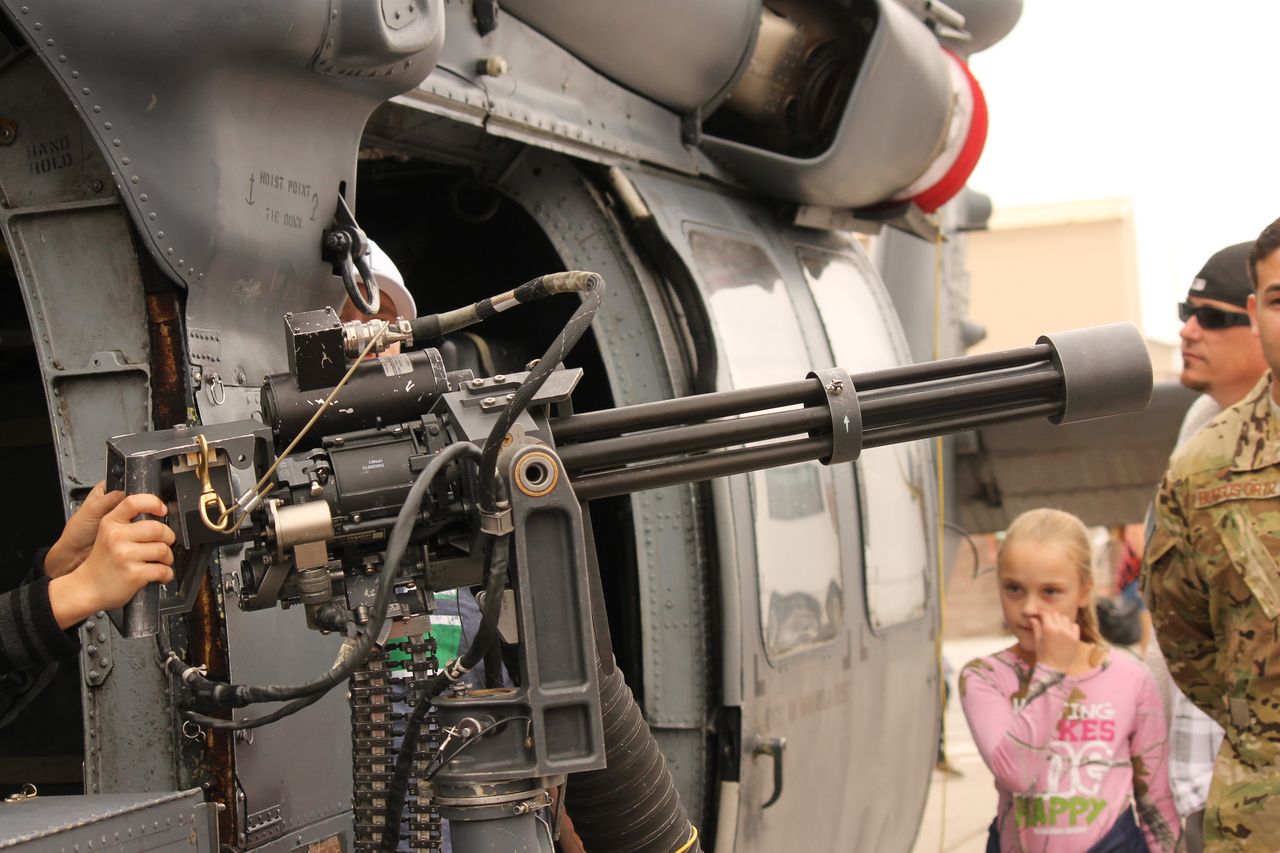
Few weapons scream “movie firepower” like the Minigun. From helicopter doorways to action heroes somehow hip-firing impossible volumes of ammo, the M134 became shorthand for overwhelming force. The reality is far more industrial. Dillon Aero’s current M134D data describes a 7.62x51mm externally powered rotary gun with a fixed firing rate of 3,000 rounds per minute and a requirement for substantial electrical power.
That technical reality explains why almost nobody owns one. This is not a conventional shoulder-fired firearm. It is a crew-served weapon system typically integrated onto aircraft, vehicles, or specialized mounts. Dillon Aero says it has fielded thousands of systems in dozens of countries, which underscores the point that these are institutional tools, not ordinary consumer purchases.
Then come the legal barriers. Under federal law, machine guns are tightly regulated, and civilian transferability is limited to lawfully registered pre-May 19, 1986 guns. Even where ownership is lawful, scarcity alone pushes prices into exotic territory. Add ammunition burn rate, support gear, mounting requirements, and maintenance, and the Minigun becomes less a gun than an operating budget.
Movies taught audiences to see it as the ultimate personal weapon. Real life reveals a platform meant for crews, systems, and logistics chains. That contrast is why the Minigun may be one of the most famous firearms in entertainment while remaining almost totally absent from normal private ownership.
Heckler & Koch MP5
derivative work: Hic et nunc/Wikimedia Commons
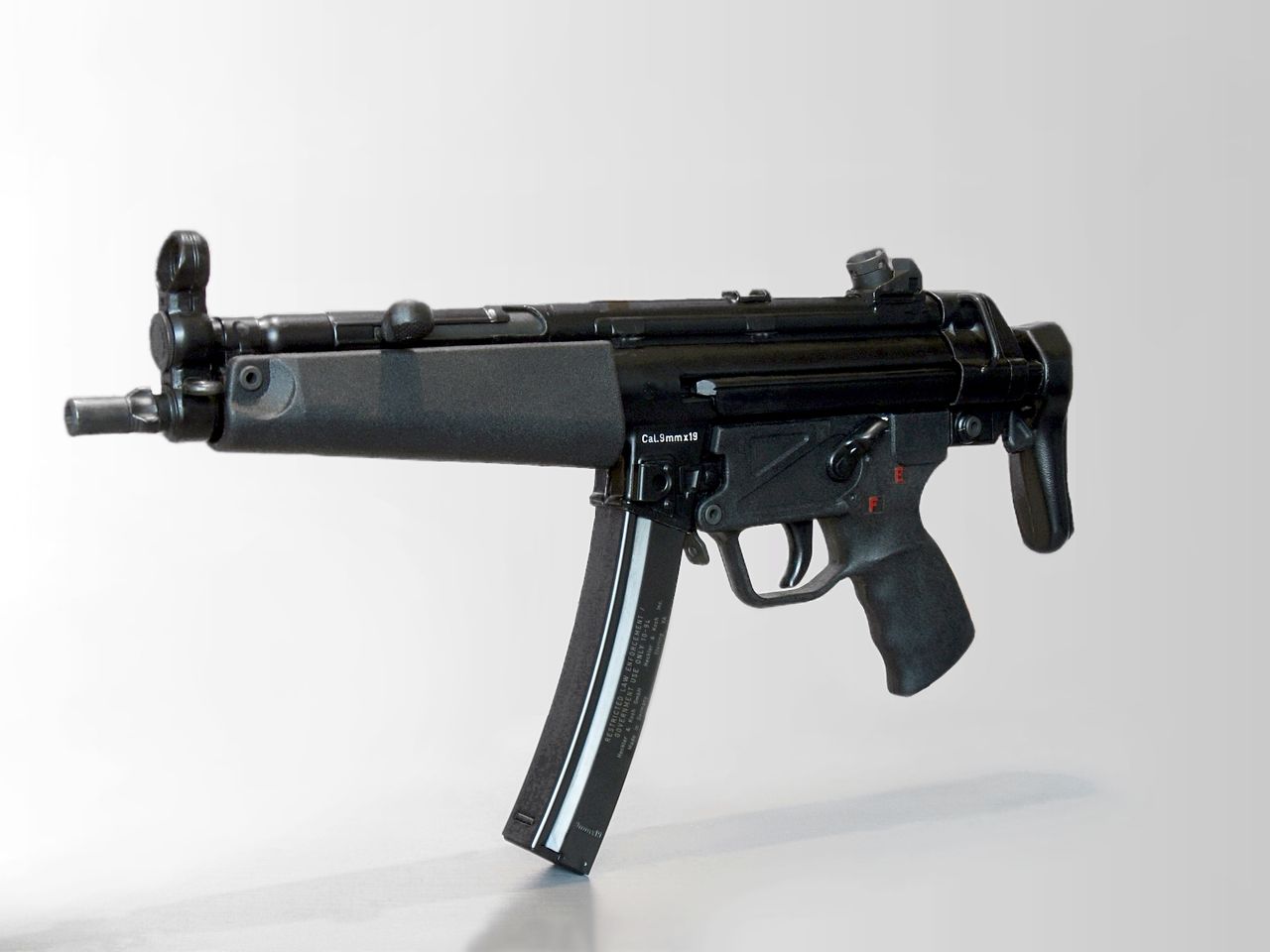
The MP5 has had one of the greatest screen careers of any modern firearm. It shows up in thrillers, action films, police dramas, and counterterror stories so often that it became visual shorthand for elite professionalism. The gun earned that reputation honestly too, with a long real-world service history. But the exact gun people picture from movies is the full-auto MP5 submachine gun, and that matters.
For ordinary American buyers, the true MP5 is not the shelf item. What they can more realistically access is a semi-automatic commercial relative like the SP5. Heckler & Koch’s own civilian material explicitly positions the SP5 and SP5K as sporting or commercial versions that capture the look and feel of the famous submachine gun while operating in single fire only.
That distinction is huge. Movie fans often imagine the MP5 as a common personal gun because it appears so constantly on screen. In practice, the real transferable full-auto versions are highly restricted and expensive, while semi-auto variants remain enthusiast purchases rather than mass-market staples. They are admired widely, owned selectively.
So yes, plenty of shooters would love an MP5 pattern gun. But love and ownership are different things. The MP5’s image is universal. The actual version made famous by movies remains uncommon in civilian hands, with most people settling for lookalikes, clones, or semi-auto stand-ins.
FN P90
The FN P90 reached peak movie and TV fame by looking like it came from the future even when it was sitting in the present. Its top-mounted magazine, compact bullpup layout, and clean sci-fi profile made it a casting director’s dream. Science-fiction franchises especially embraced it because the gun looked advanced without needing much modification.
In practical civilian ownership, though, the real P90 is not what most people buy. The select-fire original is a military and law-enforcement personal defense weapon, while civilian buyers generally encounter the semi-auto PS90 instead. That means the exact compact, fully automatic image people remember from film is already out of reach for most non-institutional owners.
There is also the simple matter of caliber and purpose. The 5.7x28mm cartridge has passionate supporters, but it is still more specialized than mainstream rifle and pistol rounds. The ergonomics are unusual, magazines are distinctive, and the whole platform asks buyers to commit to something outside the ordinary. That tends to keep ownership in enthusiast territory.
The P90 became famous because it looked unlike everything else on screen. But guns that break the visual mold often break with buying habits too. Most owners stick with AR-pattern rifles, standard handguns, and common ammunition. The P90 image went mainstream. The ownership base never really did.