The Steyr Scout is one of those rifles whose appearance makes more sense once its history is understood. Rather than evolving from a conventional military pattern, it grew from Jeff Cooper’s highly specific vision of a lightweight, compact, versatile “scout rifle.” Steyr Mannlicher spent years refining that concept into a production model, eventually creating a rifle whose unusual proportions and features were deliberate rather than decorative. Its story is as much about design philosophy as it is about Austrian engineering.
1. One Man’s Blueprint Became a Factory Rifle
The Steyr Scout began with an unusually demanding idea from Jeff Cooper, the American rifle expert who spent years defining what a modern scout rifle should be. During the 1990s, Steyr Mannlicher worked with Cooper to turn that concept into a production firearm rather than a custom-gunsmith project. The result appeared commercially in 1999 after roughly seven years of development, turning a demanding brief into a factory-ready rifle. Cooper’s target was strikingly simple: keep the rifle under about 1 meter long and below 3 kilograms while preserving useful accuracy and versatility.
2. The Numbers Were Part of the Philosophy
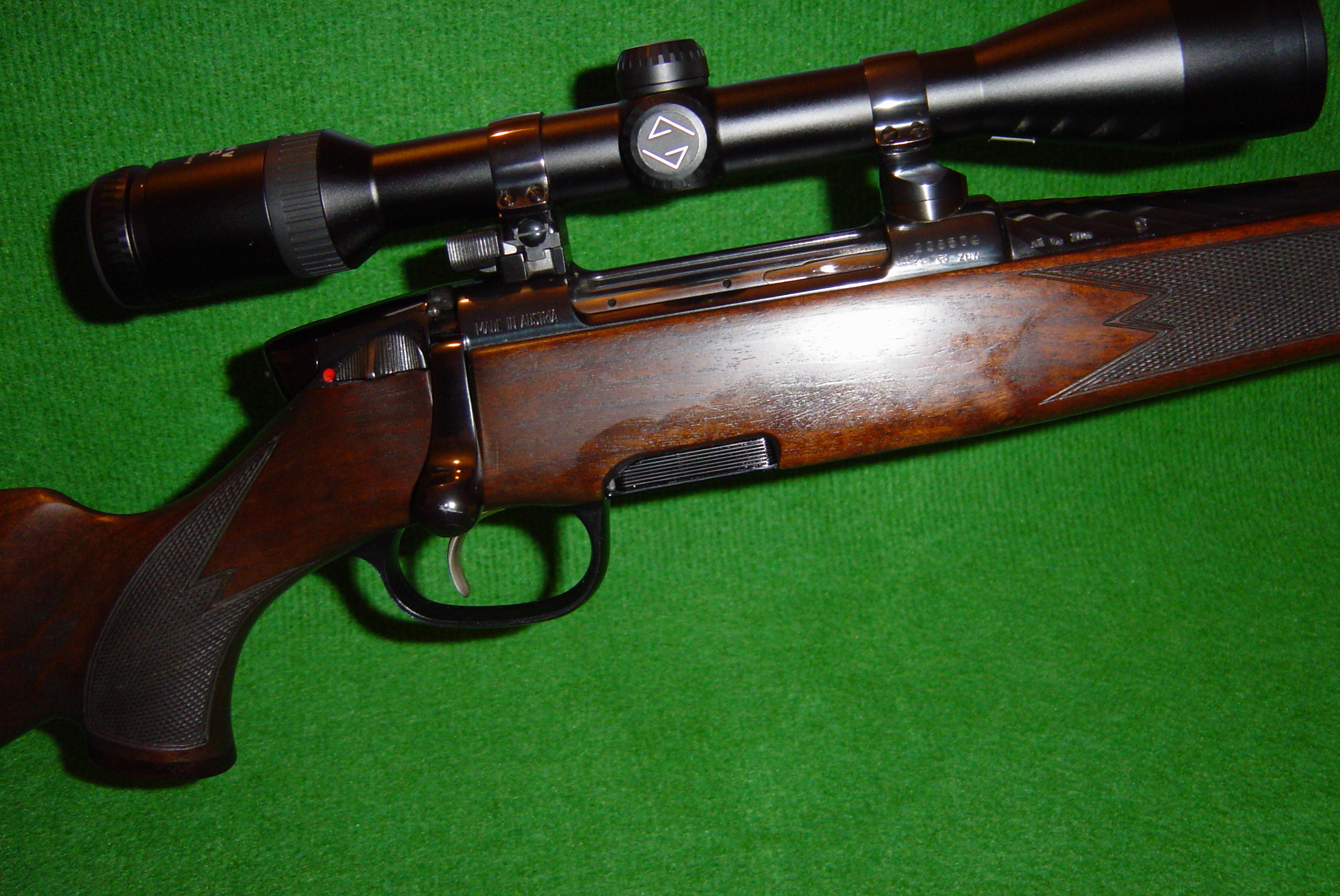
The Scout’s dimensions were not accidental styling choices. The original .308 Winchester version measured about 39.57 inches, or 1.01 meters, with its supplied stock spacers, and used a 19-inch cold-hammer-forged barrel. Its documented package weight was about 7 pounds with optic, mounts, sling, and two empty five-round magazines. Those figures reveal Cooper’s priority: a rifle compact enough to carry easily, yet powerful enough to remain a practical general-purpose platform. The proportions were deliberately balanced rather than simply shortened.
3. The Forward Scope Changed the Familiar Layout
One of the Scout’s most recognizable features is its forward-mounted optic, positioned ahead of the action rather than directly above the receiver. The original package used a 2.5-power Leupold intermediate-eye-relief scope, paired with the rifle’s mounting system. Steyr also incorporated folding backup iron sights, giving the design a second sighting option. Cooper believed this arrangement preserved a broad field of view and kept the action area accessible. The unusual placement became one of the Scout’s defining visual signatures and one of its most recognizable design choices.
4. A Spare Magazine Was Hidden in the Stock
Steyr did something surprisingly clever with ammunition storage: the Scout’s synthetic buttstock was designed to carry a spare magazine. The standard arrangement supplied two five-round magazines, while the rifle itself fed from a detachable box magazine. This feature made the spare immediately available without requiring a separate pouch or bulky carrier. It also showed how deeply the design was built around compactness. Even a seemingly minor detail, such as where the second magazine lived, was treated as part of the rifle’s overall carrying concept.
5. The Bipod Was Almost Invisible When Folded
Another signature feature is the bipod integrated into the synthetic fore-end. Instead of hanging beneath the rifle as a separate accessory, it folds forward and blends into the stock when not needed. The arrangement helped Steyr preserve the Scout’s clean, streamlined profile while adding a useful support option. The stock also included storage space for a cleaning kit, while an accessory rail was positioned beneath the fore-end. These details made the rifle feel more like a complete system than a conventional bolt-action with equipment added afterward.
6. The Action Was Built Around Fast, Positive Handling
The Scout used Steyr’s SBS, or Safe Bolt System, with a 70-degree bolt lift and a three-position tang-mounted safety. The bolt incorporated grooves intended to help shed dirt and ice, reflecting the rifle’s emphasis on field reliability. Its trigger was factory set around 3.5 pounds and specified as adjustable within a 2.0-to-4.5-pound range on the original specification. The combination of a compact action, low bolt lift, positive safety and carefully controlled trigger made handling a central part of the design rather than an afterthought in the Scout’s compact design.
7. The Scout Outlived Its Original Era
What makes the Steyr Scout especially interesting is that the concept did not disappear with the 1990s. Steyr later developed the Scout II, introduced in 2023, while retaining many of the original ideas: a roughly 19-inch barrel, about 3 kilograms of weight, a five-round magazine and a synthetic stock with an integrated bipod. The newer model also adds a full-length Picatinny rail and modern mounting provisions. That evolution shows why Cooper’s one-man vision mattered: the basic formula was distinctive enough to survive into a new generation of sporting rifles.