It looks like a novelty at first glance. Then you realize it is a real, federally regulated handgun that fires live ammunition.
What gun actually holds the title?
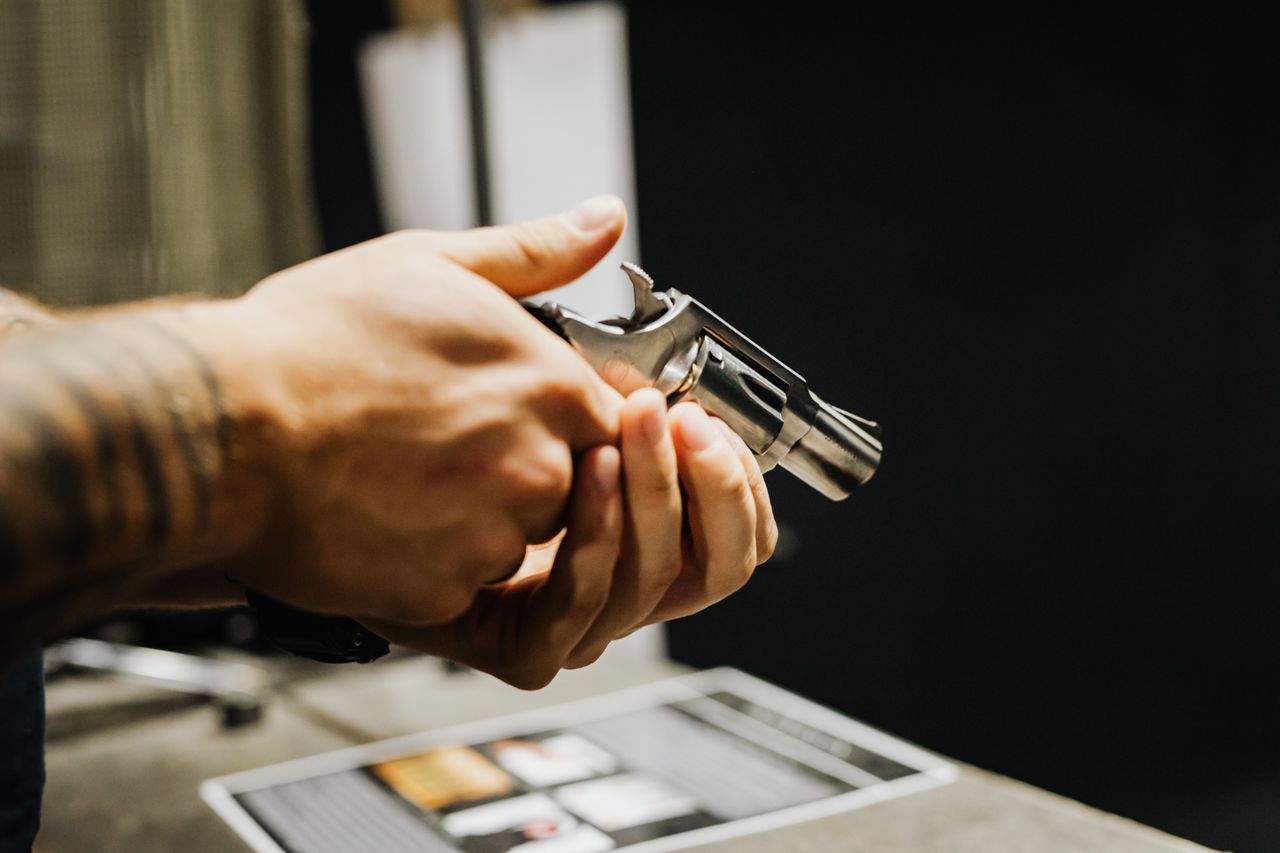
If you are talking about a firearm that is legally sellable in the United States, built by a mainstream manufacturer, and chambered for a conventional cartridge, the best answer is the North American Arms NAA-22S mini revolver in .22 Short. American Rifleman has described it as the smallest handgun titleholder in current production, and the specs explain why. The gun has a 1.125″ barrel, an overall length of 3.63″, a height of 2.38″, a width of roughly 0.76″ to 0.88″ depending on how measured, and a weight of about 4.1 oz. unloaded.
That is not toy territory. That is true extreme miniaturization in stainless steel.
The reason this revolver, rather than something even tinier, usually wins the conversation is simple. It is sold through ordinary firearm channels, uses real metallic cartridges, and comes from an established American maker, North American Arms of Provo, Utah. In the world of firearms, that matters more than internet myth or one-off curiosities.
There have been smaller functioning handguns in the broader world, including ultra-miniature specialty pieces like the SwissMiniGun and historical oddities chambered for very small cartridges. But once you narrow the field to what is realistically and legally sold in America as a standard handgun, the NAA .22 Short mini revolver is the one that keeps surfacing as the benchmark.
Why it is legal to sell in America

Federal law does not set a minimum overall size for an ordinary pistol or revolver. According to the ATF, a firearm under the Gun Control Act is, in part, any weapon designed to expel a projectile by the action of an explosion. The same agency distinguishes pistols and revolvers from more tightly regulated National Firearms Act categories, and specifically notes that a pistol or revolver with a rifled bore is not treated as an “any other weapon” just because it is concealable.
That is the key legal point. Tiny does not automatically mean prohibited.
As long as the gun is manufactured and transferred in compliance with ordinary federal firearm rules, including serialization and dealer transfer requirements where applicable, a very small revolver can still be a plain Title I handgun. The NAA mini falls into that category, which is why it can be sold by licensed dealers without entering the special tax-stamp territory associated with short-barreled shotguns, silencers, or certain disguised firearms.
State law is where things can get messier. Some states have restrictions involving roster approval, minimum design features, carry rules, or unusual firearm configurations. So “legal in America” does not mean legal in every counter display case in every state. But at the federal level, a rifled, conventionally built mini revolver like this is straightforwardly recognizable as a revolver.
The cartridge is tiny, but very real

The phrase “real bullet” matters here, because plenty of miniature curios fire proprietary rounds that are expensive, rare, or borderline impractical. The NAA-22S is different because it chambers .22 Short, one of the oldest self-contained metallic cartridges still around. That puts it in the category of a genuine working firearm, not a novelty mechanism pretending to be one.
And yes, .22 Short is absolutely live ammunition.
North American Arms publishes ballistic data for the 1-1/8″ barrel version. Using Winchester Super X, the company lists a median velocity of 702 f.p.s., with a recorded high of 725 and low of 653 under its test conditions. That is modest performance by handgun standards, but it is enough to underscore the point: this little revolver is launching an actual bullet through a rifled barrel by means of a conventional cartridge ignition system.
That also explains why the gun has always occupied a strange place in the market. It is not just a collectible conversation starter, though it certainly works as one. It is also not a toy under any serious definition. Even when power is limited, the mechanical and legal realities are exactly those of a firearm. That distinction is important, especially for first-time buyers who might underestimate what such a small gun can do.
How the gun became so small
North American Arms did not shrink a normal revolver at random. The company designed the mini platform around a single-action system, five-shot cylinder, and stainless-steel construction that strips away bulk wherever possible. There is no swing-out cylinder like a modern double-action carry revolver. On classic mini models, the cylinder is removed for loading and unloading, which saves space and helps keep the frame extremely compact.
Every design choice pushes toward minimal dimensions.
The grip is famously tiny, almost more of a place to pinch than a place to hold. The sights are minimal as well, because there is only so much room on a handgun with a barrel barely over an inch long. American Rifleman noted that this version is about as small as a “real gun” can get while still being a standard production arm, and that assessment feels fair once you look at the measurements.
The tradeoff is obvious: shootability suffers as size shrinks. Tiny grips, tiny sights, and tiny controls are the unavoidable cost of extreme concealability. But from an engineering perspective, that is what makes the NAA .22 Short impressive. It is not merely small. It is small while still remaining durable, repeatable, and recognizably built to firearm standards rather than novelty standards.
What it is like to handle and shoot

Nobody should confuse the NAA-22S with an easy range gun. It is a specialized handgun that demands slow, deliberate handling. The manual for North American Arms mini revolvers warns users that, due to the gun’s very small physical size, extra care is required in operation. That is not lawyerly overstatement. It is the plain truth of manipulating a revolver that weighs roughly 4 oz. and gives you almost no grip surface.
Loading is slower than on conventional handguns, and aiming is more instinctive than precise.
In return, the shooter gets an experience unlike almost anything else in the handgun market. Recoil from .22 Short is not severe, but the tiny grip changes how that recoil feels in the hand. The gun can be fun in a very specific way, the same way extremely light pocket knives or miniature mechanical watches are fun: you are appreciating how much function has been packed into something absurdly compact.
Accuracy is another reality check. With a 1.125″ barrel and minimal sights, nobody should expect target-pistol performance. This is a close-range gun, and even fans of the design tend to talk about it in terms of novelty, backup use, collection value, or sheer mechanical interest rather than practical marksmanship excellence.
The myths, comparisons, and common confusion
A lot of confusion comes from mixing three different categories: historically tiny guns, globally tiny guns, and tiny guns you can realistically buy in the American market. The 2mm Kolibri, for example, is often mentioned as the smallest centerfire cartridge ever made. It is historically fascinating, but it is not the modern answer for what is legally sellable today through normal U.S. firearm commerce.
The SwissMiniGun is another common comparison. It is famously microscopic and fully functional, but it occupies a rarefied, expensive niche that is closer to elite miniature manufacturing than to an ordinary retail handgun purchase. Even American Rifleman framed that kind of gun as a curiosity with a steep price and specialized ammunition, not as the practical benchmark for the smallest handgun most people mean.
That is why the NAA .22 Short keeps winning the argument. It is current production, American made, chambered in a known cartridge, and sold as an actual revolver rather than a luxury miniature.
There is also a common misconception that anything this small must fall into some special legal gray area. Federally, that is not how the rules work. A disguised gun can create legal issues. A smooth-bore concealable firearm can create legal issues. But a tiny rifled revolver, sold and marked like a normal handgun, is still just a handgun.
So who is this gun really for?
The honest answer is that the NAA-22S appeals to three groups more than anyone else: collectors, deep-concealment enthusiasts, and people who simply admire extreme mechanical design. It is not the ideal first handgun, not the easiest handgun to shoot well, and not the most powerful gun in anything resembling the same category. But none of that is really the point.
Its appeal is that it pushes the lower limit of size without crossing out of genuine firearm status.
For collectors, it represents a fascinating endpoint in the long American tradition of pocket revolvers. For enthusiasts, it is a reminder that miniaturization can be every bit as technically impressive as magnum power. For casual readers, it answers a question that sounds almost made up: yes, America really does sell a handgun small enough to nearly hide in a closed fist while still firing a real cartridge.
And that is what makes the NAA .22 Short mini revolver so compelling. The smallest legally sellable firearm in America that still fires a real bullet is not a science-fiction gadget or a Victorian relic. It is a tiny stainless revolver, still in production, still federally treated as a real handgun, and still remarkable precisely because it works.