Some rifles become legends in service. Others become legends because they never quite made it there.
The M15 belongs squarely in that second category, a weapon officially adopted by the U.S. Army and then quietly abandoned before production truly began.
The Forgotten Rifle Behind the Name
When most people hear “M15,” they assume it must be a typo for M14 or AR-15. In reality, the M15 was a real U.S. military designation tied to the T44E5, a heavy-barreled companion to the T44E4 rifle that became the M14.
The idea was straightforward and very postwar in spirit. The Army wanted one family of 7.62 mm weapons that could replace not just the M1 Garand, but also the Browning Automatic Rifle in the squad support role. According to Springfield Armory and Army historical material, that push shaped much of U.S. rifle development in the 1950s.
So the M15 was never meant to be a standard rifle for every infantryman. It was designed as a squad automatic weapon, a more controllable, sustained-fire version of the M14 concept.
Why the Army Wanted It
The M15 answered a real tactical problem. The Army still valued the BAR’s ability to deliver automatic fire at the squad level, but it also wanted to simplify logistics, training, and maintenance by using a weapon closely related to the new service rifle.
That meant the M15 borrowed the same basic action and cartridge as the M14 while adding features aimed at automatic fire. Surviving descriptions and museum records show a heavier barrel, a bipod, a distinctive butt arrangement, and extra gripping surfaces intended to help a gunner manage recoil and muzzle climb.
On paper, that was a very appealing solution. One ammunition type, one general operating system, and one weapon family looked like a cleaner answer than keeping a separate automatic rifle in service.
What Made the M15 Different
The M15 was not just an M14 with a bipod slapped on. Contemporary descriptions and later analysis note that it was purpose-built for the automatic-rifle role, with a heavier profile barrel and furniture changes intended to make automatic fire more practical.
American Rifleman has described the design’s role as replacing the M1918A2 BAR, and collectors who have examined the surviving example at Springfield Armory point to its unusual stock setup and support-oriented configuration. It typically weighed notably less than a BAR, which sounded like progress.
But reduced weight cuts both ways. A lighter automatic rifle can be easier to carry, yet also harder to keep steady in long bursts. That tradeoff would become central to the M15’s fate.
Why It Died Before Production
The M15’s downfall was brutally simple: it did not offer enough advantage. Testing and evaluation reportedly showed that a modified M14 could perform the squad automatic role well enough without creating a separate production program for a distinct M15 model.
That mattered because the Army was already committed to getting M14 production moving. Creating another dedicated variant with its own tooling and support burden made less sense once decision-makers believed the regular rifle could be adapted for the same mission.
According to Army histories and later firearms research, the M15 was adopted on paper but cancelled before full production began. In other words, it had a designation, but not a real service life.
The M14A1 Took Its Place
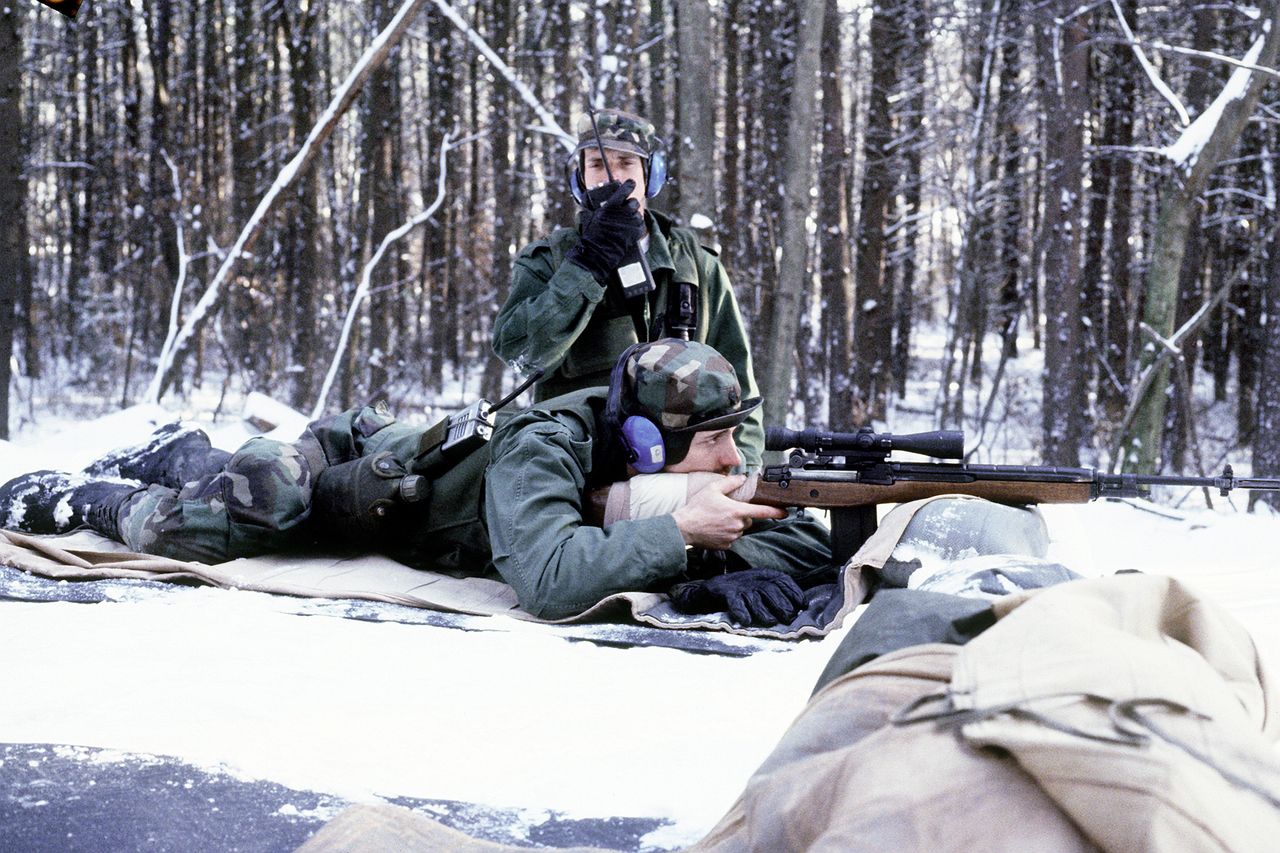
Instead of fielding the M15, the Army moved toward modified M14 configurations for automatic-rifle use. That path eventually led to the M14E2 and standardized M14A1, which carried forward the same basic mission the M15 had been created to fill.
This substitution is one reason the M15 faded from public memory so completely. The role survived, but the designation did not. In practical terms, the Army decided it could get most of the benefit by altering an existing rifle rather than launching a separate model.
It was an efficient decision, though not necessarily a glamorous one. Bureaucracies rarely preserve the near-misses, especially when a close cousin takes over the job.
Why the M15 Still Matters
The M15 is a perfect case study in how military small-arms history really works. Adoption does not always mean mass issue, and official approval does not guarantee a rifle will ever reach troops in meaningful numbers.
Its story also captures the limits of the full-power 7.62 mm battle rifle as a light automatic weapon. Even before the M16 era changed the conversation, the Army was already discovering that one gun could not easily excel at every infantry task.
That is why the M15 remains so fascinating today. It was a serious attempt to build a family weapon system around the M14, and its cancellation shows how quickly practical testing can overrule even the best-looking plans.