Some knives get trophies. The really good ones get used until the coatings wear off and the handles turn shiny from sweat.
Why the best survival knife is rarely the most celebrated

Award culture loves novelty. Survival knives usually reward the opposite: conservative design, proven steel, comfortable handles, and sheaths that work half-awake in rain or cold. That is why plenty of the most respected field knives never became glamorous headline winners, even though they keep showing up on belts, in trucks, and beside camp stoves year after year.
A serious survival knife has a brutally practical job description. It may need to carve feather sticks, notch traps, cut cordage, prep food, scrape tinder, split kindling, and handle ugly work without chipping or loosening. According to Morakniv, even its Garberg is built around fundamentals like a 3.2 mm full-tang blade, Scandi grind, and a spine designed to work with a fire starter. Those details are not flashy, but they matter when the temperature drops and dexterity disappears.
That is also why the market keeps circling back to plain drop points and durable full tangs. GearJunkie’s long-running testing has repeatedly favored knives that simply keep working, including models like the Gerber StrongArm and KA-BAR Becker BK2. These are not fashion objects. They are tools that survive scrutiny because they survive use.
Morakniv Garberg proves humble design can be serious.

If there were an award for “most likely to be underestimated on first glance,” the Morakniv Garberg would be in the running. Morakniv says it is made in Mora, Sweden, and offers it in stainless or carbon steel versions, with the stainless model using 14C28N at about 58 HRC. None of that sounds dramatic until you start listing what the knife actually does well.
The Garbergs ’ appeal is its restraint. The blade is thick enough for demanding work, the Scandi grind is easy to maintain in the field, and the exposed tang section at the rear gives it extra utility for scraping and striking. Morakniv explicitly markets it as durable enough for batoning wood and compatible with ferro rods, which tells you exactly what role it is meant to fill.
What keeps the Garberg off many award lists is also what makes it so compelling. It is not oversized, not exotic, and not priced like a collector piece. Yet for many bushcrafters and outdoors users, it quietly lands in the sweet spot between affordable and trustworthy. In the real world, that balance matters more than trophies.
The KA-BAR Becker BK2 is still a brute in the best way
Some survival knives are scalpels. The KA-BAR Becker BK2 is a pry bar with an edge, and that is a compliment. GearJunkie has described the knife as a repeat performer on its best-of lists, while KA-BAR catalog specs identify the classic build: a hefty slab of 1095 Cro-Van steel around 0.25 inches thick. This is not subtle equipment.
The BK2 became a cult favorite because it tolerates abuse that would make lighter knives nervous. It can baton, chop above its size class, and shrug off hard use in a way that gives nervous beginners confidence. In a survival scenario, confidence is not a luxury. It helps people work decisively instead of babying their gear.
The tradeoff is obvious the moment you pick it up. The BK2 is heavy, blocky, and not especially elegant for fine slicing. But that is the point of this article. Award-winning knives often charm judges with refinement. The BK2 wins users by being stubbornly overbuilt. It feels like a knife designed by someone who assumed things were going to go wrong and built accordingly.
Gerber StrongArm earns trust because it gets the basics right
The Gerber StrongArm has spent years being more respected than celebrated. Gerber calls it one of its best-selling fixed blades, and the official specifications are a concise summary of why: full tang construction, 420HC steel, rubberized diamond-texture grip, striking pommel, and a MOLLE-compatible multi-mount sheath. It is also made in the USA, which still matters to many buyers in this category.
What makes the StrongArm interesting is not steel snob appeal. On paper, 420HC will not excite collectors chasing premium metallurgy. In practice, it offers a sensible mix of corrosion resistance, toughness, and easy sharpening. For a general survival user who may not carry a complicated sharpening kit, that can be a more valuable trait than bragging rights.
The sheath deserves real credit, too. A survival knife is only useful if you can carry it securely and access it quickly. Gerber’s mounting system gave the StrongArm a practical edge in military, rescue, and outdoor settings. This is exactly the kind of detail that rarely wins romance points, but absolutely wins long-term loyalty.
Fällkniven A1 and F1 show how military credibility can stay underrated
Fällkniven has long occupied a strange space in the knife world. People who know the brand tend to respect it deeply, while casual buyers often overlook it in favor of louder names. The company’s catalogs have long positioned the F1 as the official survival knife for Swedish Air Force pilots, and its survival line, including the larger A1, has been built around all-weather dependability.
What stands out with Fällkniven is the engineering mindset. The company emphasizes features like laminated steel, strong tang construction, and weather-resistant handle materials such as Thermorun. In plain English, these knives are meant to remain reliable in cold, wet, punishing environments where brittle performance or slippery ergonomics become serious problems.
The A1 especially deserves more mainstream attention than it gets. It is large enough for heavy camp chores without drifting fully into machete territory, and it carries a quiet seriousness that many trendier knives lack. These are not knives marketed with swagger first. They are built with the assumption that failure in the field is unacceptable, which is a better starting point than hype.
ESEE and TOPS built reputations that the award circuit never fully captured

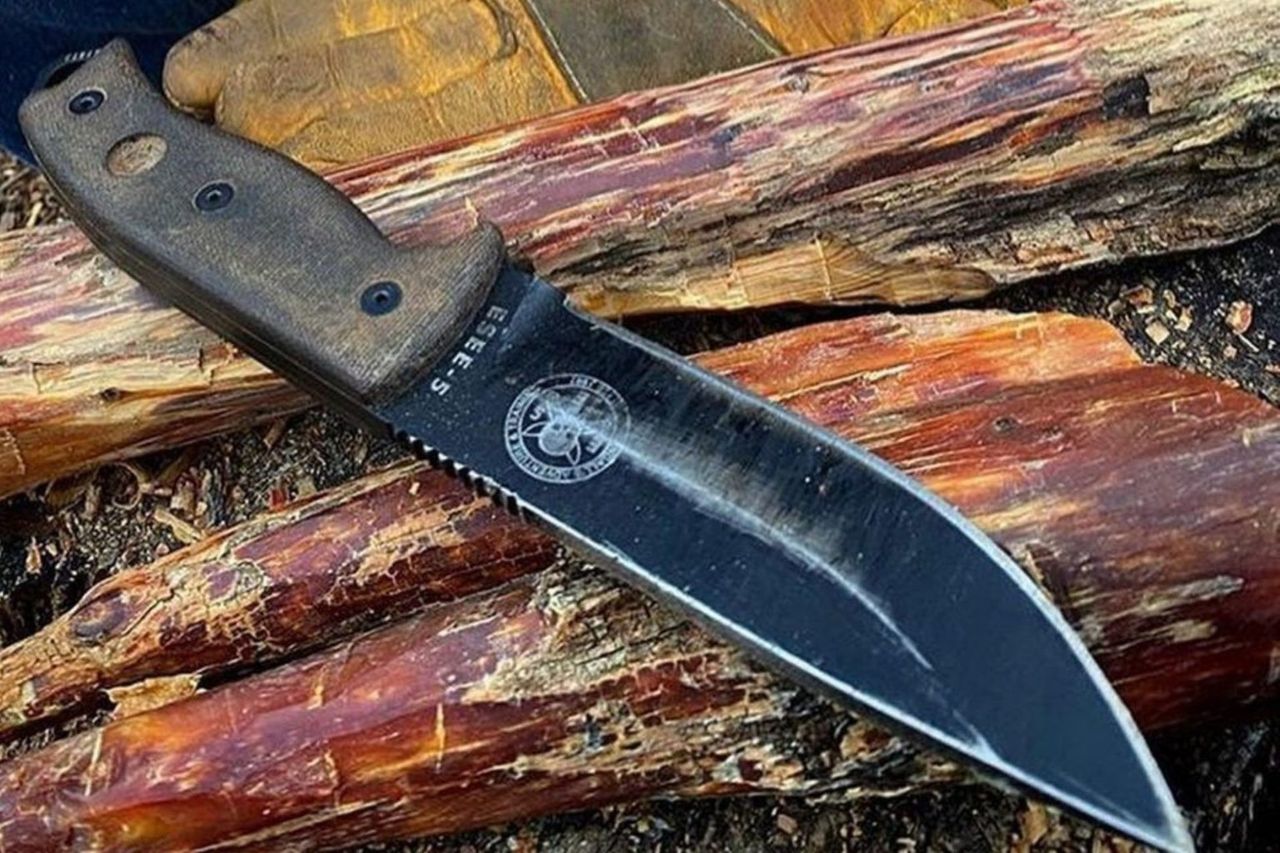
Commons Suggested: If you spend enough time around instructors, hunters, or serious backcountry people, certain brands come up with almost boring regularity. ESEE and TOPS are two of them. That is not because they dominate every glossy roundup. It is because users trust their geometry, heat treatments, handle comfort, and willingness to prioritize field function over novelty.
ESEE’s survival-minded fixed blades have long been associated with straightforward 1095 carbon steel, practical drop points, and no-nonsense ergonomics. TOPS takes a similarly purpose-driven approach, and models like the BOB Fieldcraft were designed with bushcraft and survival instruction in mind. These knives often look like they were drawn by people who actually process wood, make fires, and spend nights outside on purpose.
Neither brand built its following by chasing showroom sparkle. They built it through consistency and credibility. That matters because survival knives live in a category where buyer remorse can show up far from pavement. When people recommend ESEE or TOPS, they are usually not trying to impress you. They are trying to keep you from buying something clever that becomes annoying after one wet weekend.
What to buy when you want performance instead of bragging rights

If you are shopping in this category honestly, ignore the fantasy and focus on task fit. A great general survival knife usually lands in the middle: roughly 4 to 6 inches of blade, a strong fixed construction, a grippy handle, and steel you can maintain without drama. For many people, that means something like a Morakniv Garberg, Gerber StrongArm, Becker BK2, or a Fällkniven sized to their environment and hand.
Think about climate before steel. Stainless steel makes more sense in humid, coastal, or wet conditions, while carbon steel rewards users who do not mind wiping and oiling their blade. Think about the sheath too. A mediocre knife in a great sheath often gets carried more than an excellent knife in a frustrating one.
Most of all, buy the knife you will actually learn. Survival is less about owning the “best” blade and more about knowing how to use the one on your belt. The knives that never won awards often understand that better than the ones that did. They were designed for repetition, not applause, and that is exactly why they endure.