Anyone who has tried to get close to a wild turkey learns the lesson fast: these birds notice almost everything. Their survival depends on a sensory toolkit tuned for spotting motion, reading landscapes, and reacting in a split second. From their panoramic eyesight to their surprisingly sharp hearing, here are the key traits that make turkeys so difficult to fool.
Their Eyes Sit On The Sides Of The Head

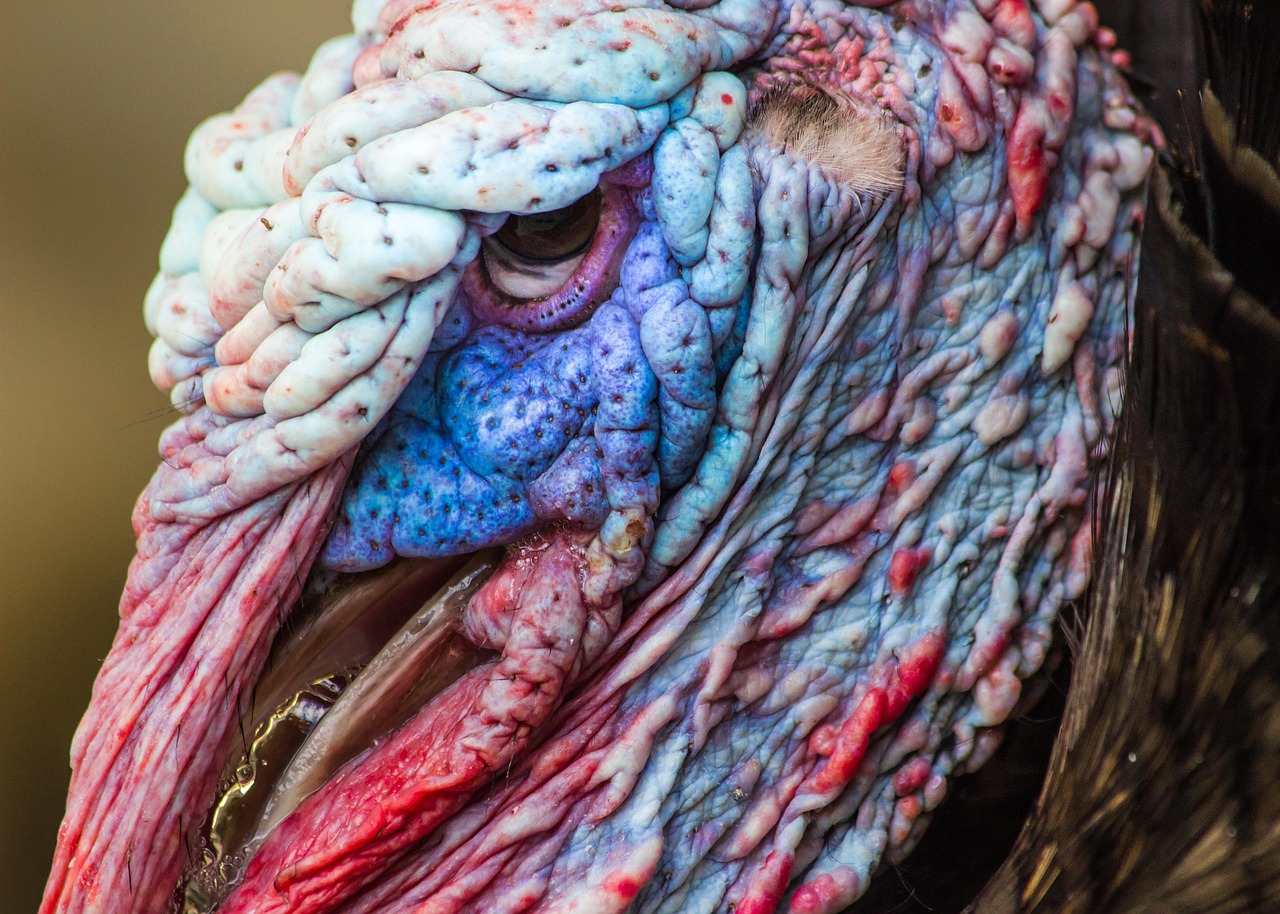
A turkey’s eyes are positioned laterally, meaning each eye looks out from the side of the head rather than straight ahead. That setup gives the bird a huge visual field, letting it monitor a broad stretch of ground and sky at the same time.
For a predator or person trying to slip in unnoticed, that wide view is bad news. A turkey does not need to stare directly at you to know something is moving nearby. It can keep feeding, walking, or strutting while still tracking activity around it with impressive efficiency.
They Can Detect Motion Extremely Well
Turkeys are especially good at picking up movement, even when the shape itself blends into the background. A slight shift of a shoulder, a turning head, or a careful step through leaves can be enough to trigger an alarm.
That sensitivity matters in the wild, where hesitation can mean becoming prey. Their brains are tuned to notice visual changes quickly, which is why standing still often works better than creeping forward. To a turkey, motion is often more revealing than color or detail, and even tiny movements can give you away long before you think you have been spotted.
Their Field Of View Is Exceptionally Wide

Because of where the eyes are placed, a turkey can take in nearly panoramic information without constantly turning its whole body. That broad field of view helps it watch for danger from multiple directions while staying focused on feeding or keeping up with the flock.
The practical effect is simple: there are fewer blind spots to exploit. Approaching from the side is not much of an advantage when the bird can already see so much of the world around it. In open country especially, that wide-angle awareness gives turkeys a major edge over anything trying to sneak closer.
They Combine Sharp Distance Vision With Open Terrain Awareness

Wild turkeys often live and travel through places where visibility matters, from pastures and field edges to open woods. Their vision works especially well in these environments, where long sightlines allow them to catch movement at a distance before danger gets close.
This is one reason they can seem almost impossible to surprise in daylight. A person may think they are still far enough away to go unnoticed, but the turkey has likely already noticed something unusual. In open terrain, their ability to process distant visual cues turns every approach into a much tougher challenge.
They Notice Contrast And Unnatural Shapes

Turkeys do not need a perfect outline to recognize that something is wrong. A hard edge, a blocky silhouette, or a patch of contrast that does not belong in the landscape can catch their attention very quickly.
That is why blending in is about more than just color. The human form, especially when upright, tends to stand out against natural lines and textures. Even when motion is limited, a turkey may still key in on the visual oddness of a shape that breaks the pattern of brush, trunks, grass, and shadows around it.
Their Hearing Helps Confirm What Their Eyes Suspect

Vision does much of the early warning work, but hearing adds another layer of protection. When a turkey sees slight movement or notices a strange shape, sound can help confirm whether the potential threat is real.
A snapped twig, rustling leaves, shifting gravel, or the swish of fabric can all reinforce that sense of danger. In natural settings, birds learn the normal rhythm of background noise, so irregular sounds stand out fast. The combination of visual detection and auditory confirmation makes turkeys much harder to fool than if they relied on either sense alone.
They Are Tuned To The Sounds Of Predators

Turkeys evolved under constant pressure from predators on the ground and in the air, so they are naturally sensitive to suspicious noises. Footsteps, brush movement, and sudden disturbances can all register as warning signals, especially when they come from the wrong place or at the wrong time.
This does not mean they analyze every sound like a detective. Instead, they react quickly to patterns associated with risk. If a noise breaks the calm in a way that feels off, a turkey is likely to raise its head, freeze, and prepare to move. That fast caution is exactly what keeps them alive.
They Constantly Lift Their Heads To Scan

Even while feeding, turkeys do not stay visually committed to the ground for long. They regularly pop their heads up to recheck their surroundings, creating a rhythm of forage, scan, and forage again that makes sustained stealth very difficult.
That repeated scanning means you are not just trying to avoid one glance. You are trying to avoid many quick checks from a bird already primed to notice change. A turkey may appear relaxed one second, then suddenly lock onto movement the next. Those frequent visual resets are a major reason close approaches often fail at the last moment.
Flocks Multiply Eyes And Ears

A single turkey is watchful, but a group is dramatically harder to approach. In a flock, different birds are often oriented in different directions, which effectively expands the group’s visual and auditory coverage.
One bird may catch movement while another hears it first, and alarm can spread almost instantly through body language and behavior. That shared vigilance gives the entire flock an advantage greater than the sum of its parts. If you think one turkey is hard to sneak up on, a flock acts like a living detection system spread across the landscape.
They React Fast Once They Detect Something

The final reason turkeys are so tough to approach is what happens after they notice trouble. They do not just observe passively. Once a bird detects suspicious movement or sound, it can shift from calm to evasive in an instant.
That quick response shortens the window for any second chance. A turkey may walk off, run, or fly before the threat gets close enough to matter. Their sensory strengths are impressive on their own, but paired with rapid decision-making, they become even more effective. By the time you realize you have been noticed, the turkey is often already one step ahead.