Some rifles become legends, then quietly slip into the margins of history as newer designs take over the spotlight. This gallery revisits nine long guns that were once widely recognized by soldiers, collectors, and the public, but rarely come up in everyday conversation now. Their stories still matter because each one helped define a moment in military history and firearms design.
Krag-Jorgensen

The Krag-Jorgensen was a major step for the United States Army in the 1890s, arriving as a modern bolt action rifle at a time when military technology was moving fast. It earned a reputation for smooth operation and unusually refined workmanship, which made it stand out from many of its peers.
Its side loading magazine was clever, but not especially quick by the standards that soon followed. During the Spanish-American War, the rifle looked polished and capable, yet it was quickly overshadowed by Mauser designs that offered faster reloading and stronger battlefield performance.
Today, the Krag is admired mostly by collectors and history enthusiasts. For a rifle that once represented America’s future, it now lives a quieter life in museums, old photos, and carefully preserved private collections.
Ross Rifle

Canada’s Ross Rifle was introduced with real national pride behind it. Accurate, elegant, and distinctly Canadian, it seemed like the kind of rifle that could give a young country its own military identity rather than relying entirely on British patterns.
On the firing range, the Ross impressed many shooters. In trench warfare, though, it struggled with mud, tight tolerances, and a reputation for mechanical headaches. Soldiers in World War I often preferred the more forgiving Lee-Enfield, which handled brutal conditions with less drama.
That contrast defined the Ross legacy. It was not a total failure, but it was badly mismatched to the war that made or broke military rifles. Now it is remembered more as a cautionary tale than a household name.
Lebel Model 1886

The Lebel Model 1886 was a genuine revolution when it appeared in France. It was the first military rifle designed for smokeless powder, a breakthrough that changed visibility, velocity, and the whole rhythm of infantry combat almost overnight.
For a moment, the Lebel looked like the future itself. Yet its tubular magazine and awkward loading system became liabilities as detachable clips and more efficient actions spread across Europe. Even while it remained in service, it began to feel like an old answer to a new question.
That makes its fading fame a little surprising. The Lebel helped launch the modern rifle age, but outside specialist circles, its importance is rarely discussed with the same energy given to later battlefield icons.
Mannlicher M1895

The Mannlicher M1895 was one of the defining rifles of the Austro-Hungarian Empire, recognizable for its straight-pull bolt and compact military profile. It served across a huge and complicated wartime landscape, carried by troops who fought from the Alps to the Balkans.
Its action could be impressively fast in trained hands, and the en-bloc clip system gave it a distinct identity. Still, the empire that fielded it disappeared, and so did much of the public memory attached to the rifle itself. Unlike some rivals, it never kept a strong place in popular culture.
Collectors still appreciate the M1895 for its engineering and history. For everyone else, it has largely become one of those once important names that faded with the map that created it.
Gewehr 41

Before the Gewehr 43 became the better remembered German self-loading rifle of World War II, there was the Gewehr 41. It came from an urgent push to give German infantry more firepower, especially after seeing Soviet semi-automatic rifles in action.
The result was complicated and not especially beloved. Early design restrictions led to awkward engineering choices, and the rifle gained a reputation for being heavy, fussy, and less reliable than soldiers wanted. It worked, but not in a way that inspired much affection.
That lack of glamour explains why it drifted out of public conversation. The Gewehr 41 was historically important as a transition rifle, yet it mostly survives in memory as the rough draft for a better known successor.
Johnson M1941 Rifle

The Johnson M1941 often appears in history as the fascinating alternative to the M1 Garand. It had innovative features, including a rotating bolt and a side-loaded rotary magazine, and for a brief period it looked like it might win a much bigger place in American service.
Instead, it became the rifle that almost was. The Garand was already established, and wartime standardization favored simplicity over second chances. Some Marine and special units used the Johnson, giving it a real combat story, but not enough to keep it in the mainstream narrative.
Today, the Johnson has an aura of what-if history around it. Firearms enthusiasts know its name, but the broader public rarely remembers how close it came to a very different legacy.
MAS-49
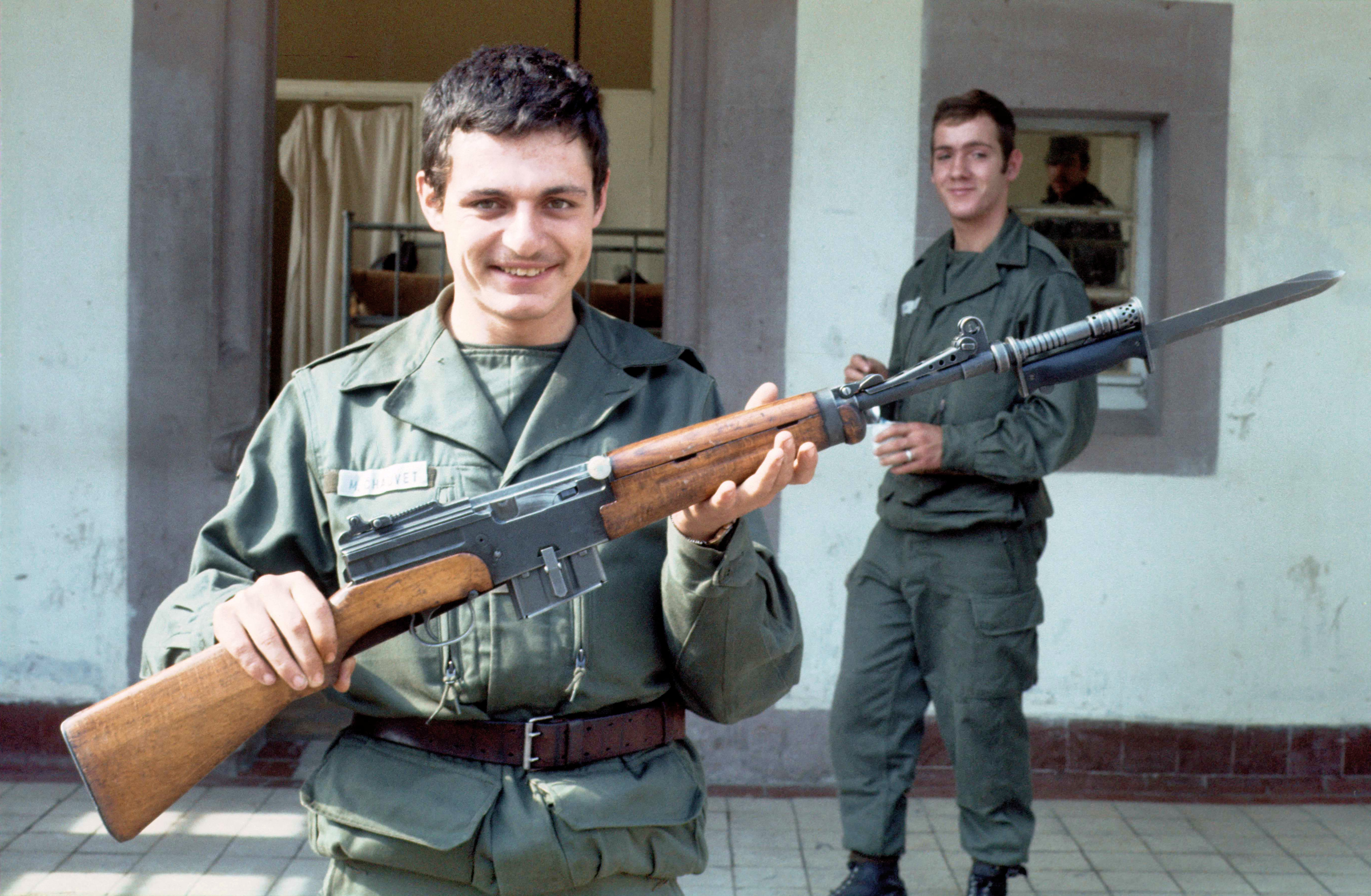
France’s MAS-49 is one of those rifles that quietly did its job without ever becoming a pop culture celebrity. Developed from earlier French semi-automatic experiments, it offered reliability, solid accuracy, and a practical design that served through the postwar era.
It saw action in conflicts tied to the end of empire and the tensions of the Cold War, which should give it a larger place in public memory than it has. But it lacked the cinematic profile of an AK or the broad international identity of an FN FAL.
That leaves the MAS-49 in an odd historical spot. It was important, competent, and widely used by France, yet it faded from common conversation almost as soon as newer battle rifles took center stage.
FN Model 1949

The FN Model 1949 was a classic bridge rifle, arriving in the years between bolt action dominance and the full flowering of modern battle rifles. Designed by Dieudonne Saive, it was adopted by several countries and showed that semi-automatic service rifles had a strong future.
Even so, it tends to live in the shadow of what came next. The FN FAL became the true international star, so the Model 1949 often feels like the opening act that audiences forgot once the headliner arrived.
That is a little unfair, because the rifle had real global reach and notable military service. Still, in popular memory, it has become one of the most significant almost famous rifles of the twentieth century.
Swiss Schmidt-Rubin

The Schmidt-Rubin family of rifles was once famous for precision, craftsmanship, and the broader Swiss reputation for exacting engineering. These rifles were admired for their straight-pull actions and excellent quality, giving them a prestige that went beyond Switzerland’s relatively small military footprint.
For a time, that reputation made the name well known among soldiers and serious riflemen. But prestige alone does not always guarantee lasting mainstream fame. As the twentieth century moved on, newer military stories and more widely distributed rifles pushed the Schmidt-Rubin out of everyday conversation.
What remains is a devoted following among historians and collectors who appreciate just how advanced these rifles felt in their day. They are still respected, just not talked about with the familiarity they once enjoyed.